
Chinese scholars have made progress in research on “Cropland Edge Management Supports Adaptation to Extreme Drought.”
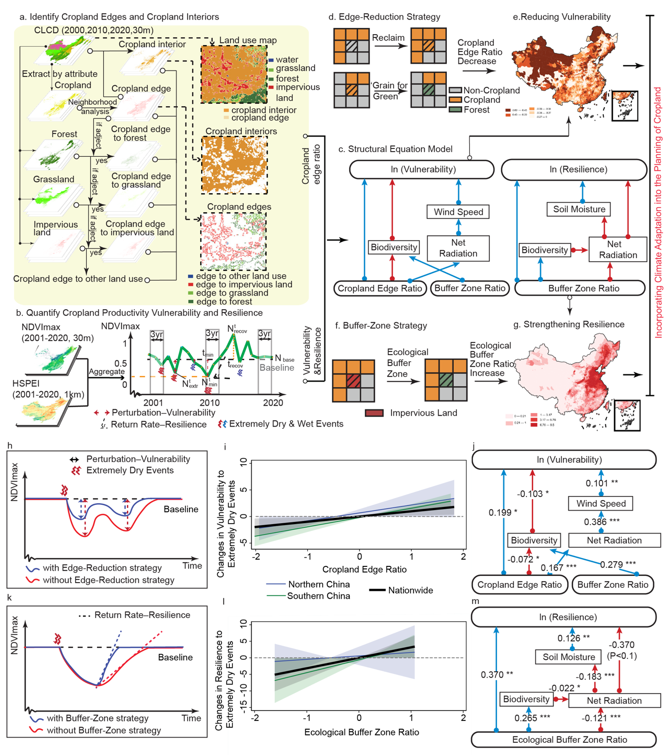
Figure. Framework for integrating climate adaptation into cropland planning
a, Classification of cropland edges and interiors. b, Assessment of cropland productivity vulnerability and resilience to extremely dry and wet events. c, Structural equation model. d, Land-use and land-cover change (LULCC) map under the Edge-Reduction strategy. e, Projected changes in productivity vulnerability under Edge-Reduction. f, LULCC map under the Buffer-Zone strategy. g, Projected changes in productivity resilience under Buffer-Zone. h, Conceptual framework for vulnerability changes under Edge-Reduction. i, Vulnerability response functions for the cropland edge ratio in northern China, southern China and China as a whole. j, Direct and indirect relationships between cropland edges and productivity vulnerability to extremely dry events. k, Conceptual framework for resilience changes under Buffer-Zone. l, Resilience response functions for the ecological buffer zone ratio in northern China, southern China and China as a whole. m, Direct and indirect relationships between the ecological buffer zone ratio and productivity resilience to extremely dry events.
Supported by an Integrated Project under the National Natural Science Foundation of China’s Sustainable Development International Cooperation Science Program (SDIC; Grant No. 72561147299), a team led by Professor Xiaoling Zhang at the University of Hong Kong examined how cropland edge management can support adaptation to climate extremes amid rapid urbanization. The study, “Cropland edge management enhances the adaptability of cropland productivity to extremely dry events,” was published in Nature Food on June 17, 2026 (https://doi.org/10.1038/s43016-026-01366-5).
Urban expansion fragments cropland and alters its boundaries with surrounding land, potentially increasing its vulnerability to climate extremes. Between 2000 and 2020, the proportion of cropland edges adjoining impervious land increased considerably, indicating growing fragmentation of peri-urban agricultural landscapes. Combining high-resolution modeling with vulnerability and resilience assessments, the team examined how fine-scale edge interactions shape productivity responses to extreme events.
A one-standard-deviation increase in the cropland edge ratio was associated with a 0.981-standard-deviation increase in log-transformed vulnerability to extremely dry events. Conversely, a one-standard-deviation increase in the ecological buffer zone ratio was associated with a 3.165-standard-deviation increase in log-transformed resilience. Structural equation modeling linked the cropland edge ratio to drought vulnerability both directly and through lower biodiversity, higher net radiation and greater wind speed. Ecological buffer zones were linked to greater resilience through higher biodiversity and lower net radiation.
The team proposed two complementary strategies: Edge-Reduction, an engineering-oriented approach that lowers the cropland edge ratio, and Buffer-Zone, a nature-based approach that increases the proportion of cropland edges adjoining ecological buffers. Edge-Reduction aims to reduce exposure, whereas Buffer-Zone aims to strengthen resilience. The analysis supports spatially differentiated management: prioritizing Edge-Reduction in highly vulnerable regions, including major grain-producing areas in northern China, and Buffer-Zone in regions with low resilience, including urbanized areas in southern China, to support a diverse agricultural supply.
The framework links cropland configuration to climate vulnerability and resilience, providing a basis for land-management assessment and policy scenario analysis in coastal urban social-ecological systems. The findings suggest that combining edge reduction with ecological buffers could improve adaptation to extremely dry events and help align cropland planning with regional climate risks.
Contact Us

National Natural Science Foundation of China
Add: 83 Shuangqing Rd., Haidian District, Beijing, China
Postcode: 100085
Tel: 86-10-62327001
Fax: 86-10-62327004
E-mail: bic@nsfc.gov.cn