
Chinese Researchers Discover Novel High-Field-Induced Re-entrant Superconductivity in Nickelates
With support from the National Natural Science Foundation of China (Grant No. 12174325), a research team led by Associate Professor Li Danfeng at City University of Hong Kong, in collaboration with the team led by Xue QiKun from Southern University of Science and Technology and Chen Zhuoyu of the Guangdong-Hong Kong-Macao Greater Bay Area Quantum Science Center, has made a breakthrough in the magnetic-field control of nickelate high-temperature superconductors.
The team observed, for the first time, strong magnetic-field-induced re-entrant superconductivity in infinite-layer nickelate superconducting thin films, and systematically revealed the physical mechanism by which a magnetic field drives the re-emergence of the superconducting state by changing its role from suppressing to promoting superconductivity. The findings were published in Nature on April 23, 2026, under the title “Field re-entrant superconductivity in Eu-doped infinite-layer nickelates”. The paper is available at: https://doi.org/10.1038/s41586-026-10547-y.
Superconductivity and magnetism have long been considered as two mutually exclusive quantum states. An external magnetic field can destroy superconducting electron pairs, known as Cooper pairs, through orbital effects and the Pauli paramagnetic effect, thereby eliminating superconductivity. However, in a very small number of strongly correlated systems such as heavy-fermion materials containing localized magnetic moments, a strong magnetic field can instead induce the reappearance of a previously suppressed superconducting phase, a phenomenon known as re-entrant superconductivity. Exploration of this exotic quantum state provides an important pathway for understanding the complex interplay between magnetism and unconventional superconductivity.
Infinite-layer nickelates are considered a new platform for investigating the mechanism of high-temperature superconductivity because they possess electronic structures similar to those of cuprate high-temperature superconductors. However, the role of rare-earth-ion magnetism in tuning superconductivity had not been fully explored.
To address this key issue, the collaborative research team focused on europium-doped infinite-layer nickelate thin films, Sm0.95-xCa0.05EuxNiO2, referred to as SCEx. Using pulsed laser deposition and in situ topochemical reduction techniques, the team fabricated high-quality SCEx thin films over a broad doping range and systematically constructed a complete Eu-doping phase diagram for this system.
Using the 45.22 T hybrid magnet at the Steady High Magnetic Field Facilities (SHMFF) and the 60 T pulsed high magnetic field facility at the National High Magnetic Field Center of Huazhong University of Science and Technology, the researchers performed electrical transport and mutual inductance measurements under low- to ultra-low-temperature conditions. They directly observed, for the first time, an unusual transition of superconducting state to normal state to superconducting state.
The experimental results show that when the Eu doping concentration falls within a specific range, x = 0.32–0.40, the low-field superconducting state is first suppressed. However, as the magnetic field is further increased to above approximately 6 T, the superconducting state reappears and remains stable beyond 45 T. The simultaneous observation of zero resistance and diamagnetic shielding provides dual experimental confirmation of the existence of this high-field re-entrant superconducting phase.
This behavior can be partly attributed to the Jaccarino–Peter compensation effect. The large magnetic moments of Eu2+ ions, with S = 7/2, generate an internal exchange field that compensates for the external magnetic field, thereby reducing the effective magnetic field acting on Cooper pairs to below the superconducting upper critical field. However, under high Eu doping, the experimental results deviate markedly from this simple compensation model, suggesting the likely existence of an unconventional superconducting pairing mechanism driven by magnetic correlations.
Unlike previously reported re-entrant superconductivity, which could only be realized within an extremely narrow angular range, the re-entrant superconductivity in this system exhibits robust angle-independent behavior. It can appear stably over the entire angular range from 0° to 90°, and the high-field superconducting state is more stable than the low-field one. The nonlinear saturation of Hall resistance and pronounced hysteresis in magnetoresistance observed in overdoped samples further confirm the complex magneto-electronic coupling effects in this system.
This study extends magnetic-field-induced re-entrant superconductivity, previously observed mainly in heavy-fermion systems near absolute zero, to nickelate high-temperature superconductors with transition temperatures reaching tens of kelvin. It provides a clear physical framework for understanding the microscopic mechanism underlying the coexistence of magnetism and unconventional superconductivity, and for developing new high-field superconducting quantum materials under extreme conditions.
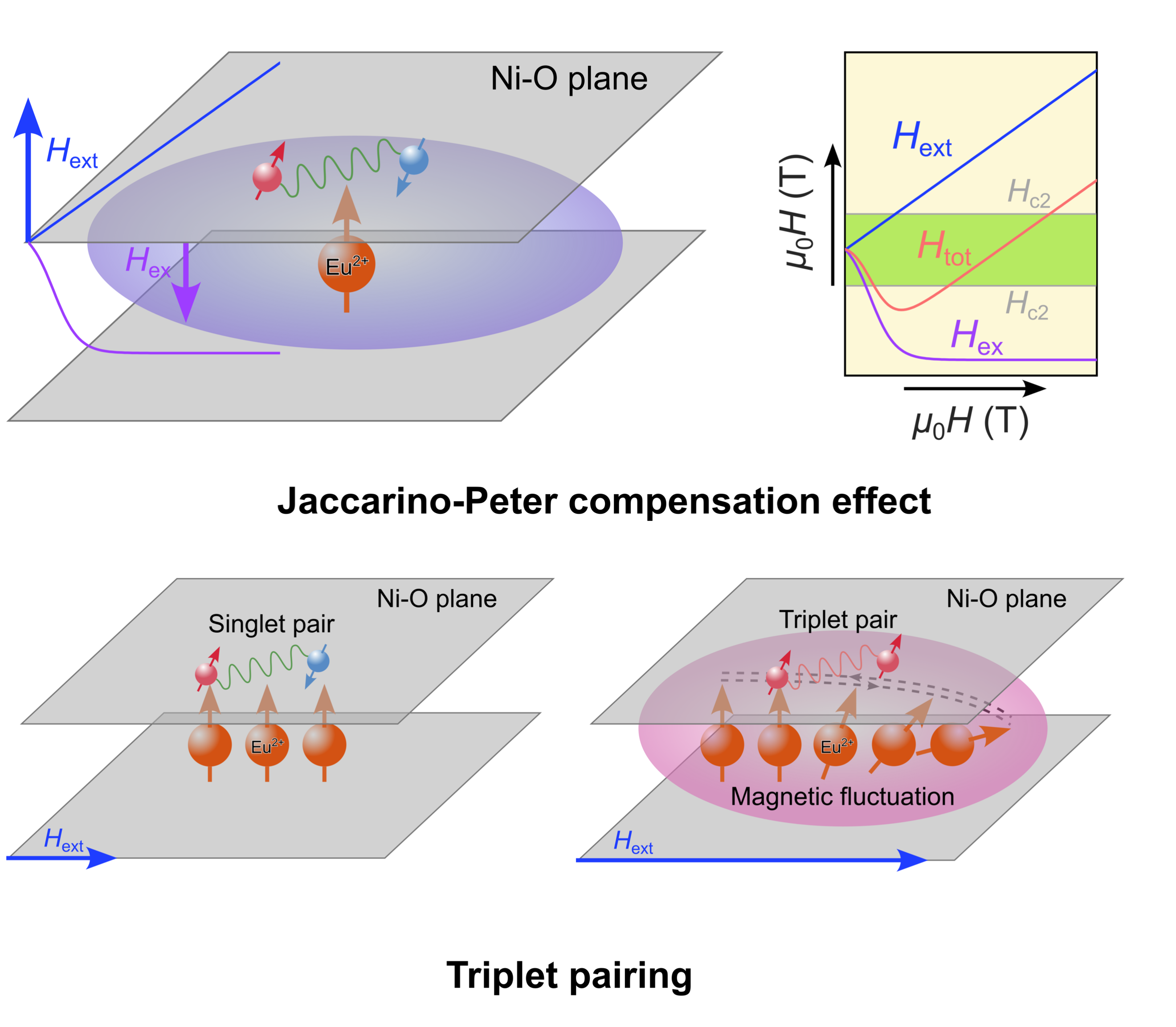
Figure 1. Possible origins of re-entrant superconductivity. Top: The internal exchange field compensates for the external magnetic field, reducing the effective magnetic field acting on Cooper pairs to below the superconducting upper critical field. Bottom: Under an applied magnetic field, carriers with the same spin form pairs, so that superconductivity is not destroyed by Zeeman energy.
Contact Us

National Natural Science Foundation of China
Add: 83 Shuangqing Rd., Haidian District, Beijing, China
Postcode: 100085
Tel: 86-10-62327001
Fax: 86-10-62327004
E-mail: bic@nsfc.gov.cn