
Chinese Researchers Make Progress in On-Chip Hyperpsectral Computing
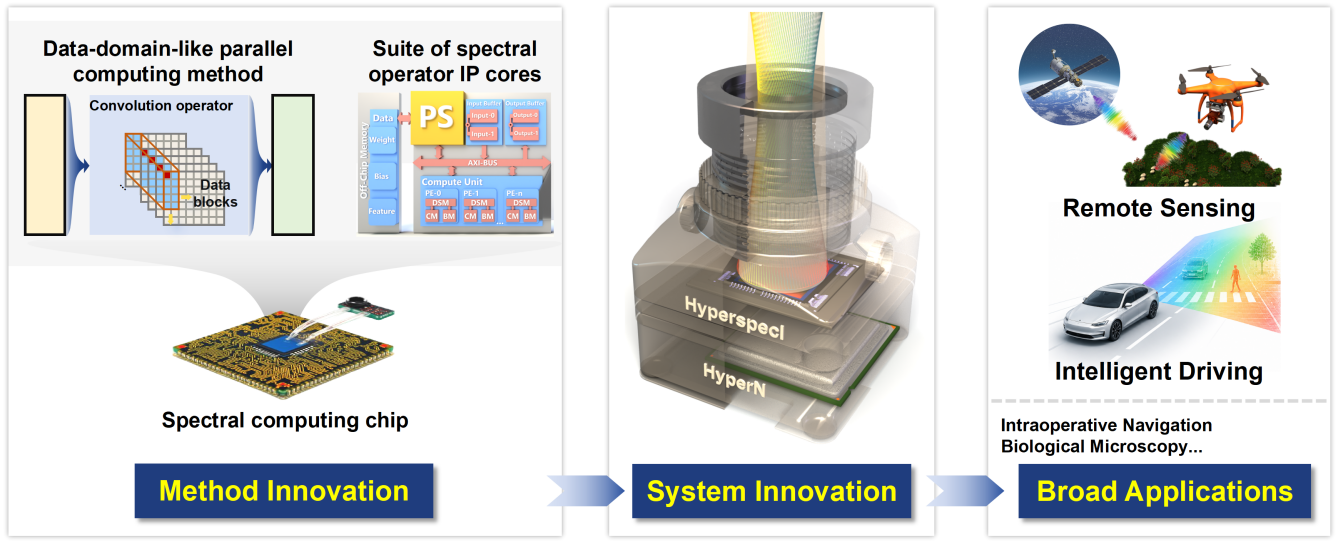
Figure: On-chip hyperspectral computing architecture
Supported by the National Natural Science Foundation of China (Grant Nos. 61827901, 62322502, and 62131003), Professor Jun Zhang’s research team at Beijing Institute of Technology has achieved new breakthroughs in the field of on-chip photonics. Following their publication of an on-chip hyperspectral imaging technique in Nature in November 2024, the team further addressed the challenges associated with efficient processing of large-scale hyperspectral data. They proposed the spectral-specific computing concept, established an on-chip spectral computing architecture, and developed an integrated online real-time hyperspectral imaging microsystem. The research outcome, entitled “Hypervision: An on-chip hyperspectral microsystem for online video-rate computational imaging”, was published in Science on August 27, 2026 (Link: https://www.science.org/doi/10.1126/science.aef8268).
Hyperspectral imaging simultaneously captures spatial structural information and spectral signatures across tens to hundreds of wavelength bands. It holds application potentials in multiple fields such as aerospace remote sensing, intelligent vehicles, and precision medicine. However, conventional hyperspectral imaging systems typically rely on a workflow of capturing raw data, transmitting data to backend servers, and performing analysis afterwards. The massive spatial–spectral datacubes impose substantial transmission and computational burdens, limiting online real-time imaging and sensing.
To address the challenge of large-scale hyperspectral computing, the team proposed a novel parallel computing approach (Figure), which exploits data locality to achieve continuous parallel processing of spectral data blocks. This novel approach overcomes the sequential instruction execution bottleneck of conventional von Neumann architecture, and significantly reduces redundant memory access. Based on this, the team developed the Hypervision microsystem that achieved online real-time hyperspectral imaging with megapixel-scale resolution and tens of spectral channels. This work represents a fundamental transition of hyperspectral imaging from “offline post-processing” to “on-chip in situ online real-time computation,”.
To sum up, this work establishes a new direction in on-chip computational imaging and sensing, opening new possibilities for emerging applications including intelligent driving, smart agriculture, and precision healthcare.
Contact Us

National Natural Science Foundation of China
Add: 83 Shuangqing Rd., Haidian District, Beijing, China
Postcode: 100085
Tel: 86-10-62327001
Fax: 86-10-62327004
E-mail: bic@nsfc.gov.cn