
Chinese Researchers Make Advances in Developing a Universal Antiviral mRNA Therapy
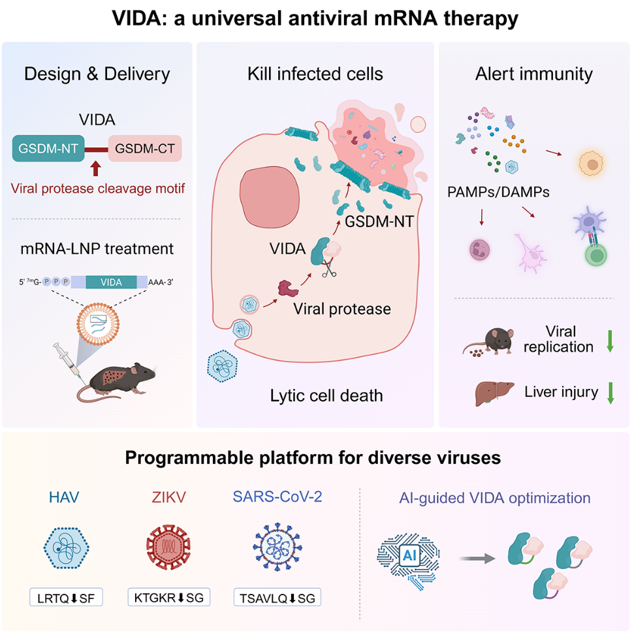
Figure. Viral protease-responsive VIDA mRNA platform for universal antiviral therapy
With support from the National Natural Science Foundation of China (Grant Nos. 32500551, 82350801, and 32130005), a research team led by Professor Chengfeng Qin and Associate Professor Yijiao Huang from the Academy of Military Medical Sciences, in collaboration with Professor Aiping Wu’s team from the Suzhou Institute of Systems Medicine, has made progress in the development of universal antiviral mRNA therapeutics. The study, entitled “Viral protease-initiated lytic cell death as a universal antiviral mRNA therapy” was published online in Cell on July 20, 2026. The article is available at https://doi.org/10.1016/j.cell.2026.06.031.
Emerging and sudden-emerging viral infections continue to pose major threats to human health and national biosecurity, highlighting the need for safe, effective, and rapidly adaptable antiviral strategies. Most existing antiviral drugs act on specific viral targets and therefore have limited applicability across different viral infections. Their clinical efficacy may also be compromised by viral evolution and the emergence of drug-resistant mutations. Moreover, simply suppressing viral replication may be insufficient to effectively mobilize systemic host antiviral immune responses. Developing an antiviral platform that can be rapidly designed and adapted for different viral pathogens while simultaneously eliminating infected cells and activating antiviral immunity therefore remains an important challenge in the field.
Inspired by the modular architecture of gasdermin (GSDM) proteins (key effectors of pyroptosis) and the clinical success of mRNA vaccines, the researchers proposed the concept of viral protease-initiated lytic cell death (VID) and developed the first mRNA-based antiviral therapeutic platform responsive to viral protease activity. The team replaced the native caspase cleavage sequence in gasdermin D (GSDMD) with viral protease-specific recognition motifs to generate VID activators (VIDAs). In virus-infected cells, VIDAs can be specifically cleaved and activated by viral proteases expressed early during infection, thereby selectively inducing lytic death of infected cells. Using hepatitis A virus (HAV) as a model, the researchers showed that lipid nanoparticle (LNP)-delivered VIDA mRNA markedly suppressed viral replication and release in vivo. Selective elimination of infected cells was accompanied by enhanced antiviral immune signatures and reduced virus-associated liver injury, together reflecting a “kill-and-alert” mode of action. The applicability of the platform was further demonstrated in infection models of Zika virus (ZIKV) and severe acute respiratory syndrome coronavirus 2 (SARS-CoV-2). In addition, by integrating a generative artificial intelligence framework, the researchers designed de novo cleavage motifs for the SARS-CoV-2 main protease and obtained optimized VIDA molecules with enhanced antiviral potency (Figure).
This study transforms viral proteases from traditional targets of antiviral inhibition into molecular triggers that activate host effector proteins to eliminate infected cells. In doing so, the therapeutic concept is extended from directly suppressing viral replication to selectively eliminating infected cells while simultaneously activating antiviral immune responses. The VIDA mRNA platform is modular, programmable, and amenable to rapid iteration, providing the potential for adaptation to diverse viruses that encode specific proteases. The combination of mRNA-LNP delivery with AI-enabled generative design may also provide a rapid-response framework for addressing viral evolution and emerging viral threats. Together, these findings provide a new conceptual framework and platform for the development of universal antivirals and mRNA-based therapeutics.
Contact Us

National Natural Science Foundation of China
Add: 83 Shuangqing Rd., Haidian District, Beijing, China
Postcode: 100085
Tel: 86-10-62327001
Fax: 86-10-62327004
E-mail: bic@nsfc.gov.cn