
Chinese Researchers Make Progress in C=C Bond Dehydrogenative Restructuring
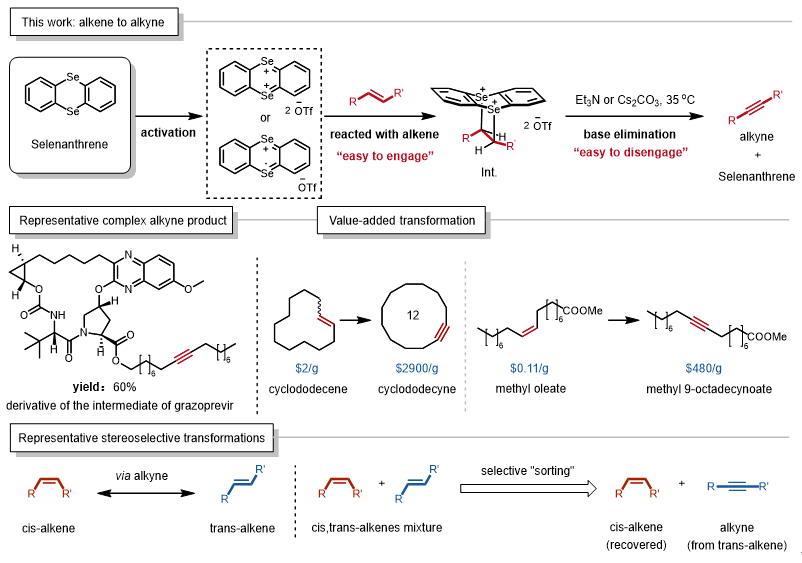
Figure. Direct conversion of alkenes to alkynes enabled by a selenanthrene reagent platform.
Supported by the National Natural Science Foundation of China (Grant Nos. 22293014, 22131002, and T2450076), a research team led by Jiao Ning at Peking University has made progress in carbon–carbon bond restructuring. Their work, entitled “Direct Conversion from Alkenes to Alkynes”, was published online in Nature on March 17, 2026. The paper is available at: https://www.nature.com/articles/s41586-026-10372-3.
Alkenes and alkynes are fundamental building blocks of modern synthetic chemistry. Yet, despite the wide availability of alkenes, the supply of alkynes remains comparatively limited, restricting their broader applications. Furthermore, converting the bent geometry of an alkene into the more linear structure of an alkyne can significantly change a molecule’s three-dimensional architecture and properties, opening new possibilities for drug and materials discovery. Therefore, developing efficient approaches to transform inexpensive and readily available alkenes into alkynes has been a long-standing research priority.
Efforts to achieve this transformation date back to 1861, when Markovnikov, known for Markovnikov’s rule, first reported the conversion of alkenes into alkynes through a multistep sequence involving halogenation and elimination. However, the method requires harsh conditions, including high temperatures and strong bases, limiting its scope to a narrow range of substrates. Despite more than 160 years of research, a mild and practical alternative has remained elusive.
To address this challenge, the research group adopted an unconventional strategy by turning to selenanthrene, a selenium-containing heterocycle first discovered 130 years ago. Through a cascade activation strategy, the team enabled selenanthrene to serve as a reagent platform that efficiently mediates the conversion of alkenes to alkynes under mildly basic conditions. The selenanthrene reagent exhibits characteristic reactivity that is “easy to engage, easy to disengage”. This selenanthrene reagent can be readily prepared at a large scale, exhibits good storage stability, and is recoverable for reuse..
The transformation proceeds under mild conditions and tolerates a broad range of sensitive and reactive functional groups. It is compatible with trans-, cis-, and terminal alkenes, and can also achieve alkene geometric interconversion, enabling the selective conversion of alkene stereoisomers. In summary, this work provides a practical new strategy for the direct restructuring of C=C bonds and offers a general approach to accessing alkynes from readily available alkenes.
Contact Us

National Natural Science Foundation of China
Add: 83 Shuangqing Rd., Haidian District, Beijing, China
Postcode: 100085
Tel: 86-10-62327001
Fax: 86-10-62327004
E-mail: bic@nsfc.gov.cn