
Chinese Scientists Pioneer Chemiluminescence-Based Super-Resolution Microscopy
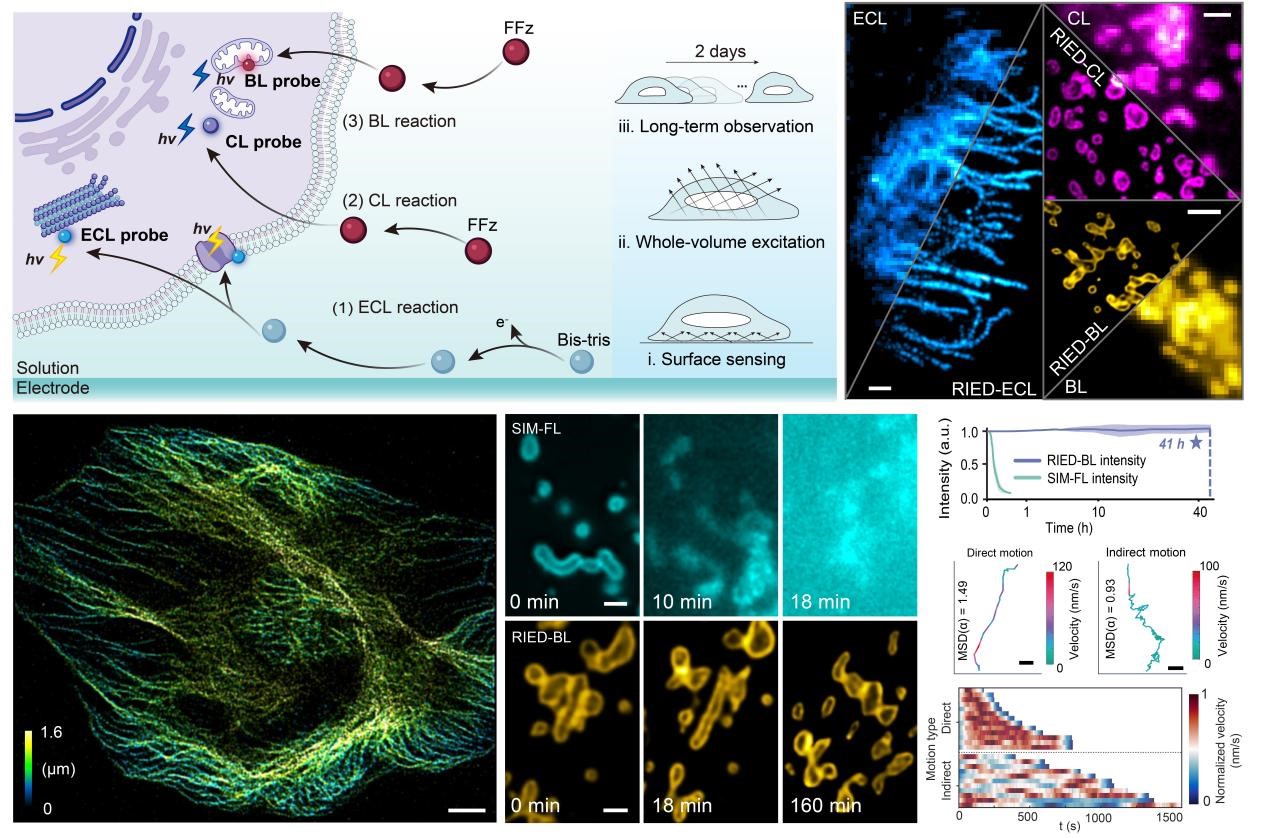
Figure. RIED achieves near zero background and continuous long-term super-resolution observation of live cells without excitation light emission.
Supported by the National Natural Science Foundation of China (grant numbers 21974123, 32422052 and 62305083), the research teams led by Jiandong Feng at Zhejiang University and Weisong Zhao at Harbin Institute of Technology have developed a new super-resolution approach based on luminescent reactions, namely, reaction enabled super-resolution imaging via entropy-weighted correlation combined with deconvolution (RIED). By fully eliminating photobleaching, phototoxicity and auto-fluorescence background in super-resolution fluorescence microscopy, RIED establishes a new way for continuously observing biological dynamics at the nanoscale for days. The research paper entitled “Luminescent-reaction-enabled super-resolution imaging” was published online in Nature on August 12, 2026. Article link: https://www.nature.com/articles/s41586-026-10889-7.
Understanding how cells function requires not only resolving their nanoscale structures but also tracking these structural dynamics over time. Super-resolution fluorescence microscopy has overcome the optical diffraction limit and transformed the study of visualizing subcellular structures, a development recognized by the 2014 Nobel Prize in Chemistry. However, fluorescence microscopy fundamentally relies on using external light to excite fluorophores. Continuous illumination can cause photobleaching and phototoxicity, creating an intrinsic trade-off in live cell imaging between spatial resolution, temporal resolution and imaging duration.
In 2021, Jiandong Feng and his colleagues first reported direct optical imaging of single-molecule electrochemiluminescence (ECL) reactions, demonstrating that ECL could be harnessed for super-resolution imaging without conventional optical excitation. However, ECL is inherently associated with electrode interface limiting its bioimaging capability while conventional ECL produces relatively few photons. Consequently, cell imaging with high spatiotemporal resolution based on ECL has remained a challenge.
To this end, the researchers first developed a 1,000-fold improved ECL cell imaging system, achieving the first ECL based intracellular organelle imaging. They then designed a spatiotemporal isolation strategy to capture the highly dynamic photon emission process generated by luminescent reactions. Instead of accumulating weak luminescence over long exposure times, which averages its temporal dynamics, their strategy records reaction-driven photon fluctuations both in space and time. The team then designed a reconstruction framework that combines entropy-weighted correlation analysis with deconvolution to efficiently reconstruct super-resolution structures from these reaction-driven photon statistics. This experimental–computational framework, RIED, is broadly applicable across three imaging modalities of reaction-enabled luminescence including ECL, chemiluminescence (CL) to bioluminescence (BL). The researchers achieved super-resolution imaging of multiple intracellular organelles with spatial resolution reaching 100 nm, as well as 3D and large field of view imaging. RIED-ECL enabled highly sensitive imaging of cell-surface proteins. Most notably, RIED-BL allowed continuous super-resolution imaging of live cells for as long as 41 hours, enabling nanoscale observation and quantitative analysis of single mitochondrial dynamics. They further showed that the technique can probe the intercellular mitochondrial transfer events, for the first time at single-organelle level over extended observation window.
Rather than relying on optically controlled excitation, RIED uses reaction-tailored luminescence chemistry to define how luminescent signals are generated and leveraged, establishing an emerging class of chemistry-enabled, laser-free super-resolution microscopy, which opens new avenues for bioimaging.
Contact Us
National Natural Science Foundation of China
Add: 83 Shuangqing Rd., Haidian District, Beijing, China
Postcode: 100085
Tel: 86-10-62327001
Fax: 86-10-62327004
E-mail: bic@nsfc.gov.cn