
Chinese Researchers Make Progress in Photocatalytic Water Splitting for Hydrogen Production
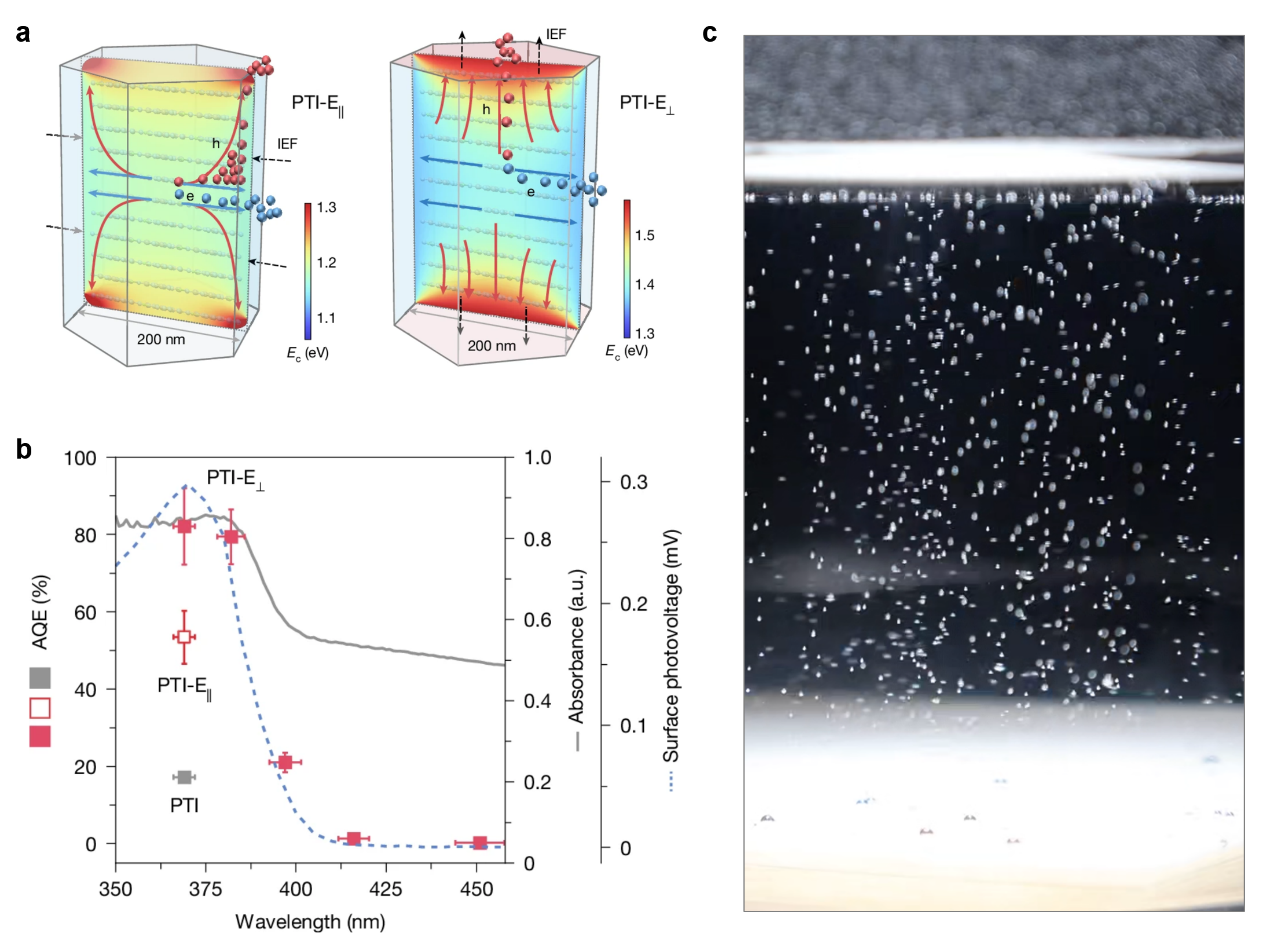
Figure. (a) Schematic illustration of the construction of lateral (left) and vertical (right) internal electric fields on PTI crystal surfaces and their roles in regulating the spatial separation and transport pathways of photogenerated charge carriers. (b) Wavelength-dependent apparent quantum efficiency (AQE) for photocatalytic water splitting. (c) Digital photographs of the generation of hydrogen (H₂) and oxygen (O₂) during the photocatalytic water splitting reaction.
Supported by the National Natural Science Foundation of China (Grant Nos. 22032002, U24A20567, 52222102 and 22272024), a research team led by Professor Wang Xinchen of Fuzhou University and Professor Kazunari Domen of Shinshu University, Japan, has made progress in photocatalytic water splitting. Their research, entitled "Photocatalytic water splitting by 2D polymer with out-of-plane carrier flow," was published in Nature on 29 July 2026. Paper link: https://www.nature.com/articles/s41586-026-10866-0.
Photocatalytic water splitting represents an attractive route to the low-cost, large-scale production of green hydrogen. Two-dimensional (2D) π-conjugated polymer photocatalysts are promising candidates for solar-driven water splitting owing to their earth-abundant composition, low-cost synthesis, and readily tunable optoelectronic properties. Unlike 3D inorganic photocatalysts, however, photoexcited states in conjugated polymers are typically confined within individual π-conjugated planes, leading to severe bulk charge recombination. Despite longstanding efforts to enhance in-plane charge separation through molecular backbone engineering and structural optimization, the intrinsic 2D confinement fundamentally limits further improvements in the apparent quantum efficiency (AQE) of photocatalytic water splitting. Overcoming this limitation to enable directional interlayer transport and efficient spatial separation of photogenerated charge carriers therefore represents a core challenge in polymer photocatalysis.
To address this challenge, the research team employed single-crystalline poly(triazine imide) (PTI)-type carbon nitride as a model system and developed a facet-selective surface engineering strategy to induce directional internal electric fields on different crystal facets of PTI. This strategy successfully activated out-of-plane carrier flow across hundreds of π-conjugated layers, enabling directional separation of photogenerated charges (Fig.a). Further investigation revealed that the construction of lateral and vertical electric fields substantially enhanced the gas evolution rates, increasing the corresponding AQEs to 53.4% and 82.1%, respectively (Fig.b). The optimized system achieved a maximum solar-to-hydrogen (STH) conversion efficiency of 1.06% and sustained generation of hydrogen and oxygen under illumination (Fig.c).
This work overcomes the intrinsic quasi-2D carrier-transport limitation of polymer photocatalysts, establishing a paradigm shift from 2D-confined photoexcited states to 3D spatially separated states and providing a new design principle for high-performance polymer photocatalysts. The uncovered mechanism of “internal-electric-field-induced out-of-plane carrier transport” may provide broader guidance for manipulating charge transport and achieving efficient energy conversion in a wider range of low-dimensional inorganic and organic–inorganic hybrid semiconductors.
Contact Us

National Natural Science Foundation of China
Add: 83 Shuangqing Rd., Haidian District, Beijing, China
Postcode: 100085
Tel: 86-10-62327001
Fax: 86-10-62327004
E-mail: bic@nsfc.gov.cn