Chinese Researchers Advance High-Value Conversion of Waste Plastics
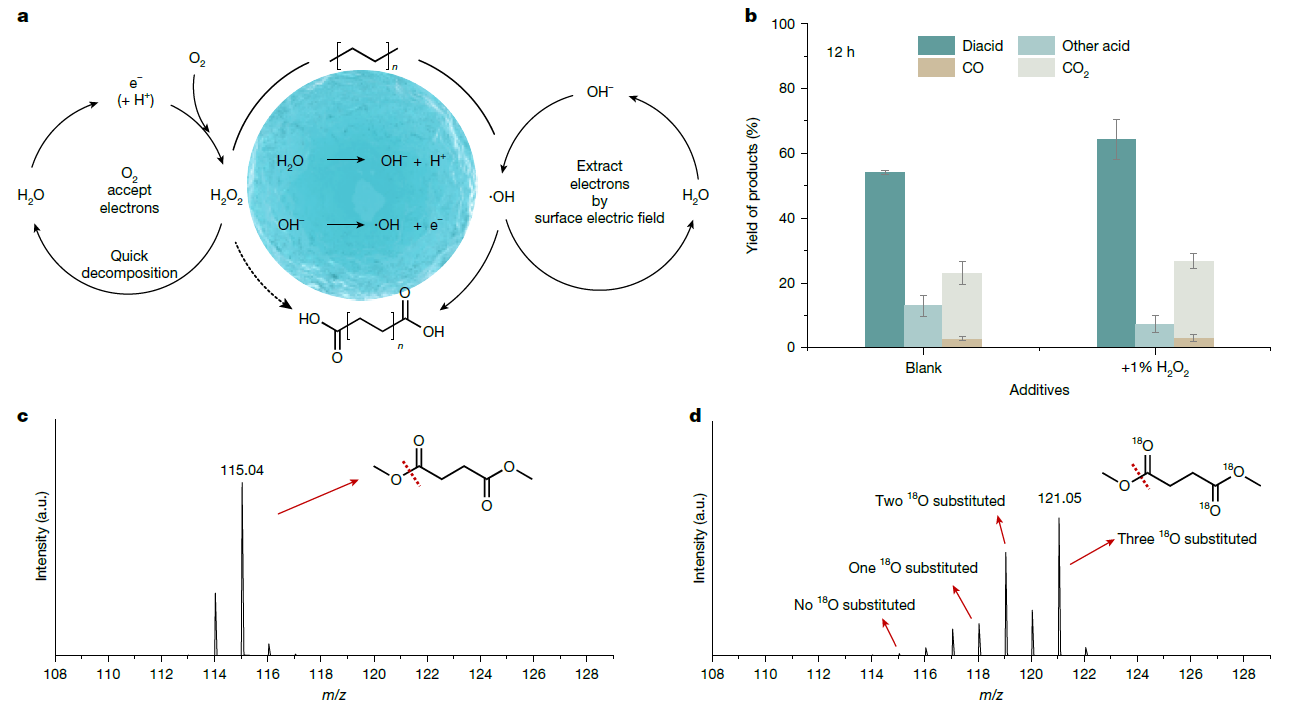
Figure. Reaction pathway and proposed mechanism for the catalyst-free oxidative conversion of polyethylene into diacids. a, Proposed mechanism for the spontaneous oxidation of polyethylene into diacids at microdroplet surfaces; b, Comparison of product yields between the polyethylene oxidation system and the system supplemented with 1% H2O2; c,d, GC-MS analysis of esterified succinic acid produced in the H216O and H218O systems.
Supported by the National Natural Science Foundation of China (Grant Nos. 22325204 and 22472147), a research team led by Professor Wang Yong and Researcher Mao Shanjun from the Department of Chemistry at Zhejiang University, in collaboration with Professor Graham J. Hutchings of Cardiff University in the United Kingdom and colleagues, has made progress in the green, high-value conversion of waste plastics. The findings, titled "Catalyst-free, microdroplet-mediated waste plastic conversion to diacids", were published online in Nature on July 15, 2026. Article: https://doi.org/10.1038/s41586-026-10746-7.
Plastic waste poses a major challenge to the global environment and public health. Polyolefins, including polyethylene and polypropylene, account for more than 60% of all plastics. Their stable C-C and C-H bonds and hydrophobic structures make them resistant to degradation in the natural environment, creating a major obstacle to waste-plastic recycling and high-value utilization. Although existing chemical recycling routes can degrade and upcycle polymers, their application to real-world plastic waste remains constrained by catalyst deactivation caused by active site poisoning, coke deposition from reaction intermediates, and complex product distributions that require lengthy downstream separation. Collectively, these bottlenecks undermine the economic viability and operational stability of conventional approaches at scale.
To address these challenges, the researchers developed an oxidative upcycling and depolymerization strategy that uses only water and oxygen. Under heating and stirring, molten polymer and water form an emulsion containing micrometre-scale oil-in-water droplets. Strong localized electric fields at the water-oil microdroplet interfaces split water molecules, generating highly oxidizing hydroxyl radicals in situ. These radicals efficiently oxidize and cleave C-H and C-C bonds in polymer chains without any added catalyst. At 125 °C under 2 MPa oxygen atmosphere, polyethylene was converted into organic acids with a carbon-number distribution concentrated in the C4-C7 range, along with small amounts of gaseous carbon oxides (COx). The carbon yield of saturated dicarboxylic acids approached 70%, with succinic acid as the dominant component, accounting for 58 mol% of the total diacids. This strategy was compatible with complex real-world waste streams containing polyethylene, polypropylene, polystyrene and waste tyres. It also showed strong tolerance to common nitrogen-, sulfur- and chlorine-containing organic additives, inorganic impurities, and water sources including tap water and seawater. By extending conventional gas-liquid microdroplet interfaces to microemulsion interfaces, the team further demonstrated the conversion of 300 g of polyethylene in a 5-litre reactor, achieving 89% conversion and a saturated diacid yield above 52%. A 50,000-tonne-scale process simulation also revealed strong competitiveness in economic performance, carbon-emissions reduction and energy savings. The study provides a new approach to the green, high-value utilization of real-world mixed plastic waste and identifies a potential pathway for scaling up microdroplet interfacial chemistry.
Contact Us

National Natural Science Foundation of China
Add: 83 Shuangqing Rd., Haidian District, Beijing, China
Postcode: 100085
Tel: 86-10-62327001
Fax: 86-10-62327004
E-mail: bic@nsfc.gov.cn