
Hexagonal Diamond Has Been Developed by Chinese Researchers
Supported by projects from the National Natural Science Foundation of China (Grant Nos.: 62422408, 62027816) and others, a research team led by Professors Chongxin Shan, Xigui Yang and Shaobo Cheng from Zhengzhou University, in collaboration with Professor Jian Sun from Nanjing University, has made progress in diamond research. The related research results were published online in Nature under the title “Bulk hexagonal diamond” on March 5, 2026 (https://www.nature.com/articles/s41586-026-10212-4).
Diamond has a variety of unique properties, such as high hardness, high chemical inertness, wide bandgap, high carrier mobility, and rich quantum properties, which have attracted significant research attention and led to applications in cutting tools, thermal management, quantum information, semiconductor devices, etc.
Conventional diamond adopts a cubic crystal system, while its allotrope hexagonal diamond has attracted extensive attention due to its theoretically superior hardness and thermal stability. Nevertheless, natural hexagonal diamond only exists as nanoscale inclusions trapped within meteorites and cannot be easily separated; it forms via meteorite impacts, a process that is extremely fleeting and occurs with an extremely low probability. Experimentally, hexagonal diamond has a higher formation energy than cubic diamond, indicating that cubic diamond is the dominant product synthesized under high pressure and high temperature. Whether hexagonal diamond can exist as a stable standalone phase, as well as its intrinsic physical properties, has long been subjects of controversy.
To address the above challenges, researchers from Zhengzhou University proposed a strategy of "confined sliding of graphite layers" and developed a large-volume uniaxial high-pressure technique. By using highly oriented pyrolytic graphite (HOPG) as the precursor, phase-pure bulk hexagonal diamond was successfully synthesized at 20 GPa and 1300 °C. The crystal structure and bonding characteristics of the hexagonal diamond have been systematically analyzed via multiple advanced characterization techniques including synchrotron X-ray diffraction, spherical aberration-corrected transmission electron microscopy, electron energy loss spectroscopy, Raman spectroscopy, and thermal tolerance experiment, etc (Figure). Combined with machine learning-based molecular dynamics simulations, the researchers clarified the phase transformation pathway from graphite to hexagonal diamond. Mechanical characterizations including ultrasonic sound velocity measurements, nanoindentation and Vickers hardness tests verified that the hexagonal diamond outperforms conventional cubic diamond in both Vickers hardness, shear modulus and thermal stability.
This study settles the academic controversy regarding the independent stable existence of hexagonal diamond, unveils a novel phase transformation mechanism governing graphite-to-hexagonal-diamond conversion under extreme conditions, and delivers a reliable synthetic route and conclusive experimental evidence for hexagonal diamond, thus laying a foundation for its future large-scale fabrication and applications.
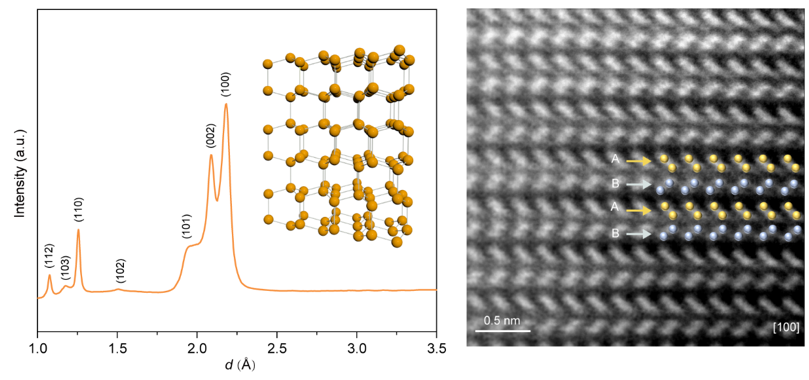
Figure: Crystal Structure, X-Ray Diffraction and Atomic-Resolution Images of Hexagonal Diamond.
Contact Us

National Natural Science Foundation of China
Add: 83 Shuangqing Rd., Haidian District, Beijing, China
Postcode: 100085
Tel: 86-10-62327001
Fax: 86-10-62327004
E-mail: bic@nsfc.gov.cn