
Chinese Researchers Make Progress in Human Early Embryonic Development and Hematopoietic Origin
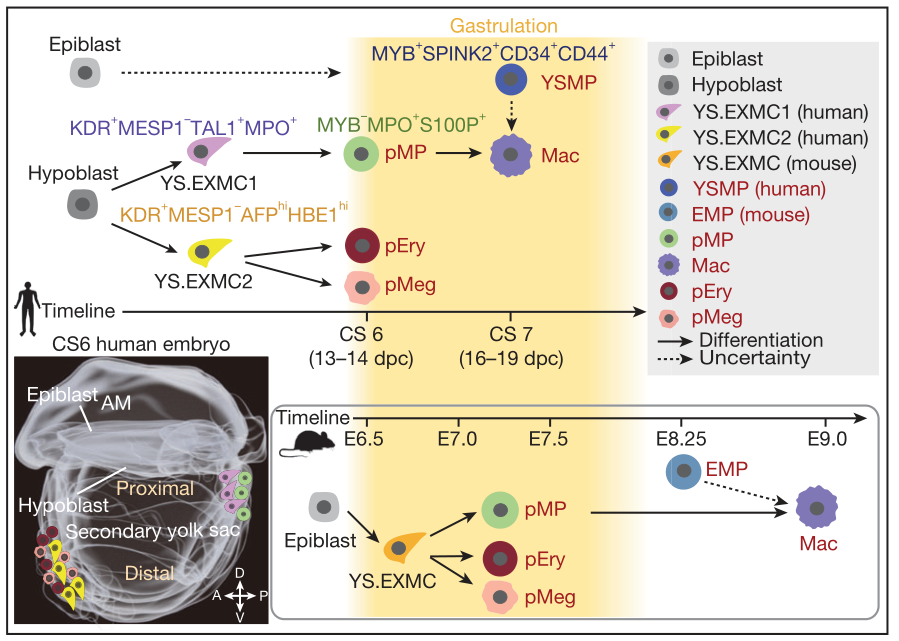
Figure. Cellular origins, developmental trajectories, and species differences between human and mouse in primitive hematopoiesis.
Supported by the National Natural Science Foundation of China (Grant Nos. 82330006, 31930054, 82371685), the collaborative team of Professor Lan Yu from the Institute of Hematology & Blood Diseases Hospital, Chinese Academy of Medical Sciences (CAMS) & Peking Union Medical College (PUMC), Professor Xiao Zhenyu from Beijing Institute of Technology, and Professor Liu Bing from the Fifth Medical Center of Chinese PLA General Hospital, has made significant progress in the field of human early embryonic development and hematopoietic origin. The research findings, titled “Epiblast diversification and blood formation in a human pregastrula”, were published online in Nature on June 24, 2026 (DOI: https://doi.org/10.1038/s41586-026-10698-y).
Gastrulation is a critical and pivotal stage in human early embryonic development. During this phase, the embryo undergoes systematic structural remodeling: the simple bilaminar germ disc further differentiates into three germ layers, establishes body axis polarity, and lays the foundation for the subsequent differentiation and development of various organs. However, the regulatory mechanisms governing embryonic development before and during gastrulation have long been a scientific challenge in developmental biology. In addition, the classical hematopoietic theory holds that all blood cell lineages originate from the mesoderm generated during gastrulation, with the earliest primitive hematopoiesis arising from the extraembryonic mesoderm producing from gastrulation. Nevertheless, the temporal progression, spatial distribution, and regulatory mechanisms of early hematopoiesis in human embryos remain largely unclear and require further in-depth elucidation.
By performing spatial transcriptomic sequencing on a single human pre‑gastrulation embryo at Carnegie stage 6 (CS6, approximately 13–14 days post‑fertilization), the research team identified four heterogeneous epiblast subpopulations and revealed the lineage specification trajectories in which the most stem‑like epiblast subpopulation differentiates into amniotic cells, gastrulation‑initiating cells, and organizer precursor cells. This demonstrates that, prior to the formal onset of gastrulation, human epiblast cells have already undergone critical fate pre‑specification. Furthermore, the team discovered that the initiation of human primitive hematopoiesis occurs earlier than previously recognized (16–18 days post‑fertilization) and is independent of the gastrulation process. More importantly, the earliest human hematopoietic cells do not originate from the classical epiblast, but rather from the extraembryonic mesoderm derived from hypoblast. In addition, two blood-forming regions with distinct spatial localization, cellular compositions, and types of lineages produced were identified within the yolk sac, which respectively give rise to myeloid immune cell precursors and erythroid‑megakaryocytic progenitors. The core niche cells in these distinct regions release different microenvironment signals that precisely guide the differentiation and maturation of distinct lineages. The study further revealed that the primitive myeloid progenitors (pMP) at CS6—distinct from the later-stage myeloid‑biased progenitors (YSMP)—exhibit a preferential propensity for direct differentiation into primitive macrophages, and precociously express microglial marker genes, thereby constituting the core cellular origin of microglia.
This study elucidates the fundamental principles of early human hematopoiesis, providing a theoretical basis for revealing the conserved mechanisms and species‑specific differences in the development of key tissues and organs, and also lays a research foundation for understanding embryonic developmental defects and the pathogenesis of related disorders.
Contact Us

National Natural Science Foundation of China
Add: 83 Shuangqing Rd., Haidian District, Beijing, China
Postcode: 100085
Tel: 86-10-62327001
Fax: 86-10-62327004
E-mail: bic@nsfc.gov.cn