
Chinese Researchers Achieve Record Efficiency for Large-Area All-Perovskite Tandem Solar Modules
Supported by the National Natural Science Foundation of China (Grant Nos. T2325016, etc.), Professor Hairen Tan and team from Nanjing University and their collaborators have made significant breakthroughs in all-perovskite tandem photovoltaic technology. They proposed a novel strategy of nanocrystal-tailored recombination and successfully achieved high-efficiency, large-area all-perovskite tandem photovoltaic modules, providing critical support for the development of lightweight, high-efficiency, and low-cost space photovoltaic technologies. The related research findings were published online in Nature on June 15, 2026, under the title "Nanocrystal-tailored recombination for all-perovskite tandem solar module." Link: https://www.nature.com/articles/s41586-026-10768-1.
For a long time, the performance improvement of large-area all-perovskite tandem modules has been constrained by issues such as high optical losses at the recombination interconnection layers, insufficient interfacial stability, and limited charge transport in narrow-bandgap lead-tin perovskite. Conventional ultrathin metal recombination layers are difficult to prepare uniformly over large areas and are prone to metal diffusion and interfacial degradation, while organic hole transport layers suffer from optical losses and stability defects that further limit device efficiency and long-term operational reliability. How to achieve high transmittance, high stability, and efficient charge transport simultaneously has become a key scientific challenge restricting the scalable development of all-perovskite tandem modules.
The research team designed a hole-transport-layer-free nanocrystal-tailored recombination structure, replacing conventional metal recombination layers with functionalized oxide nanocrystals. Combined with a synergistic bulk and interfacial regulation strategy, they achieved simultaneous optimization of interfacial structure and charge transport. Specifically, by introducing a phosphate-based hole-selective transport material into the lead-tin perovskite bulk to regulate the crystallization process, and by using self-designed ligands to functionally modify the surface of indium oxide nanocrystals for precise work function tuning of the recombination layer, they significantly improved hole extraction efficiency and interfacial carrier transport capability. Additionally, the team developed a binary co-solvent system to achieve uniform and controllable fabrication of large-area lead-tin perovskite thin films, providing a reliable process foundation for high-performance module manufacturing.
Based on the above strategies, the fabricated 65 cm2 all-perovskite tandem photovoltaic module achieved a certified efficiency of 26.2% independently certified by the Japan Electrical Safety and Environment Technology Laboratories (JET), setting a new world record for all-perovskite tandem modules. The study demonstrates that the nanocrystal-tailored recombination junction effectively reduces optical losses, improves interfacial stability, and promotes efficient charge transport, achieving simultaneous enhancement in module efficiency and stability.
This research proposes a novel nanocrystal recombination junction design concept applicable to all-perovskite tandem modules, realizing synergistic optimization of interfacial structure, energy level alignment, and scalable fabrication processes. It provides a new technological pathway for the development of high-efficiency, large-area all-perovskite tandem modules and lays an important technical foundation for future space solar power stations, satellite power systems, and other space photovoltaic applications with extremely high specific power requirements.
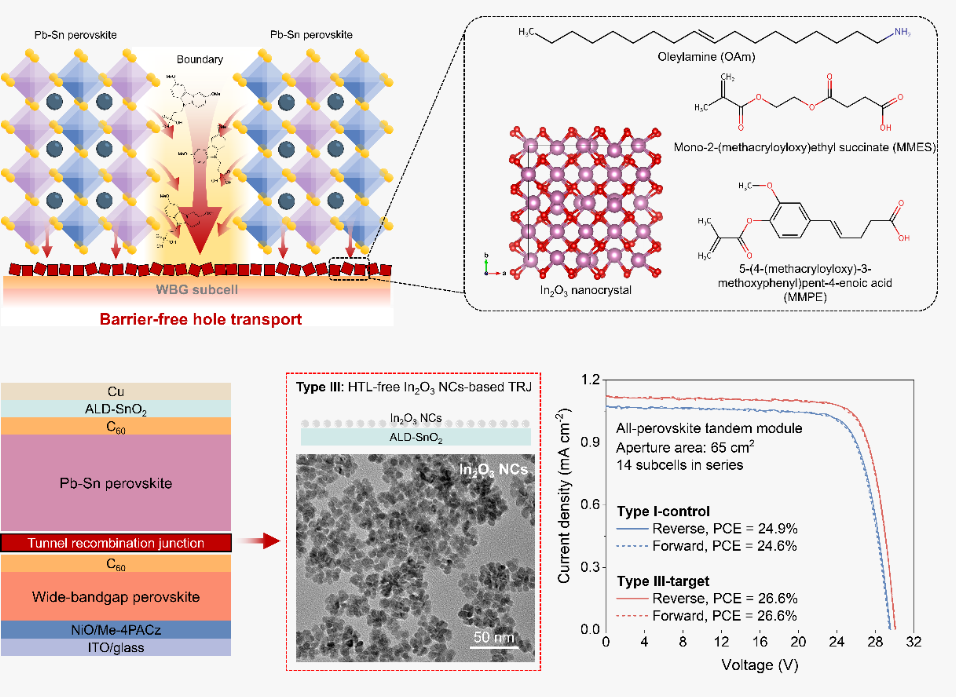
Figure. Charge transport optimization by functionalized nanocrystal illustration, device structure and performance of all-perovskite tandem solar modules.
Contact Us

National Natural Science Foundation of China
Add: 83 Shuangqing Rd., Haidian District, Beijing, China
Postcode: 100085
Tel: 86-10-62327001
Fax: 86-10-62327004
E-mail: bic@nsfc.gov.cn