
Chinese Researchers Set a New Efficiency Record for n–i–p Perovskite Solar Cells
Supported by the National Natural Science Foundation of China (Grant No. T2225024), a research team led by Prof. Mingjian Yuan and Research Fellow Yuanzhi Jiang at Nankai University, in collaboration with Research Fellow Jian Xu from Beijing Institute of Technology, has made significant progress in the development of high-efficiency n–i–p perovskite solar cells. The research, entitled “Continuously graded-doped SnO2 for efficient n–i–p perovskite solar cells,” was published in Nature on April 30, 2026. The paper is available at https://www.nature.com/articles/s41586-026-10587-4.
Perovskite solar cells combine high efficiency, low cost and scalable processability, and are widely regarded as one of the most promising next-generation thin-film photovoltaic technologies. In high-performance n–i–p devices, nano-textured transparent conductive substrates are commonly used to enhance light harvesting. However, such complex textured interfaces can also intensify recombination losses at the buried interface between the electron transport layer and the perovskite absorber, leading to increased voltage loss and limiting further efficiency improvement in n–i–p perovskite solar cells.
To address this critical bottleneck, Prof. Yuan’s team started from fundamental device physics and revealed that the synergistic effect of energy-level mismatch and electron accumulation at the buried interface between the SnO₂ electron transport layer and the perovskite absorber on nano-textured substrates is a key physical origin of severe non-radiative recombination losses. The team developed a chemical bath deposition-based strategy to construct n⁺/n continuously graded-doped SnO₂ electron transport layers. By regulating the spatial distribution of organic ligands during deposition, the electron transport layer was engineered to gradually transition from a heavily doped n⁺ region near the cathode to a lightly doped n region near the perovskite side. This graded structure forms conformal coverage on textured substrates, while simultaneously optimizing energy-level alignment, promoting electron extraction and suppressing interfacial electron accumulation, thereby effectively reducing non-radiative recombination losses at the buried interface.
The optimized perovskite solar cells achieved a certified stabilized power conversion efficiency of 27.17% and a reverse-scan efficiency of 27.50%, setting a new efficiency record for n–i–p perovskite photovoltaic devices. This work clarifies the interfacial loss mechanism that has long constrained the efficiency improvement of n–i–p perovskite solar cells, and provides a new materials and interfacial engineering strategy for the development of high-efficiency, highly stable and scalable perovskite photovoltaic devices and modules.
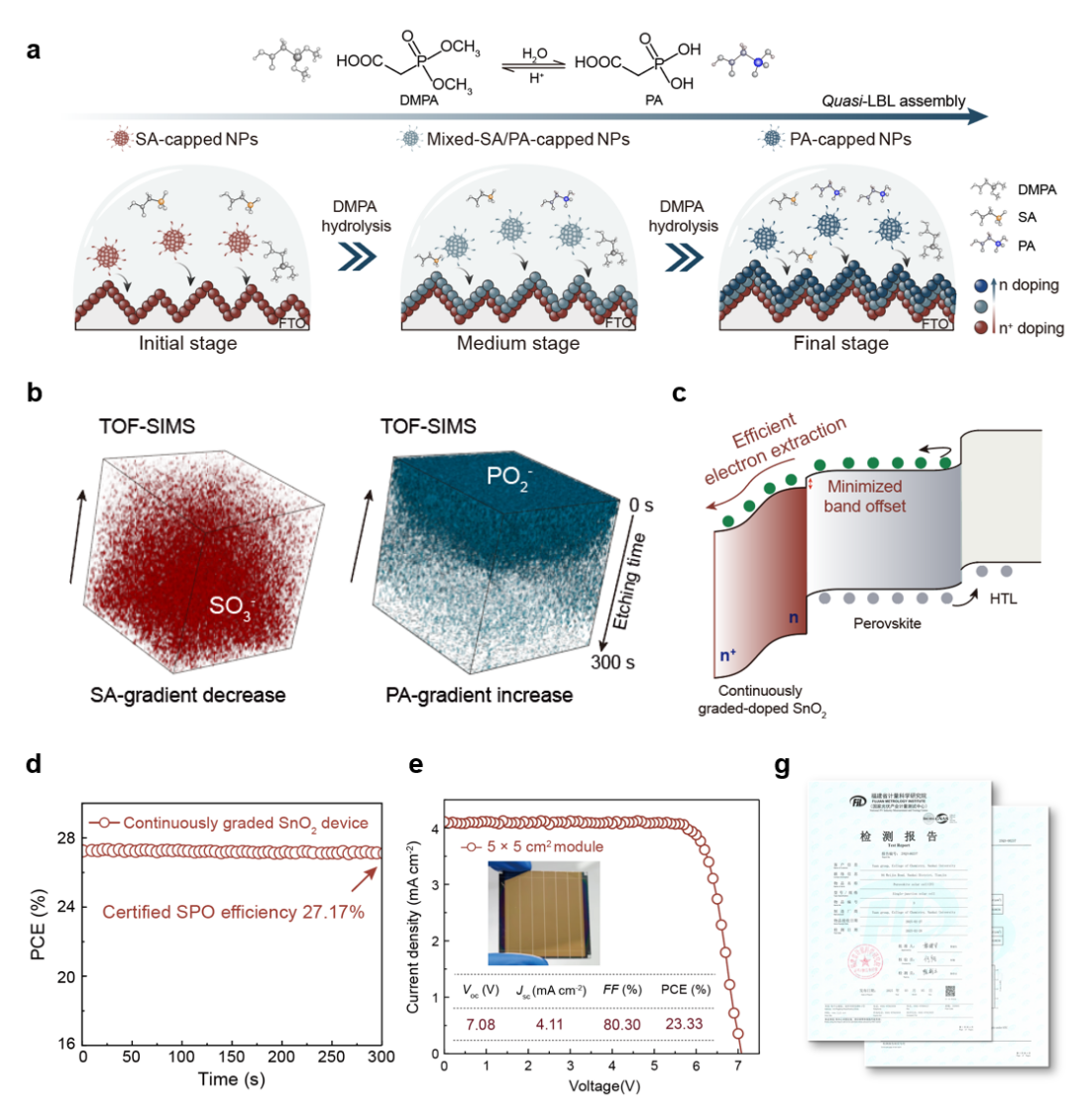
Figure | Continuously graded-doped SnO2 electron transport layers for high-efficiency perovskite solar cells.
Contact Us

National Natural Science Foundation of China
Add: 83 Shuangqing Rd., Haidian District, Beijing, China
Postcode: 100085
Tel: 86-10-62327001
Fax: 86-10-62327004
E-mail: bic@nsfc.gov.cn