
Chinese Researchers Make Progress in Adaptive Precision Therapy for Nasopharyngeal Carcinoma
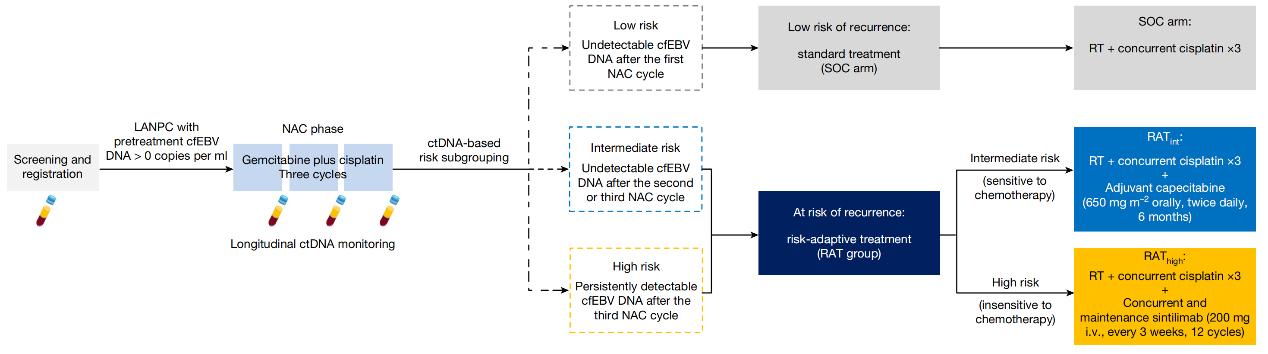
Figure: Risk-adaptive therapy for nasopharyngeal carcinoma guided by dynamic liquid biopsy: a dynamic and context-specific approach
With support from the National Natural Science Foundation of China (Grant No. 82521003、82522065、82441026、92259202、81803105), the research team led by Professor Ying Sun, Professor Jun Ma, Chief Physician Guan-Qun Zhou, and Researcher Ji-Bin Li at Sun Yat-sen University Cancer Center has made significant progress in risk-adaptive individualized therapy for nasopharyngeal carcinoma (NPC). The related findings, titled “Risk-adaptive Therapy Guided by Dynamic ctDNA in Nasopharyngeal Carcinoma,” were published online in Nature on March 12, 2026. The article can be accessed at: https://www.nature.com/articles/s41586-026-10244-w.
For decades, the treatment of NPC has followed a fixed, standardized protocol. However, during treatment, tumor cells and their microenvironment undergo continuous dynamic evolution, and the risk of recurrence for patients dynamically changes accordingly. Applying a static treatment strategy to a dynamically evolving recurrence risk often results in overtreatment for low-risk patients, while high-risk patients are undertreated and ultimately experience recurrence and metastasis.
To address this challenge, the research team previously discovered that cell-free Epstein-Barr virus DNA (cfEBV DNA) in plasma during treatment could serve as a real-time, non-invasive biomarker reflecting treatment response and recurrence risk in NPC (published in Cancer Cell, 2024). Building on this finding, the team further designed and conducted a multicenter, phase II adaptive clinical trial named EP-STAR. The study precisely classified patients into low-, intermediate-, and high-risk groups based on the dynamic clearance kinetics of cfEBV DNA after neoadjuvant chemotherapy, and implemented individualized adaptive therapy according to the remodeling characteristics of the tumor microenvironment in each risk group. Specifically, low-risk patients, who exhibited an excellent prognosis with sustained anti-tumor immune activation after chemotherapy, continued with the standard regimen without risk-adaptive treatment adjustments. Intermediate-risk patients, who had a high tumor burden and relatively poorer prognosis, showed enrichment of cancer stem cells in the tumor microenvironment after chemotherapy; their treatment was intensified by adding metronomic capecitabine—an agent effective against cancer stem cells—after standard chemoradiotherapy. High-risk patients, who faced an extremely high risk of recurrence and metastasis, displayed marked T-cell exhaustion in the tumor microenvironment after chemotherapy; their treatment was adjusted to combine immunotherapy from the initiation of radiotherapy and maintain it through the adjuvant phase. Results showed that after a median follow-up of 47.3 months, the 3-year disease-free survival rate for intermediate- and high-risk patients receiving adaptive therapy reached 89.1%. Compared with patients at the same risk levels who did not receive adaptive therapy, this strategy significantly reduced the risk of nasopharyngeal carcinoma progression and death by 59%, while demonstrating favorable clinical safety and health economic benefits. After a median follow-up of 47.3 months, the 3-year failure-free survival rate for intermediate- and high-risk patients receiving adaptive treatment was 89.1%. Compared with patients at the same risk levels who did not receive adaptive therapy, this strategy significantly reduced the risk of NPC progression or death by 59%, while demonstrating favorable clinical safety and health economic benefits (Figure).
This study provides the first clinical validation that risk-adaptive therapy can significantly improve the prognosis of patients with high-risk locoregionally advanced NPC. This breakthrough marks a shift in NPC treatment from the long-standing paradigm of fixed, static regimens toward a dynamic, adaptive therapeutic approach. In the future, this strategy holds promise for extension to other virus-associated tumors, ushering in a new era of biomarker-guided precision therapy.
Contact Us

National Natural Science Foundation of China
Add: 83 Shuangqing Rd., Haidian District, Beijing, China
Postcode: 100085
Tel: 86-10-62327001
Fax: 86-10-62327004
E-mail: bic@nsfc.gov.cn