
Chinese Scientists Make Progress in GPCR-targeting Protein Design
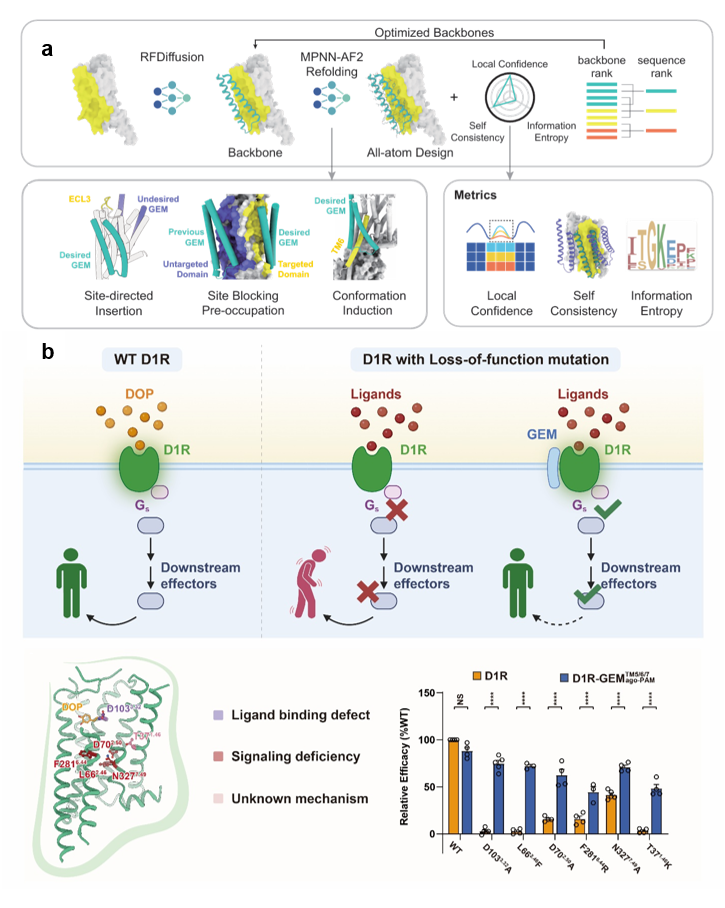
Figure. AI-based de novo design of GPCR Exoframe Modulators (GEMs) and rescue of loss-of-function mutant receptors.
Supported by the National Natural Science Foundation of China (Grant Nos. 92353303, 32430051, 32141004, 62202426), the research team led by Yan Zhang from Zhejiang University School of Medicine reports a progress in the field of membrane protein design. Their findings were published in Nature on February 17, 2026, titled "De novo Design of GPCR Exoframe Modulators", and the paper can be accessed at https://www.nature.com/articles/s41586-025-09957-1. The study developed a novel class of GPCR Exoframe Modulators (GEMs) targeting the transmembrane domains of G protein-coupled receptors (GPCRs) through deep learning, thereby overcoming a bottleneck in the functional design of membrane proteins and providing a powerful therapeutic strategy for treating diseases associated with GPCR loss-of-function mutations.
GPCRs constitute the largest family of membrane proteins in humans and are essential therapeutic targets. Orthosteric modulation—binding to the site where endogenous ligands attach—is the most commonly used pharmacological strategy. However, due to the highly conserved nature of orthosteric sites among receptor subtypes, traditional drugs often suffer from poor selectivity and significant side effects. Furthermore, orthosteric drugs are generally ineffective at repairing receptor dysfunctions caused by loss-of-function (LoF) mutations. In nature, a class of naturally occurring transmembrane proteins, such as receptor activity-modifying proteins (RAMPs), regulates GPCR functions through transmembrane interactions, providing inspiration for the development of novel modulators. Despite this immense potential, the function-oriented de novo design of proteins targeting GPCR transmembrane domains remains an extremely challenging and underexplored territory.
The de novo design dimension was driven by advanced AI algorithms and structural constraints. Using deep learning, the authors demonstrate the successful design and validation of four distinct GEMs—an anchor, a biased allosteric modulator (BAM), a negative allosteric modulator (NAM), and an agonist-positive allosteric modulator (ago-PAM)—using the dopamine D1 receptor (D1R) as a model system. The team showed that the GEM-BAM achieves signaling pathway selectivity (biased signaling) by targeting specific receptor interfaces. They further show that the GEM-NAM effectively locks the receptor in an inactive conformation, while the ago-PAM stabilizes the active conformation characterized by tthe outward movement of transmembrane helix 6, highlighting the power of one ago-PAM among GEMs to restore the signal transduction activity of multiple D1R LoF mutants, including those associated with Parkinson's disease.
In this work, the team established a "hallucination-like" de novo protein design pipeline integrating AlphaFold2-multimer, RFDiffusion, and ProteinMPNN to map potential transmembrane regulatory sites. Guided by computational structural insights, the team developed three "structural prompting" strategies, including site-directed insertion, site-blocking preoccupation, and conformation induction. These strategies impose structural constraints during the design process, effectively guiding the generation of transmembrane proteins with specific binding modes and desired functions. These AI-designed GEMs enabled diverse and precise regulation of receptor functions, offering a broadly applicable and programmable toolkit that brings opportunities to GPCR allosteric modulation, structural biology, and the development of transmembrane protein-centric drug modalities.
Contact Us

National Natural Science Foundation of China
Add: 83 Shuangqing Rd., Haidian District, Beijing, China
Postcode: 100085
Tel: 86-10-62327001
Fax: 86-10-62327004
E-mail: bic@nsfc.gov.cn