
Chinese Researchers Advance Precision RNA Editing Technology
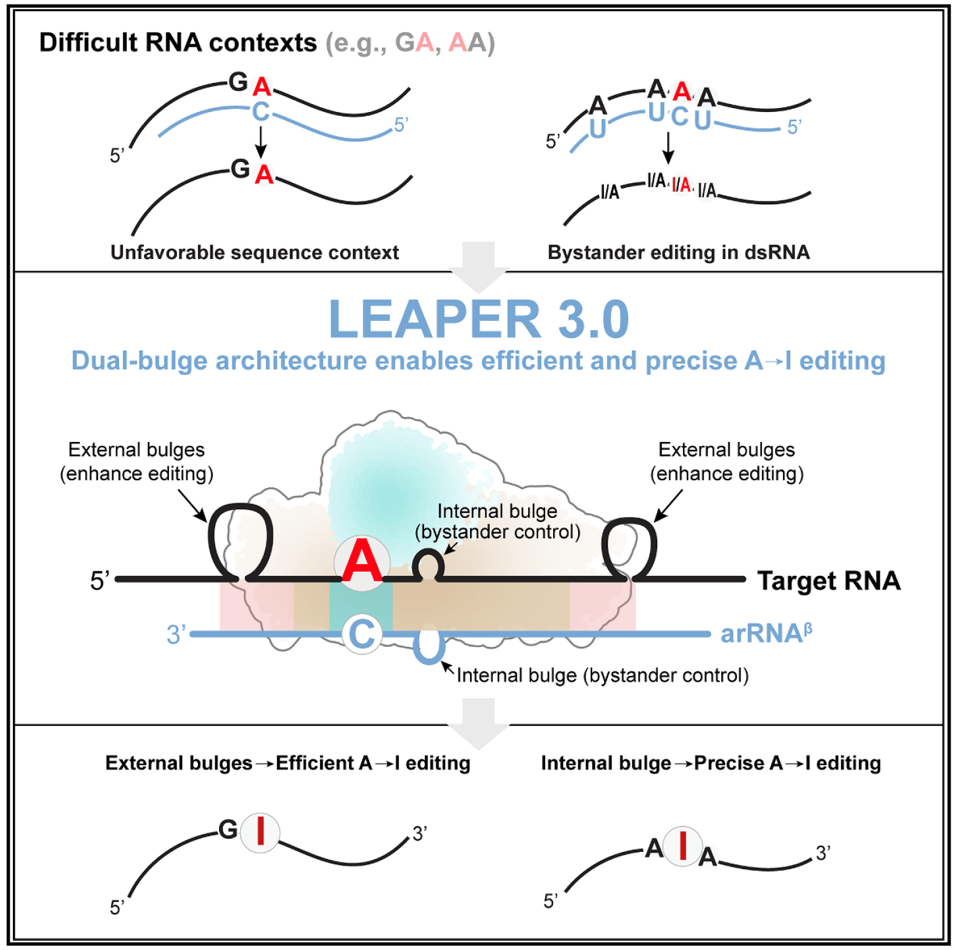
Figure. The dual-bulge design of LEAPER 3.0 enables efficient and precise A-to-I RNA editing
Imagine being able to correct the “typos” in the body’s genetic messages without permanently altering the genome itself. Such an approach could make the treatment of many genetic diseases both safer and more controllable. Supported by the National Natural Science Foundation of China (Grant Nos. 82341207 and 31930016), Professor Wensheng Wei’s team from the School of Life Sciences and the Biomedical Pioneering Innovation Center (BIOPIC) at Peking University has made an important advance in precision RNA editing technology.
Unlike traditional DNA editing, which permanently modifies genetic information in the genome, RNA editing operates at the transcript level, leaving the genome unchanged. This reversible nature offers important advantages in safety and clinical controllability. In 2019 and 2022, Professor Wensheng Wei’s team successively developed LEAPER 1.0 and LEAPER 2.0, two generations of programmable RNA editing technologies. Rather than introducing exogenous editing proteins, LEAPER uses an engineered ADAR-recruiting RNA (arRNA) to harness the cell’s endogenous adenosine deaminase acting on RNA (ADAR), thereby eliminating the need for exogenous protein delivery, minimizing immunogenicity, and establishing a safer platform for therapeutic RNA editing.
Despite these advances, endogenous RNA editing has continued to face several major challenges. ADAR enzymes exhibit strong intrinsic sequence preferences, rendering many pathogenic mutation sites refractory to efficient editing. In addition, undesired bystander editing frequently occurs at nearby adenosines, limiting editing precision. Most importantly, the binding rules governing ADAR and double-stranded substrate RNA remain poorly defined, leaving tool design reliant on empirical trial and error and severely hindering technical optimization and clinical translation.
To overcome these challenges, the researchers combined AlphaFold 3-based structural prediction with biochemical characterization and high-throughput functional screening to systematically investigate the molecular basis of ADAR-RNA recognition. They discovered that introducing rationally designed bulge structures into RNA duplexes can remodel the interaction between ADAR and its RNA substrate. These engineered structural elements not only overcome ADAR’s intrinsic sequence constraints, enabling efficient editing of previously difficult targets, but also restrict the enzyme’s catalytic activity to suppress bystander editing and achieve single-nucleotide precision.
The study further revealed that ADAR1 and ADAR2 exhibit distinct structural preferences for bulges. By strategically introducing optimized bulges on both sides of the editing site, the researchers achieved consistently enhanced editing efficiency and precision across different endogenous ADAR expression backgrounds. Building upon these mechanistic insights, they developed the next-generation RNA editing platform, LEAPER 3.0.
The performance of LEAPER 3.0 was validated in multiple disease models, including Duchenne muscular dystrophy (DMD), Usher syndrome, and alpha-1 antitrypsin deficiency (AATD). Across all models, LEAPER 3.0 substantially outperformed previous generations. Notably, in the PiZZ mutation responsible for AATD, LEAPER 3.0 achieved approximately 40% sustained correction of the disease-causing amino acid while significantly improving liver pathology, demonstrating its potential for treating previously intractable genetic disorders. The study, titled “RNA structure programs endogenous ADAR for precise and efficient editing,” was published online in Cell on June 10, 2026. DOI: https://doi.org/10.1016/j.cell.2026.04.047.
The evolution of the LEAPER platform can be illustrated with a simple analogy. LEAPER 1.0 resembles a flexible rope that binds target RNA and recruits endogenous ADAR for editing. LEAPER 2.0 closes the two ends of the rope to form a circular RNA, greatly improving molecular stability and extending editing duration. LEAPER 3.0 further incorporates programmable "knots," engineered bulge structures, into this circular scaffold. These structural features precisely shape the three-dimensional RNA architecture, expanding editing at previously inaccessible targets while simultaneously minimizing unwanted bystander editing.
This work establishes a structure-guided framework for the rational design of endogenous RNA editing tools. Rather than relying on protein engineering, LEAPER 3.0 enhances editing performance entirely through RNA structural engineering, preserving the inherent advantages of endogenous RNA editing, including low immunogenicity, simplified delivery, and improved safety. More broadly, the study demonstrates how artificial intelligence-driven structural biology can enable the rational design of next-generation biotechnology.
Contact Us

National Natural Science Foundation of China
Add: 83 Shuangqing Rd., Haidian District, Beijing, China
Postcode: 100085
Tel: 86-10-62327001
Fax: 86-10-62327004
E-mail: bic@nsfc.gov.cn