
Chinese Researchers Make Progress in Developing New Thermoelectric Cooling Device
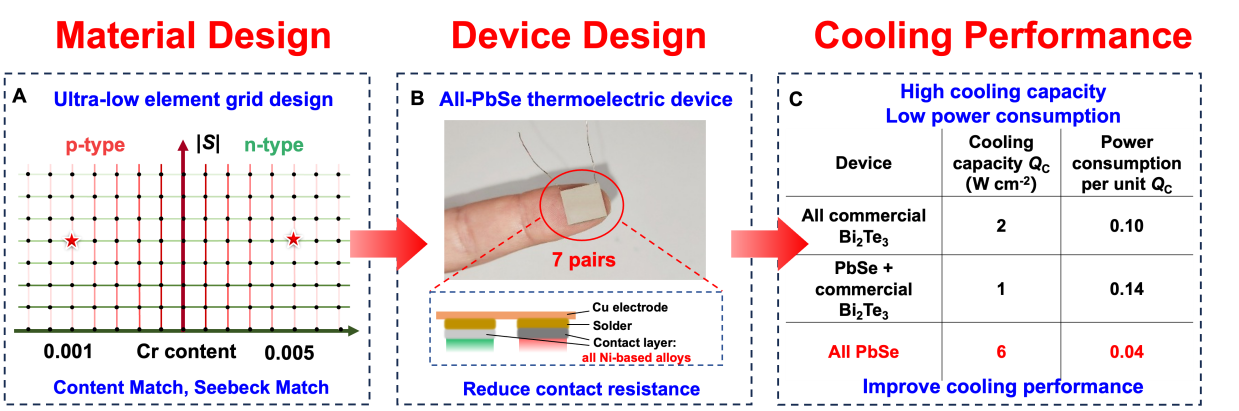
Figure. A Schematic illustration of the trace-element grid design strategy. The gradient incorporation of trace amounts of Cr enables the development of high-performance p-type and n-type PbSe within the same material system, with closely matched chemical compositions and Seebeck coefficients. B Schematic illustration of an all-PbSe thermoelectric cooling device. A Ni-based alloy is employed as the contact and barrier layer, and the interfacial contact materials are optimized to reduce electrical contact resistance. C. Cooling performance of the all-PbSe thermoelectric cooling device. Compared with commercial Bi2Te3 devices (Natl. Sci. Rev. 12, nwae448 (2024)) and heterogeneous devices combining PbSe with commercial Bi2Te3 (J. Am. Chem. Soc. 147, 15827–15837 (2025)), the all-PbSe device delivers a higher cooling-power density while consuming less electrical power.
Supported by the National Natural Science Foundation of China (grant nos. 52525101 and 524B2004, etc.), the research team led by Professor Lidong Zhao at Beihang University has made new progress in thermoelectric energy materials. The research article, entitled “Ultralow Chromium Doping Enables All-PbSe Thermoelectric Cooling,” was published in Science on June 5, 2026 (https://www.science.org/doi/10.1126/science.aeg8963).
Thermoelectric cooling is based on the Peltier effect, through which an applied electric current directly drives heat transfer and enables active temperature regulation. Thermoelectric coolers offer several distinctive advantages, including the absence of mechanically moving components, silent operation, rapid response, ease of miniaturization, and long service life. In aerospace applications, they can provide precise temperature control for chips, detectors, sensors, and other sensitive electronic components, thereby preventing performance degradation or failure caused by overheating. Compared with conventional vapor-compression refrigeration, thermoelectric cooling is particularly well suited to miniaturized systems requiring highly precise thermal management.
Most commercial thermoelectric cooling devices currently rely on tellurium-containing bismuth telluride, Bi2Te3. However, tellurium has a crustal abundance of only ~ 0.001 parts per million, resulting in limited resource availability and relatively high material costs. In addition, Bi2Te3 is mechanically brittle and exhibits limited interfacial stability, which constrains the large-scale deployment of Bi2Te3-based cooling devices.
To develop tellurium-free thermoelectric cooling materials, lead selenide, PbSe, has emerged as a promising candidate because of the favorable mechanical properties associated with its intrinsic cubic crystal structure. Selenium is also considerably more abundant than tellurium: its crustal abundance is ~ 0.05 parts per million, about 50 times that of tellurium. In 2024, the research team reported room-temperature n-type PbSe cooling materials in Science (Science 383, 1204–1209 (2024)). Nevertheless, the absence of a p-type PbSe material with matching thermoelectric performance has remained a major obstacle to the construction of all-PbSe thermoelectric cooling devices.
To address this challenge, the research team developed a trace-element grid design strategy. By introducing ultralow concentrations of chromium into PbSe along a compositional gradient, both n-type and p-type thermoelectric materials were obtained within a single PbSe-based material system. This strategy enabled precise regulation of carrier transport in the two types of PbSe and produced p-type and n-type materials with closely matched compositions and Seebeck coefficients. Such compatibility provides an essential materials foundation for device fabrication and stable operation.
Building on these material advances, the research team further optimized the device architecture and fabrication process. The use of chemically compatible all-PbSe materials alleviates the thermal-expansion mismatch commonly encountered in heterogeneous thermoelectric devices, thereby improving the dimensional stability of the device under practical operating conditions. The material interfaces were also engineered by depositing a Ni-based alloy barrier layer through magnetron sputtering. This interfacial design reduced the electrical contact resistance and minimized additional Joule-heating losses during device operation.
Through the coordinated optimization of thermoelectric materials, interfaces, and device fabrication, the research team developed an ultrathin all-PbSe thermoelectric cooling device. At room temperature, the device achieved a cooling-power density of ~ 6 W cm-2 and a maximum coefficient of performance of ~ 21. When the hot-side temperature was maintained at 363 K, the maximum temperature difference reached ~ 53 K. Moreover, owing to its intrinsic cubic crystal structure, PbSe exhibits greater fracture toughness and compressive strength than commercial Bi2Te3 materials. The resulting all-PbSe device therefore combines high cooling performance with enhanced mechanical reliability.
These findings demonstrate the potential of PbSe as a tellurium-free material platform for thermoelectric cooling. In the future, such ultrathin cooling devices could be used in aerospace and other applications in which compact dimensions, low power consumption, precise temperature regulation, and high mechanical reliability are required.
Contact Us

National Natural Science Foundation of China
Add: 83 Shuangqing Rd., Haidian District, Beijing, China
Postcode: 100085
Tel: 86-10-62327001
Fax: 86-10-62327004
E-mail: bic@nsfc.gov.cn