
Chinese Researchers Make Progress in Developing New Ultrahigh-Temperature Alloys
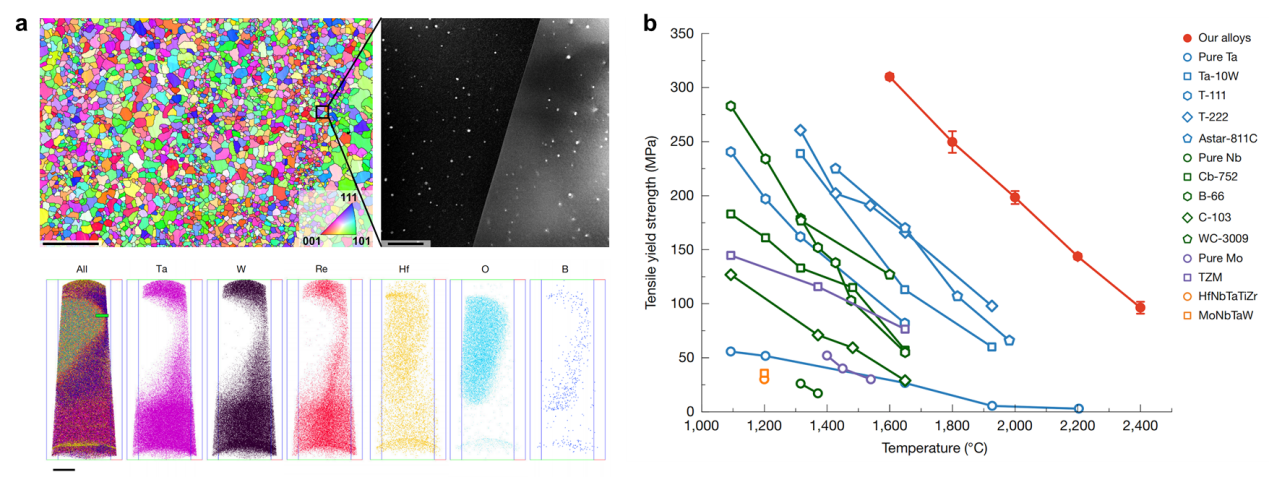
Figure The boron-stabilized oxide dispersion strengthened Ta alloy (B-ODS Ta alloy). a, The carefully designed boron-intervened oxidation reaction produces oxide particles with an average diameter of about 50 nm and a homogeneous distribution within the grain interior. b, Our B-ODS alloys exhibit an excellent tensile yield strength in the ultrahigh-temperature regime, outperforming by far all the previously reported conventional refractory alloys and refractory multi-principal-element alloys.
Supported by the National Natural Science Foundation of China (grant nos. 52425104 and 52595631 etc.), the research team, led by Professor Suzhi Li, Professor Xiangdong Ding, Professor En Ma, and Academician Jun Sun from the State Key Laboratory for Mechanical Behavior of Materials at Xi’an Jiaotong University, has developed a new ductile alloy capable of withstanding loads at temperatures as high as 2000-2400 °C. The findings, entitled “Ductile alloys offering 100 MPa tensile strength at 2400 ℃”, were published in Nature on 24 June 2026 (https://www.nature.com/articles/s41586-026-10708-z).
The demand for ultrahigh-temperature alloys has grown significantly in aerospace. The operating temperature of heat-end components often goes beyond 2000 °C. At present, tantalum (Ta) alloys are considered as promising candidates to operate in extreme environments due to their high melting points (~3000 °C) and relevant properties. However, the traditional Ta alloys do not have adequate strength at ultrahigh temperatures. The reason lies in the fact that metals usually undergo the degradation of mechanical properties at high temperatures. When the working temperature reaches above approximately 0.5~0.6 Tm, the mechanical strength drops sharply due to thermally driven microstructural evolution, such that most strengthening mechanisms that function well at room temperature become inapplicable. In addition, not only good strength, the material must also offer ample ductility for easy shaping to process complex-shaped components at temperatures near room temperature. Now it is still very challenging to obtain an exceptional combination of high-temperature strength and room-temperature ductility in metallic materials.
Here, we show that this trade-off could be overcome using a boron-intervened in situ oxidation strategy to directly fabricate a bulk Ta-based refractory alloy with boron-stabilized oxide particles dispersed uniformly in the grain interior. Our new design starts from a body-centred-cubic Ta-12W-1Re (in weight ratio) base alloy. A small concentration of HfB2 was intentionally added to the refractory matrix. Because oxygen (O) solutes, which are inevitably present as impurities in the refractory alloy, possess a highly negative formation enthalpy with HfB2, the selective oxidation reaction of O with HfB2 forms HfO2 oxide particles. The oxygen thus takes Hf away from B, locking down Hf but freeing up B. B is known to diffuse faster than O towards the interfaces and grain boundaries. The aggregation of B there suppresses the nucleation of oxides at grain boundaries and promotes their uniform distribution in the matrix. Meanwhile, B atoms leaving the particles also tend to aggregate at the interface between the oxide nanoparticle and the matrix, preventing excessive growth of the former. Thus, the carefully designed boron-intervened oxidation reaction produces oxide nano-particles and homogeneous distribution within the grain interior (Figure a).
Our B-ODS Ta alloys have an ultimate tensile strength >800 MPa at room temperature. The elongation-to-failure reaches 35%, good for easy processing. More impressively, the tensile yield strength reaches about 200 MPa at 2000 °C and about 100 MPa at 2400 °C, outperforming all the reported traditional refractory alloys and recently emerged refractory multi-principal-element alloys (Figure b). For example, the yield strength of our B-ODS Ta alloys at approximately 2000 °C doubles that of the carbide-strengthened counterparts. Our alloy could elevate the upper limit of working temperature by 500 °C under the 100 MPa bearing load in comparison to conventional Ta alloys. Furthermore, our alloys also exhibit good thermal stability. The creep test results indicate noticeable longer-term improvement over all previous refractory alloys. This B-ODS design strategy could be applied to other alloys, such as niobium-based alloys, to enhance their working temperatures.
Contact Us

National Natural Science Foundation of China
Add: 83 Shuangqing Rd., Haidian District, Beijing, China
Postcode: 100085
Tel: 86-10-62327001
Fax: 86-10-62327004
E-mail: bic@nsfc.gov.cn