
Chinese Researchers Advance Non-Destructive Picometre-Scale Deformation Probing in Low-Dimensional Materials
Supported by the National Natural Science Foundation of China (grant numbers: 52022025, 52522208 and 52472155), Professor Qing Dai’s team at Shanghai Jiao Tong University, Professor Xiaoxia Yang’s team at the National Center for Nanoscience and Technology, and their collaborators have developed a picometrology model based on hyperbolic phonon polaritons. This approach enables non-invasive and quantitative characterization of atomic-scale out-of-plane interlayer deformations in van der Waals (vdW) materials. The work, entitled “Probing picometre-scale interlayer deformations via hyperbolic polaritons”, was published online in Nature on 17 June 2026. Paper link: https://www.nature.com/articles/s41586-026-10638-w.
vdW materials can tolerate large strain fields, making them an important platform for tuning electronic, optical and magnetic properties. However, strain characterization remains challenging: in-plane strain can be conveniently mapped by Raman spectroscopy or photoluminescence, whereas interlayer deformation along the out-of-plane direction is difficult to quantify in a non-invasive manner, especially when such tiny distortions are buried at functional interfaces. These hidden interlayer deformations often play a decisive role in determining the performance of vdW heterostructure devices. Although advanced computational microscopy can image such distortions at the atomic scale, it generally requires complex instrumentation, substantial computational resources and high-energy electron beams that may damage delicate structures, making it unsuitable for non-destructive and large-scale metrology.
To address this challenge, the joint research team proposed an optical metrology model based on polaritons. The method uses mid-infrared out-of-plane hyperbolic phonon polariton (oHPs) modes to achieve highly sensitive, non-destructive detection of out-of-plane interlayer deformation in hexagonal boron nitride (hBN), a prototypical vdW polar insulator. The key physical mechanism is that interlayer compression in vdW materials softens the out-of-plane transverse optical (oTO) phonon mode. Even a compression of only a few picometres can induce a pronounced redshift, whereas the directly detectable out-of-plane longitudinal optical (oLO) phonon mode remains nearly unchanged. However, the oTO phonon is intrinsically spectroscopically “dark” and is difficult to observe directly using conventional infrared spectroscopy. The oHPs can illuminate and activate this otherwise invisible phonon mode, thereby converting minute structural distortions into measurable optical frequency shifts. By comparing theoretical calculations with experimental data, the team achieved quantitative and non-destructive detection of interlayer deformation in hBN, with a detection limit of 10 ± 0.71 pm.
The team further selected a tellurium quantum dot/boron nitride nanotube (Te-QDs/BNNT) heterostructure as a model system for buried interfaces. Using aloof-mode high-spatial-resolution STEM-EELS, they observed a localized redshift of approximately 12 cm⁻¹ only at the deformation site (see Figure). This result demonstrates that oHPs can resolve deeply buried and highly localized deformation fields in complex nanostructures. This study provides a new technical route for non-destructive optical characterization of picometre-scale interlayer deformation, and it is expected to expand the use of polaritons in strain metrology and buried-interface structural characterization of low-dimensional materials.
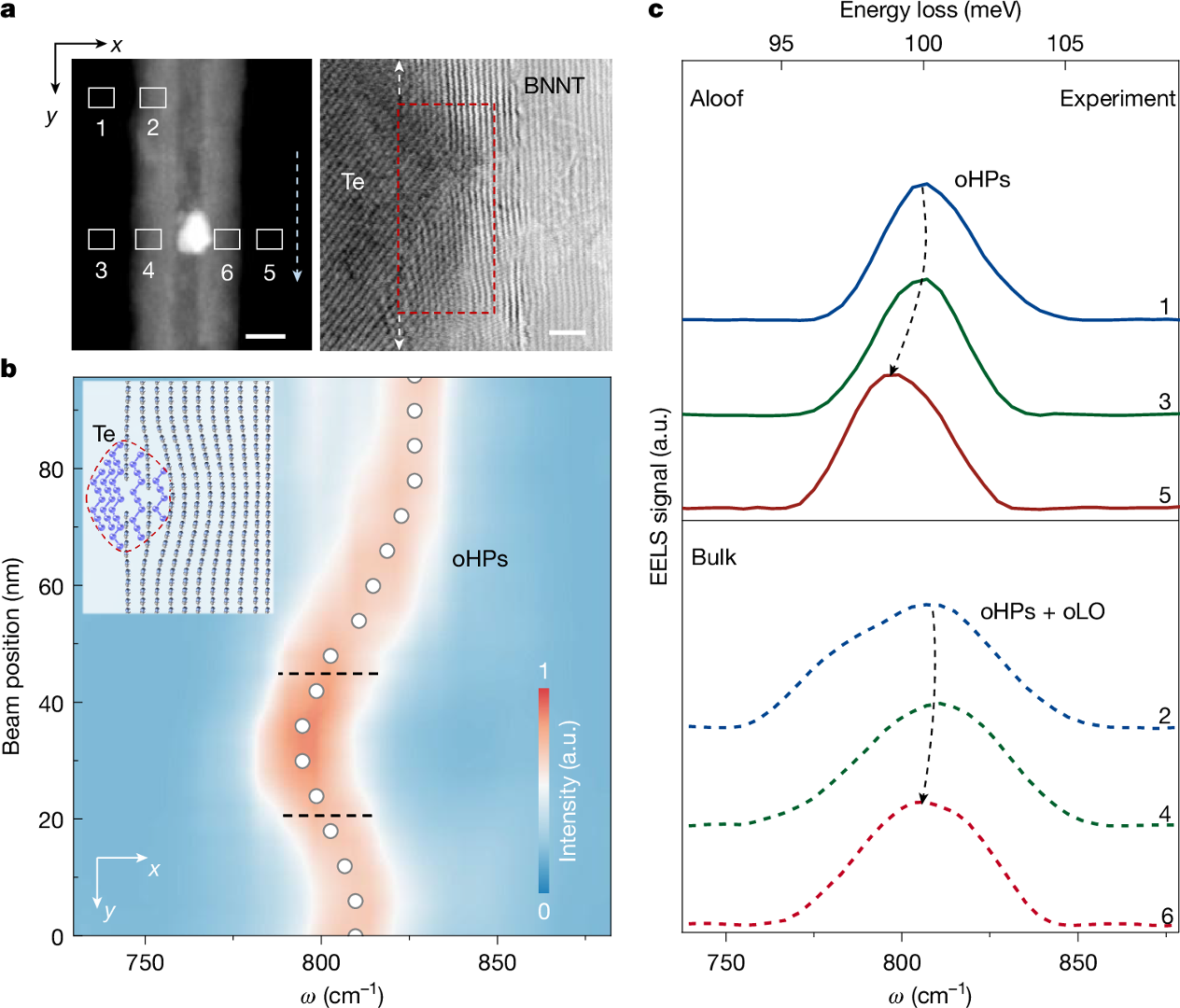
Figure. Localized interlayer deformation at the Te-QDs/BNNT interface: (a) Local deformation at the Te-QDs/BNNT interface; (b) Experimentally observed redshift of the pure oHPs signal; (c) Redshift comparison between the pure oHPs signal (solid curves) and the total signal after superposition with the oLO background (dashed curves).
Contact Us

National Natural Science Foundation of China
Add: 83 Shuangqing Rd., Haidian District, Beijing, China
Postcode: 100085
Tel: 86-10-62327001
Fax: 86-10-62327004
E-mail: bic@nsfc.gov.cn