
Chinese Researchers Report Progress in High-Efficiency and Stable Blue Light-Emitting Diodes
Supported by the National Natural Science Foundation of China (Grant Nos. 52125206, 52433013, and 52202209), a research team led by Prof. Huanping Zhou from the School of Materials Science and Engineering at Peking University, together with collaborators, has developed a strategy for the controllable in situ formation of highly crystalline perovskite nanocrystals. Using this approach, the team fabricated blue perovskite light-emitting diodes (PeLEDs) with an external quantum efficiency (EQE) of 21.8% and markedly improved operational stability. The study, entitled “In situ nanocrystal confinement for efficient blue perovskite LEDs”, was published online in Nature on June 10, 2026. Paper link: https://www.nature.com/articles/s41586-026-10596-3.
Achieving high crystallinity while maintaining nanoscale crystal dimensions during in situ nanocrystal formation has long been a major challenge in the development of high-performance PeLEDs. High crystallinity is essential for reducing defect density, suppressing non-radiative recombination, and enhancing device stability, whereas nanoscale grains provide strong carrier confinement and promote efficient radiative recombination. However, it is often challenging to balance these two requirements during the in situ crystallization of perovskite on the substrate. Extensive crystal growth generally improves lattice ordering but leads to larger grain sizes, while direct formation of quantum-confined nanocrystals often introduces abundant surface and interfacial defects. Therefore, the simultaneous control of crystal quality and grain size remains a key scientific challenge, particularly for blue PeLEDs.
To address this issue, the researchers designed polymerizable ligands that form a polymer network in situ during perovskite crystallization. The resulting network dynamically regulates nanocrystal growth through spatial confinement. Unlike conventional confinement approaches, the polymer network not only suppresses secondary grain growth but also modulates crystallization kinetics, providing sufficient time for lattice rearrangement and ordering. As a result, nanoscale crystal dimensions and high crystallinity are achieved simultaneously.
Further studies showed that the in situ nanocrystal confinement strategy not only precisely controls grain size but also induces a phase transition from the orthorhombic phase to the cubic phase. The structural evolution weakens electron–phonon coupling, thereby reducing non-radiative energy loss and enhancing radiative recombination efficiency. In addition, the polymer network stabilizes the crystal lattice and suppresses defect formation, leading to perovskite films with excellent structural integrity and luminescence properties.
Using this high-quality emissive layer, the researchers fabricated blue PeLEDs with an emission peak at 491 nm and a peak EQE of 21.8%, significantly outperforming control devices. The operational lifetime was also extended by more than six times. Further analysis revealed that the in situ polymer network effectively suppresses electric-field-induced migration, mitigating interfacial degradation and performance decay during device operation. As a result, both device efficiency and operational stability were substantially improved.
This work provides a new strategy for the controllable in situ synthesis of high-quality perovskite nanocrystals, enabling the synergistic optimization of nanocrystal size, crystallinity, and crystal structure. The study also elucidates how in situ ligand polymerization regulates perovskite crystallization and phase evolution, offering new insights into the design of high-performance optoelectronic materials. Owing to its versatility and scalability, the strategy may find applications in a broad range of optoelectronic devices, including perovskite solar cells and quantum-dot light-emitting technologies.
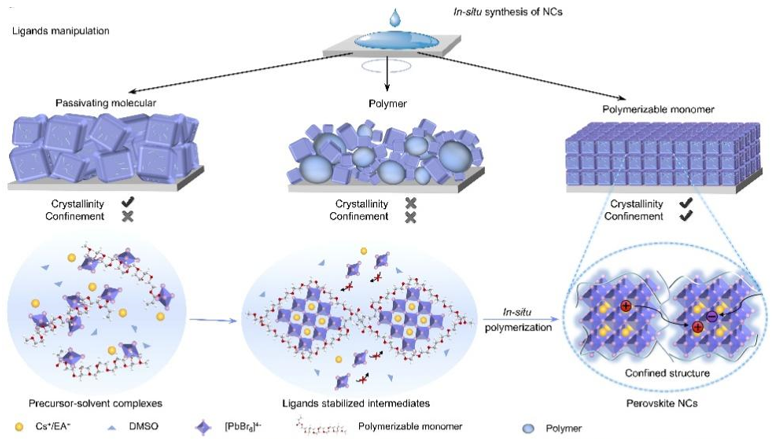
Figure. Schematic illustration of ligand design and crystallization process of perovskite nanocrystals.
Contact Us

National Natural Science Foundation of China
Add: 83 Shuangqing Rd., Haidian District, Beijing, China
Postcode: 100085
Tel: 86-10-62327001
Fax: 86-10-62327004
E-mail: bic@nsfc.gov.cn