
From Fish to Humans: A Major Step Forward in Tracing Our Ancestry as Silurian Fossils Fill a Key Evolutionary Gap
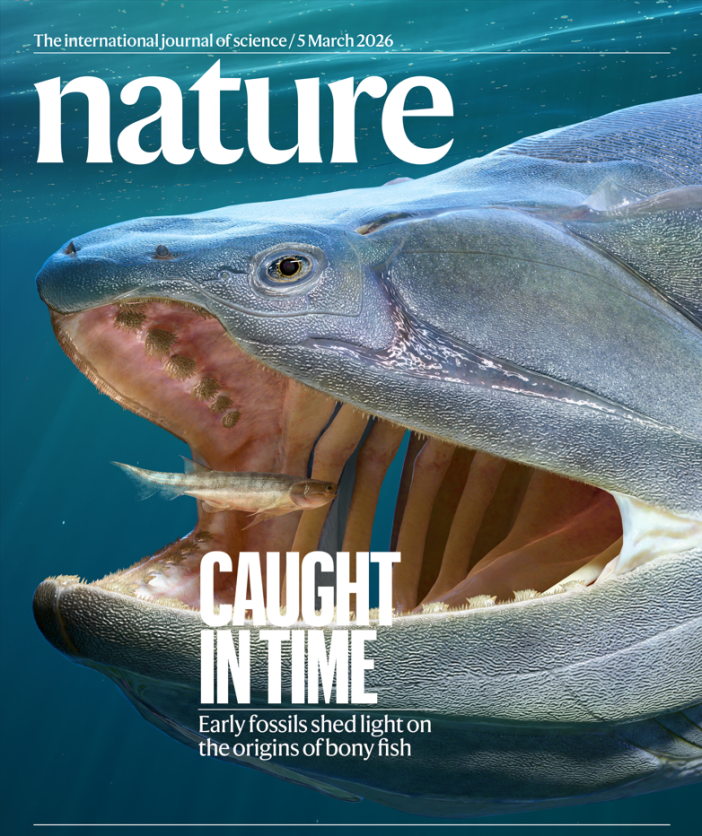
Figure 1. Life reconstruction of Eosteus chongqingensis (middle) as the cover image of Nature. The larger fish is Megamastax amblyodus, the largest known Silurian vertebrate.
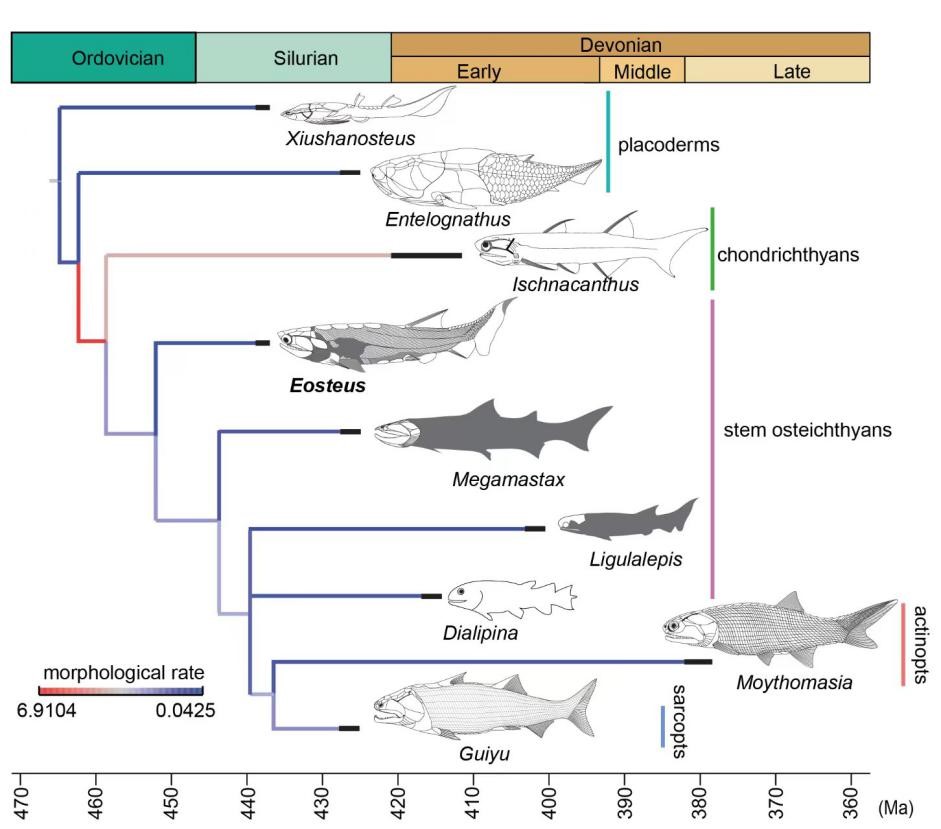
Figure 2. Evolution and interrelationship of early bony fish.
Humans, who belong to sarcopterygians (lobe-finned fish and tetrapods), and most modern fish, which belong to actinopterygians (ray-finned fish), shared a common bony fish ancestor hundreds of millions of years ago. For a long time, the scarcity of early bony fish fossils has prevented scientists from knowing the morphology of this last common ancestor of ray-finned fish and lobe-finned fish, creating a major gap in the evolutionary history from fish to humans.
Supported by the National Natural Science Foundation of China (Grant Nos. 42130209 and 42272028), Chinese scientists have discovered the world’s oldest and most complete fossil of a bony fish. This three-centimeter-long fossil fish, named Eosteus chongqingensis, was recovered from the early Silurian strata of Xiushan, Chongqing. Crucially, Eosteus has been identified as the last common ancestor of lobe-finned and ray-finned fish, filling the aforementioned gap.
Bony fishes (osteichthyans) have accounted for the majority of vertebrate biodiversity throughout most of their evolutionary history. The two surviving bony fish lineages, ray-finned fishes and lobe-finned fishes, occupy many ecological niches in water and on land. Ray-finned fishes have evolved into more than 30,000 species, including nearly all fish commonly seen today; while one group of lobe-finned fishes crawled onto land during the Devonian and evolved into all tetrapods, including humans. Since the second half of the last century when Academician Zhang Miman, a distinguished paleontologist of the Chinese Academy of Sciences, began to work on a series of pivotal lobe-finned fish fossils from South China, researchers worldwide have expected more discoveries in this region, especially the missing stem group of bony fishes.
After more than ten years of field excavations and laboratory investigations, a team led by Academician Zhu Min from the Institute of Vertebrate Paleontology and Paleoanthropology (IVPP) of the Chinese Academy of Sciences—including professors Lu Jing, Zhu You’an, and Chen Yang from the Chongqing Institute of Geology and Mineral Resources together with their research collaborator, has made significant progress regarding bony fish origins. Their findings were published as a cover story in Nature on March 5, 2026, under the title "The oldest articulated bony fish from the Early Silurian period" (Figure 1, https://www.nature.com/articles/s41586-026-10125-2 ).
Living approximately 436 million years ago, Eosteus predates all previously known bony fish fossils, even earlier than the previously earliest microfossils of bony fish. This small fish displays a mosaic of primitive and derived traits: its streamlined body, single dorsal fin, and caudal fulcra resemble those of early ray-finned fishes, yet it lacks the lepidotrichia (bony fin rays) unique to bony fishes and possesses an anal fin spine previously known only in cartilaginous fishes and placoderms. The discovery of Eosteus demonstrates that the core set of bony fish traits emerged much earlier than previously thought.
Phylogenetic analyses (Figure 2) place Eosteus in the stem group of bony fishes, representing a primitive bony fish before the divergence of ray-finned and lobe-finned fishes. It clarifies the previously unclear morphology of the last common ancestor of ray-finned and lobe-finned fishes. In addition, this discovery enriches our understanding of the early radiation of jawed vertebrates, and refutes the hypothesis that the ancestral bony fish was more similar to lobe-finned fishes.
This research confirms that South China was the cradle for the origin and early radiation of bony fish, and possibly all jawed vertebrates. Future studies on China’s unique Silurian vertebrate fossil record will continue to drive us to rethink the series of key leaps in the early evolutionary history of vertebrates.
Contact Us

National Natural Science Foundation of China
Add: 83 Shuangqing Rd., Haidian District, Beijing, China
Postcode: 100085
Tel: 86-10-62327001
Fax: 86-10-62327004
E-mail: bic@nsfc.gov.cn