Major Breakthrough by Chinese Researchers in Rosacea Treatment
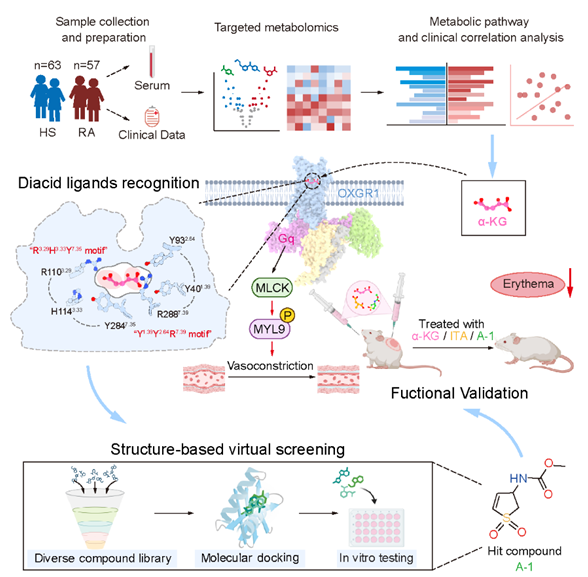
Figure. Developing a new therapeutic target based on rosacea metabolomics
Supported by the National Natural Science Foundation of China (Grant Nos. 82225039, 82422063, 82404179, etc.), the teams led by Prof. Ji Li and Prof. Zhili Deng at Xiangya Hospital, Central South University, together with the teams led by Prof. Jinpeng Sun and Prof. Lulu Guo at Shandong University, have achieved a major breakthrough in the treatment of rosacea. The study, entitled “Metabolite-gated vascular contractility switch: OXGR1 activation mechanism enables agonist therapy for rosacea erythema,” was published online in Cell on March 5, 2026. Article link: https://doi.org/10.1016/j.cell.2026.01.036.
Rosacea is a chronic inflammatory skin disorder that predominantly affects the face, with a global prevalence of approximately 5.5%. Persistent facial erythema driven by abnormal vasodilation is its most prominent and refractory clinical feature. Current treatments for this erythema are limited, often suboptimal in efficacy, and associated with notable adverse effects, representing an urgent clinical unmet need and highlighting the necessity for safer and more effective therapeutic strategies.
Through clinical metabolomics, the researchers found that the key metabolite α-ketoglutarate (α-KG) is significantly elevated in the sera of patients with rosacea and is positively correlated with erythema severity. Mechanistic studies showed that α-KG specifically binds to and activates OXGR1, a G protein–coupled receptor (GPCR) located on the membrane of vascular smooth muscle cells, thereby activating Gq signaling and enhancing myosin light chain kinase (MLCK)–dependent phosphorylation of myosin light chain 9 (MYL9). This signaling cascade promotes vascular smooth muscle contraction, effectively suppresses pathological vasodilation, and alleviates rosacea-like erythema in mice. To further clarify the activation mechanism of OXGR1, the team investigated how OXGR1 recognizes α-KG/itaconate (ITA) and uncovered the molecular basis of receptor activation, including a distinctive diacid-recognition pocket and ligand-binding mode. Building on this structural foundation, the team used AI-assisted approaches to design and synthesize A-1, a novel OXGR1-selective agonist with high potency and selectivity. In vivo experiments demonstrated that low-dose A-1 markedly improves erythema in mice, with efficacy comparable to the first-line clinical drug brimonidine and with a higher safety profile (Figure).
This work establishes an integrated research pipeline spanning clinical metabolomics, disease mechanism, receptor signal transduction, and AI-assisted drug design. It reveals a molecular mechanism by which targeting a metabolic pathway can intervene in rosacea-associated vascular dysfunction and, by leveraging the new target OXGR1, develops a novel agonist, providing a new precision therapeutic strategy to address persistent erythema in rosacea.
Contact Us
National Natural Science Foundation of China
Add: 83 Shuangqing Rd., Haidian District, Beijing, China
Postcode: 100085
Tel: 86-10-62327001
Fax: 86-10-62327004
E-mail: bic@nsfc.gov.cn