
Mechanism of Innate Immune Antagonism Against Cross-Species Transmission of Avian Influenza A Virus Unveiled by Chinese Researchers
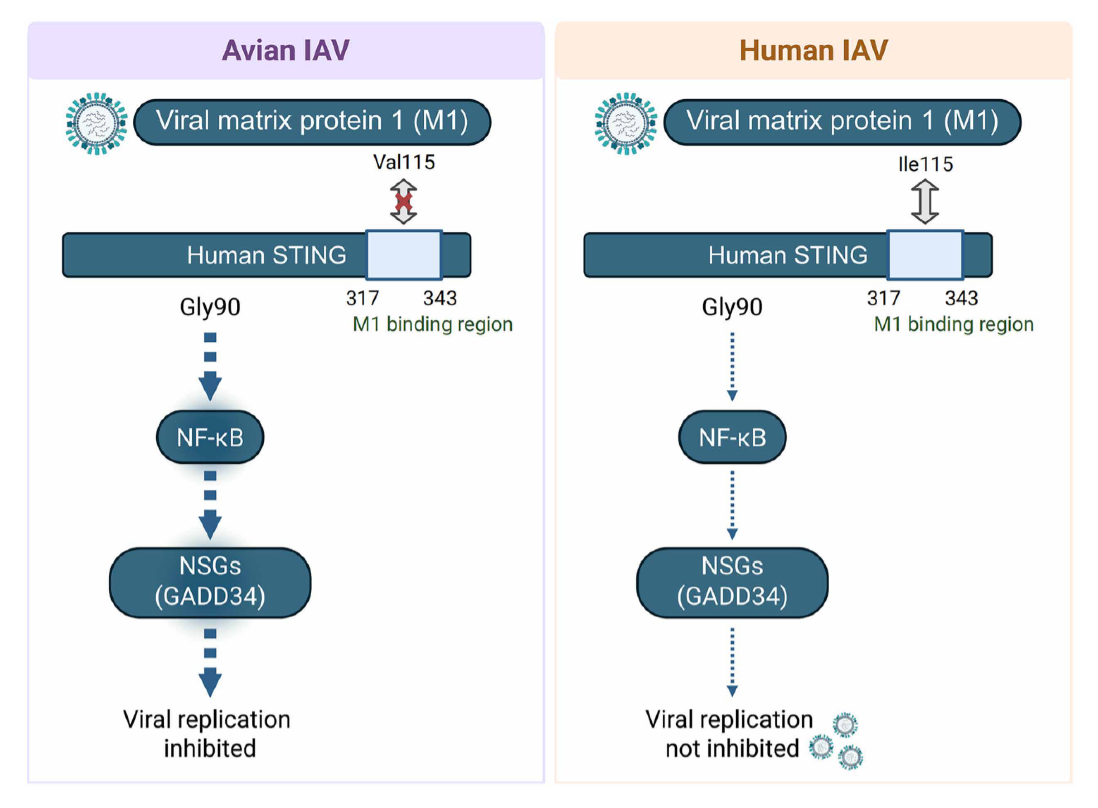
Figure. M1 protein adaptation enables influenza A virus to evade STING–NF-κB–GADD34-mediated host defense
Supported by the National Natural Science Foundation of China (Grants No. 92169203 and 31970151), Professor Yu Xiaofang (Zhejiang University) and Professor Wei Wei (Jilin University) have elucidated key mechanisms governing avian influenza virus cross - species transmission. Their study, entitled "STING - NF-κB signaling builds an influenza spillover barrier", was published in Science on February 26, 2026.
[Article] https://www.science.org/doi/10.1126/science.ads4405
Cross-species transmission of avian-origin influenza A virus (IAV) presents a significant global public health challenge. While receptor compatibility and polymerase adaptability are known transmission barriers, mechanisms by which human innate immunity restricts avian IAV spillover remain incompletely understood. Defining these interspecies barriers and corresponding viral evasion strategies constitutes a critical research priority.
This work demonstrates that IAV infection activates the host STING protein, and STING deficiency markedly enhances viral replication in vitro and in vivo. Pharmacological and genetic analyses confirm that STING restricts IAV replication through NF - κB pathway activation. Screening a STING mutant library identified Gly90 as essential for NF - κB activation and antiviral function. Transcriptomic comparison of wild-type STING versus the G90A mutant revealed GADD34—an NF-κB-stimulated gene (NSG)—as an inhibitor of IAV polymerase activity, independent of its canonical phosphatase function. Systematic profiling of IAV proteins further showed that human-adapted M1 subverts the STING–NF-κB–GADD34 axis, while avian-origin M1 lacks this antagonistic capability. The Val115→Ile115 mutation in human IAV M1 was identified as the critical adaptation permitting evasion of human STING-mediated immunity, thereby breaching the species barrier and enhancing viral fitness in human cells.
This study establishes the STING–NF-κB–GADD34 pathway as a host defense mechanism against avian IAV spillover, providing a theoretical foundation for pandemic risk assessment and the development of broad-spectrum antiviral therapeutics.
Contact Us

National Natural Science Foundation of China
Add: 83 Shuangqing Rd., Haidian District, Beijing, China
Postcode: 100085
Tel: 86-10-62327001
Fax: 86-10-62327004
E-mail: bic@nsfc.gov.cn