
Chinese Scholars Make Progress in Optical and 6G Telecommunications
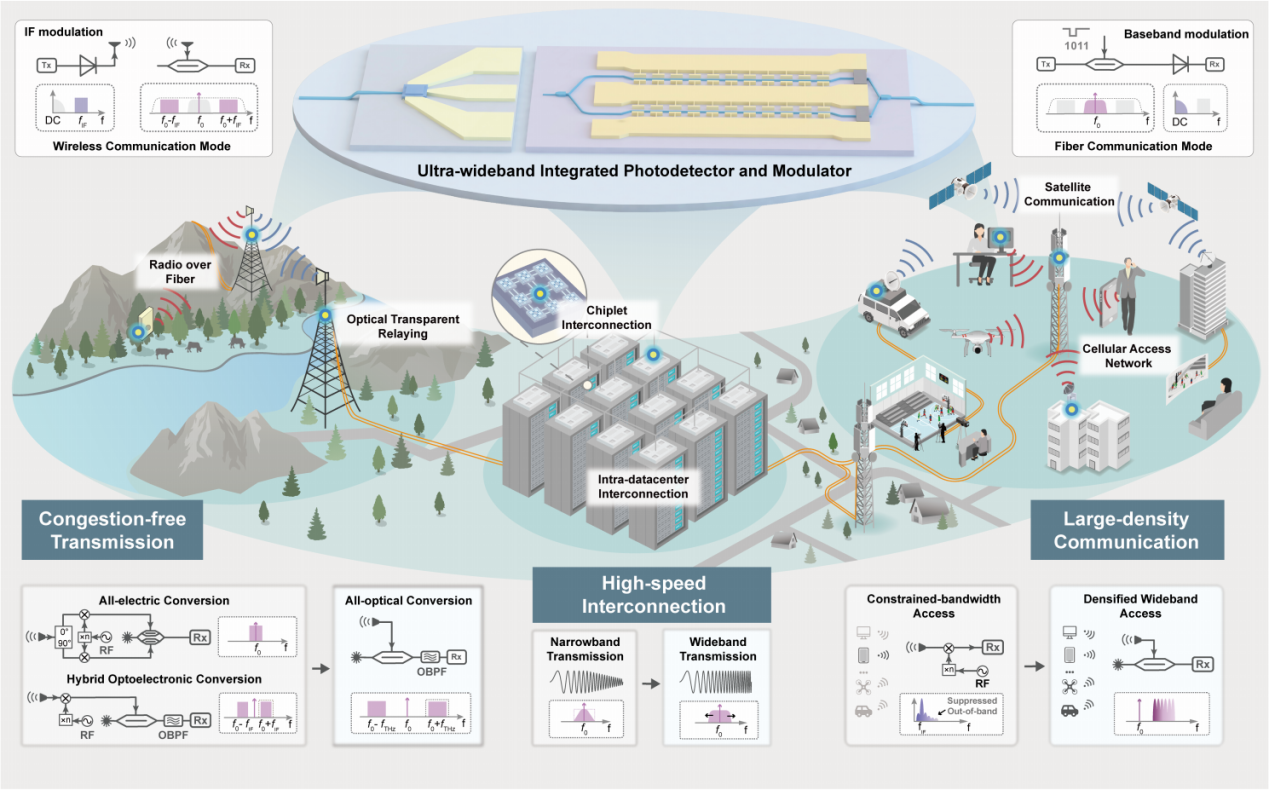
Fig: Conceptual drawings for all-optical ultra-broadband telecommunication system powered by integrated photonics.
Supported by projects from the National Natural Science Foundation of China (Grant Nos.: 62322501, 62235002) and others, a research team led by Professor Xingjun Wang and Researcher Haowen Shu from Peking University, together with Professor Shaohua Yu from Peng Cheng Laboratory and Associate Professor Baile Chen from ShanghaiTech University, has made progress in the field of optical and 6G telecommunications. On February 18, 2026, the related research results were published online in Nature under the title “Integrated photonics enabling ultra-wideband fibre–wireless communication” (https://www.nature.com/articles/s41586-026-10172-9).
In recent years, with the rapid development of AI technology, the higher-density and higher-performance computing power has become a critical component in the future competition within the field of artificial intelligence. Achieving higher-speed interconnections between computing chips and within large-scale data centers has emerged as a major bottleneck restricting the development of computing resources. Simultaneously, the growing demand for ubiquitous access, exemplified by satellite-terrestrial communication and intelligent connected vehicles, poses challenges for next-generation mobile communication technologies, represented by terahertz (THz) communication, which require higher capacity and lower latency. Furthermore, looking toward the future "Internet of Everything" era, a long-standing pain point within telecommunication systems has become increasingly prominent: the bandwidth mismatch between fibre communication and its wireless counterpart arises from fundamental disparities in signal architectures and hardware constraints, hinders unified system design and makes it difficult to achieve high-speed and compatible end-to-end transmission across the two domains over the same infrastructure.
To address the aforementioned issues, the research team proposed the concept of integrated "fibre-wireless converged communication" (see figure above), achieving seamless integration of the fibre–wireless system. The research team adopted an integrated photonics scheme, developing electro-optic/optic-electronic conversion devices with an ultra-wide bandwidth exceeding 250 GHz. Building on this, the research team demonstrated an integrated fibre-wireless converged system, achieving single-channel signal transmission at 256 Gbaud (512 Gbps) for fiber-optic communication, and single-channel signal transmission at 400 Gbps for terahertz wireless communication. Furthermore, they successfully demonstrated real-time multichannel 8K video across 86 channels.
This research, through self-developed ultra-wideband optoelectronic integrated chips and an AI-empowered advanced balancing algorithm, has achieved data transmission rates exceeding previously published reports across all major telecommunications scenarios (including optical fiber, wireless, and hybrid links), realizing "one system, cross-scenario reuse". This achievement is expected to reshape the architecture of telecommunication systems, lay a research foundation for the vision of future all-optical interconnection, and promote leapfrog development for China in this field.
Contact Us

National Natural Science Foundation of China
Add: 83 Shuangqing Rd., Haidian District, Beijing, China
Postcode: 100085
Tel: 86-10-62327001
Fax: 86-10-62327004
E-mail: bic@nsfc.gov.cn