
Chinese scientists solve the ferroelectric scaling trilemma
Supported by the National Natural Science Foundation of China (Grant No. T2588301), Professor Hailin Peng’s group from Peking University and their collaborators have developed a novel high-dielectric-constant (κ) van der Waals ferroelectric material, α-bismuth selenite (Bi2SeO5). They fabricated ferroelectric transistors and logic-in-memory circuits operating at an ultralow voltage (0.8 V) with extremely high endurance (>1.5×10¹² cycles). The exceptional performance significantly surpasses that of the existing industrial-grade hafnium-based ferroelectric systems. The related findings were published in Science on January 29, 2026, entitled "Wafer-scale ultrathin and uniform van der Waals ferroelectric oxide." The paper link is: http://dx.doi.org/10.1126/science.adz1655.
In the era of artificial intelligence (AI), ferroelectric materials with fast polarization switching characteristics offer opportunities for developing computing-in-memory architectures to break through the existing "power consumption wall" and "memory wall" of conventional architectures. Among them, ferroelectric field-effect transistors (FeFETs), which integrate logic and memory functions, are regarded as core devices for constructing next-generation high-efficiency embedded memories and compute-in-memory chips. Currently, the preparation of wafer-scale uniform and ultrathin ferroelectric films is a key challenge limiting the practical application of ferroelectric devices. How to maintain ferroelectricity at the atomic-layer thickness and achieve reliable, consistent wafer-scale integration has become a core problem that must be overcome for developing high-efficiency ferroelectric compute-in-memory chips.
To address the above issues, the research team developed the novel bismuth-based two-dimensional ferroelectric material α-Bi2SeO5. They established a back-end-of-line (BEOL) compatible (≤400 °C) in-situ oxidation preparation method, achieving for the first time the controllable preparation of wafer-scale, ultrathin, uniform ferroelectric films and ferroelectric/semiconductor heterostructures. Based on this material system, the team successfully fabricated high-performance ferroelectric transistors. Under ultra-low voltage (0.8 V) and high-speed writing (20 ns) conditions, the devices demonstrated endurance exceeding 1.5×10¹² cycles, along with a retention time of 10 years, 5-bit multi-level storage capability, and ultra-low energy consumption of 2.8 fJ bit−1 μm−2. This performance has already surpassed the industry's highest level for devices of the same type. Furthermore, the constructed dynamically reconfigurable in-memory logic computing circuits can achieve reconfigurable logic functions under conventional CMOS-compatible operating voltages (<1 V). This work simultaneously breaks through the limits in both ferroelectric material preparation and ferroelectric device performance, providing a novel material platform and integration scheme for next-generation high-performance, low-power chip technology. It marks an important leap from material innovation to functional verification in the "More than Moore" roadmap.
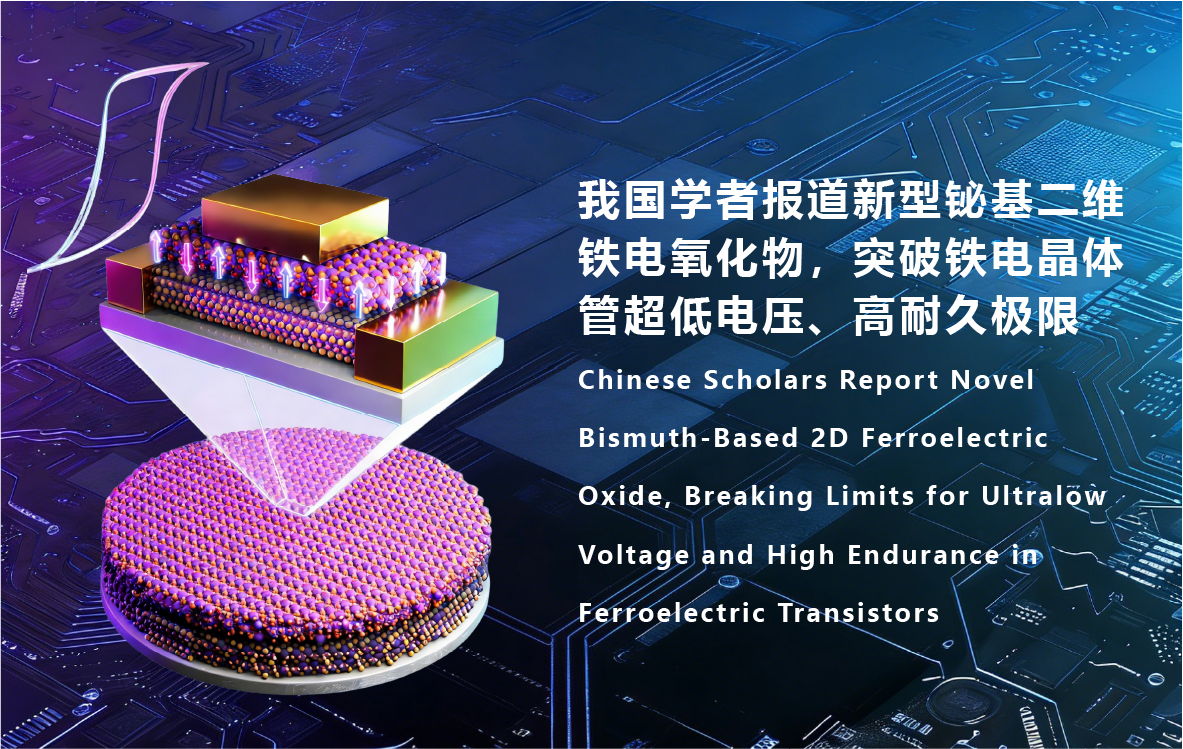
Figure: Wafer-scale two-dimensional high-κ ferroelectric oxide system and high-performance ferroelectric transistor.
Contact Us

National Natural Science Foundation of China
Add: 83 Shuangqing Rd., Haidian District, Beijing, China
Postcode: 100085
Tel: 86-10-62327001
Fax: 86-10-62327004
E-mail: bic@nsfc.gov.cn