Chinese Researchers Make Progress in AI-Enabled Remote Sensing Monitoring of Rivers and Lakes
Supported by the National Natural Science Foundation of China (NSFC) Young Scientists Fund (Category A) (Grant No. 52325901), Professor Di Long’s research team at Tsinghua University has made significant progress in AI-enabled remote sensing monitoring of rivers and lakes. The related research findings, titled “Global dominance of seasonality in shaping lake-surface-extent dynamics” and “Satellite altimetry reveals intensifying global river water level variability,” were published in Nature on May 28, 2025 (Article link: https://www.nature.com/articles/s41586-025-09046-3#Abs1) and in Nature Communications on December 19, 2025 (Article link: https://www.nature.com/articles/s41467-025-67682-9#Abs1), respectively.
Due to the uneven distribution of ground-based stations and inherent limitations of existing remote sensing techniques, such as low signal-to-noise ratios in complex environments, as well as insufficient spatiotemporal resolution and continuity, current monitoring approaches have struggled to establish a systematic and mature integrated “space–atmosphere–ground” monitoring framework for rivers and lakes. The lack of large-scale, spatiotemporally continuous, high-resolution, and high-accuracy structured data makes it difficult to meet the demands of China’s national water network development and major hydraulic and hydropower projects for accurate monitoring of complex hydrological dynamics.
To address these challenges, Professor Di Long from the Department of Hydraulic Engineering at Tsinghua University led a research team that integrated artificial intelligence, multisource remote sensing big data, and high-performance computing technologies to develop a high-accuracy, high-spatiotemporal-resolution remote sensing monitoring system covering rivers and lakes globally. This system features two major technological breakthroughs. First, building upon the fundamental principle of pixel decoupling, the team established a comprehensive multisource remote sensing spatiotemporal fusion framework that balances strong fitting capability with robust prior information, overcoming the long-standing trade-off between spatial and temporal resolution in hydrological observations. Second, focusing on radar waveform characteristics in complex riverine environments, the team developed a novel waveform retracking algorithm. Through refined noise filtering, adaptive multi-peak detection, and an outlier removal mechanism based on spatiotemporal constraints, the algorithm resolves the challenge of extracting reliable water level signals under complex climatic and topographic conditions.
Based on these advances, the research has achieved the most extensive, highest-resolution, and the most continuous global monitoring of river and lake dynamics to date. It provides reliable insights into seasonal fluctuations of terrestrial water bodies and the characteristics of hydrological variability, offering a scientific basis for mitigating climate change risks and ensuring the safe construction and stable operation of hydraulic and hydropower infrastructure.
The proposed AI-enabled spatiotemporal fusion technology for multisource remote sensing big data is highly scalable and can be further extended to high-resolution monitoring of comprehensive hydrological dynamics. It will help promote the development of an integrated intelligent sensing system encompassing “space–atmosphere–ground–water–engineering” dimensions. These research outcomes will support the construction goals of China’s national water network, namely, systematic completeness, security and reliability, intensive efficiency, green intelligence, smooth circulation, and orderly regulation, and provide technological support for responding to extreme hydrological events and advancing precision water resources management.
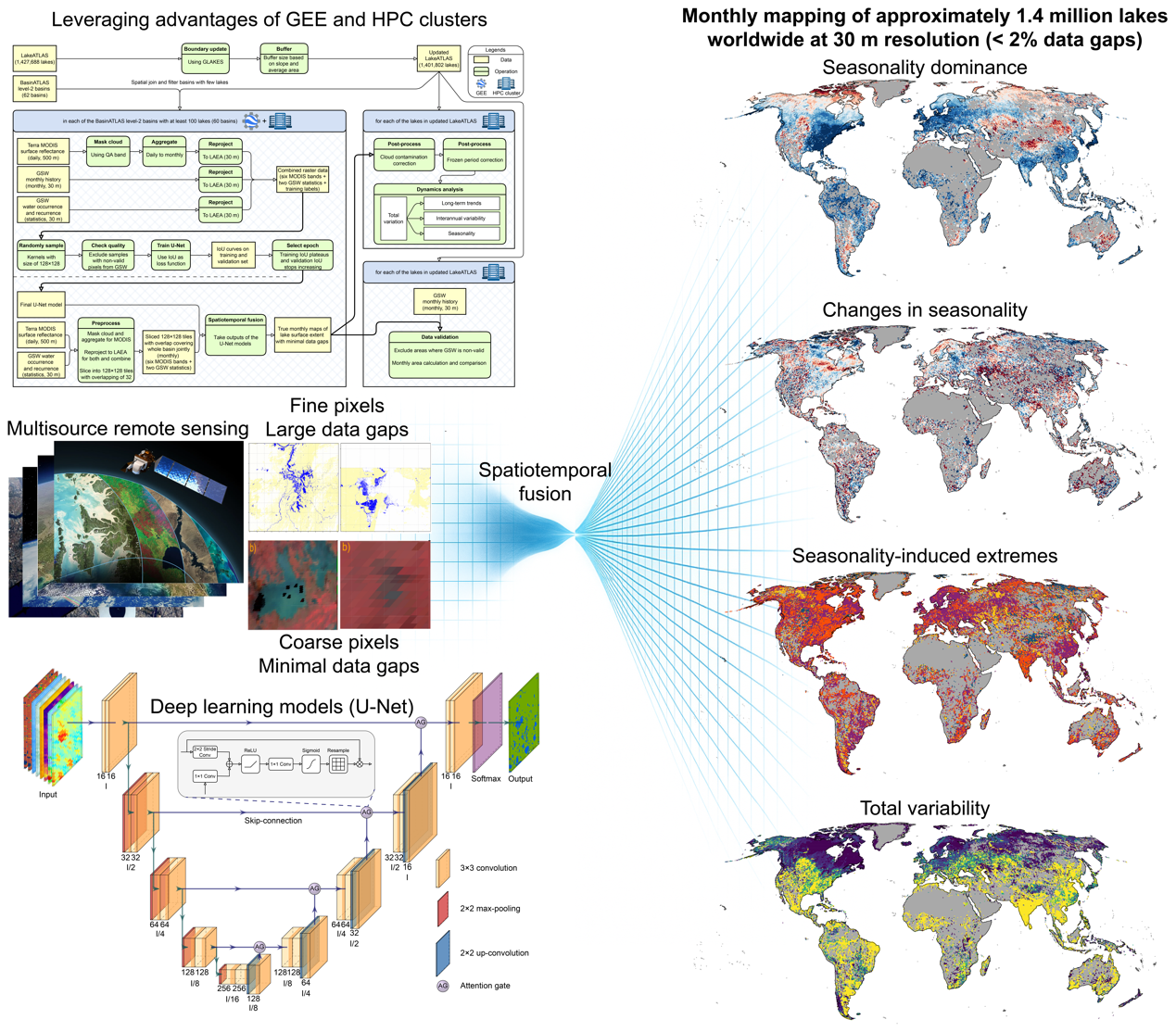
Figure: AI-enabled spatiotemporal fusion technology for multisource remote sensing big data enables high-resolution, continuous dynamic monitoring of rivers and lakes globally.
Contact Us
National Natural Science Foundation of China
Add: 83 Shuangqing Rd., Haidian District, Beijing, China
Postcode: 100085
Tel: 86-10-62327001
Fax: 86-10-62327004
E-mail: bic@nsfc.gov.cn