Chinese researchers advance central nerve system drug delivery for stroke therapy
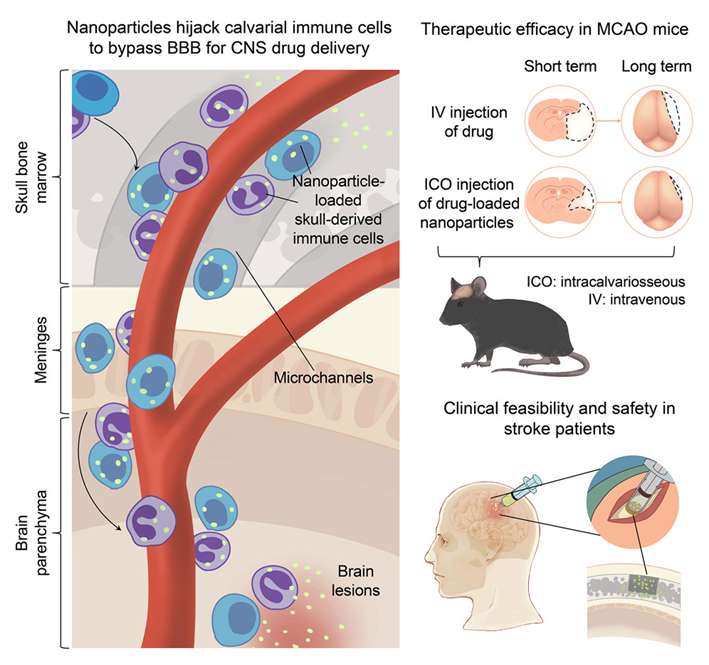
Figure: Skull bone marrow immune cells deliver nanoparticles to brain parenchymal lesions
Supported by the National Natural Science Foundation of China (Grant Nos.: 62350710211 and 82425101), a research team led by Professor Yilong Wang from Beijing Tiantan Hospital, Capital Medical University, in collaboration with a team led by Professor Mingjun Zhang from Tsinghua University, has made significant progress in central nervous system drug delivery for stroke therapy. The study was published online in Cell on January 16, 2026, under the title “Nanoparticles hijack calvarial immune cells for CNS drug delivery and stroke therapy”. The paper is available at: https://www.cell.com/cell/fulltext/S0092-8674(25)01421-7.
Drug development for central nervous system (CNS) disorders has long suffered from high clinical trial failure rates. A major bottleneck is the blood–brain barrier (BBB), which limits the penetration of most therapeutics, resulting in inadequate brain exposure and diminished efficacy. Wang and colleagues previously demonstrated that natural microchannels between the skull bone marrow and the dura mater can be leveraged to deliver agents efficiently to the brain. However, because many CNS diseases affect discrete, vulnerable regions, the lack of targeted delivery strategies often results in adverse outcomes.
This study shows that albumin nanoparticles, delivered via minimally invasive intracalvarial intraosseous (ICO) injection, are efficiently taken up by skull bone marrow immune cells, forming “calvarial immune cell microrobots”. These immune cell carriers then migrate along the skull-meningeal microchannels into the CNS, thereby bypassing the BBB to achieve drug delivery. In rodent models of ischemic stroke, this migratory process was markedly enhanced, resulting in high enrichment of nanoparticles within the meninges and the ischemic lesion. Compared with conventional intravenous (iv) administration, this approach achieved significant reductions in infarct volume and cerebral edema and improved both short- and long-term outcomes, despite using only one-fifteenth of the iv dose.
Building on this skull bone marrow-dura-glymphatic pathway, the researchers also conducted an exploratory clinical study (the SOLUTION trial), which indicated the translational feasibility of ICO injection for the treatment of malignant middle cerebral artery infarction (Figure).
This study unveils a previously unrecognized delivery route that leverages skull bone marrow–meningeal microchannels and immune cell-mediated drug transport. It establishes a new paradigm for precision drug delivery and mechanistic investigation in CNS diseases, and offers a novel therapeutic strategy targeting the skull bone marrow-dura-glymphatic system.
Contact Us

National Natural Science Foundation of China
Add: 83 Shuangqing Rd., Haidian District, Beijing, China
Postcode: 100085
Tel: 86-10-62327001
Fax: 86-10-62327004
E-mail: bic@nsfc.gov.cn