
Chinese Researchers Discovered One-Dimensional Charged Domain Walls in Fluorite Ferroelectric Thin Films
Supported by projects of the National Natural Science Foundation of China (Grants: 12222414, 12174437, 12304123) and other funding, a research team led by Academician Kui-juan Jin, Professor Chen Ge, Associate Professor Qinghua Zhang, and their collaborators from the Institute of Physics, Chinese Academy of Sciences / Beijing National Laboratory for Condensed Matter Physics has made a breakthrough in the study of ferroelectric domain walls. They have discovered a novel one-dimensional (1D) charged domain wall (CDW) structure with subcell dimensions in fluorite ferroelectric thin films and achieved their manipulation. The findings were published in the journal Science on January 22, 2026, titled “Observation of one-dimensional, charged domain walls in ferroelectric ZrO2”. The paper is available at: https://www.science.org/doi/10.1126/science.aeb7280.
Ferroelectric domain walls often exhibit physical properties distinct from those of the domains. As proposed by J. F. Scott from the University of Cambridge and R. Ramesh from the University of California in Review of Modern Physics, "the wall is the device." Indeed, domain wall nanoelectronic devices have shown promising applications in non-volatile memory and artificial intelligence. In three-dimensional ferroelectric crystals, domain walls are typically considered two-dimensional structures with nanometer-scale thickness. How to achieve domain walls with reduced dimensions to increase device density is a key scientific challenge in this field.
The emergence of fluorite-structured ferroelectrics presents new opportunities to address this issue. Their three-dimensional crystal structure consists of alternating layers of two-dimensional polar and non-polar sheets, with ferroelectric polarization confined within the two-dimensional polar layers. Phonon band theory indicates that the presence of non-polar layers decouples the interaction between adjacent polar layers, allowing each polar layer to undergo independent polarization switching while remaining stable. It is thus inferred that within these two-dimensional polar layers, there may exist dimensionally confined and independently movable CDWs. However, this area has remained largely unexplored because of the significant experimental challenges involved.
The research team prepared freestanding ZrO2 ferroelectric thin films using the laser molecular-beam epitaxy method and transferred them for plan-view imaging. Utilizing multislice electron ptychography, they directly observed one-dimensional head-to-head (H-H) and tail-to-tail (T-T) CDWs confined within the polar layers. These walls exhibit subcellular-scale dimensions, with a thickness and width of approximately 2.55 Å and 2.70 Å, respectively. Quantitative analysis of the oxygen occupancy near the domain walls revealed a charge screening mechanism via self-balancing oxygen occupancy. Furthermore, controllable creation, motion, and erasure of one-dimensional H-H CDWs were achieved. These domain walls can be manipulated within adjacent polar layers, suggesting their potential application in high-density multi-level memory. Additionally, the electric-field-driven motion of these oxygen-carrying one-dimensional CDWs reveals the microscopic coupling between polarization switching and oxygen ion transport.
This work challenges the traditional understanding that domain walls in three-dimensional crystals are inherently two-dimensional structures, providing a scientific foundation for developing artificial intelligence nanoelectronic devices with extreme density.
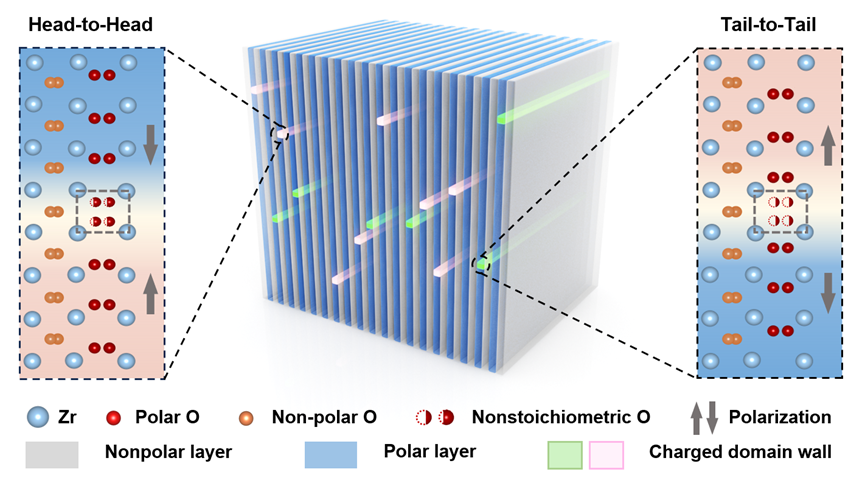
Figure: Cartoon illustration of the ferroelectric ZrO2 structure and atomic models of H-H and T-T charged domain walls confined within the two-dimensional polar layers.
Contact Us

National Natural Science Foundation of China
Add: 83 Shuangqing Rd., Haidian District, Beijing, China
Postcode: 100085
Tel: 86-10-62327001
Fax: 86-10-62327004
E-mail: bic@nsfc.gov.cn