
Chinese researchers and overseas collaborators confirm a rogue planet candidate as a planet for the first time
With support from the National Natural Science Foundation of China (Grant No. 12133005) and other funding sources, an international research team led by Prof. Subo Dong at Peking University has measured the mass of a rogue planet candidate for the first time. The object's mass was found to be approximately one-fifth of Jupiter’s mass, or similar to that of Saturn, thereby confirming its planetary nature. The research article, titled “A free-floating-planet microlensing event caused by a Saturn-mass object”, was published in Science on January 1, 2026 (https://www.science.org/doi/10.1126/science.adv9266). A “Perspective” written by Gavin A. L. Coleman from Queen Mary University of London was published in the same issue of Science, providing commentary on the findings (https://www.science.org/doi/10.1126/science.aed5209).
Unlike planets in our solar system, rogue planets do not orbit host stars and instead roam the darkness of space alone. The way to detect these invisible objects is via the gravitational microlensing effect: when a rogue planet passes in front of a background star, the object’s gravity bends and intensifies starlight like a lens, causing a brief increase in the star's brightness. Previously, about 10 rogue planet candidates had been identified via microlensing. However, for a long time, researchers had only been able to rely on rough statistical estimates of their masses, without direct and accurate measurements. As a result, the lack of firm information about this central property left many questions unanswered about their basic nature and origins.
In early May 2024, two ground-based surveys detected a two-day-long event caused by a rogue planet candidate (KMT-2024-BLG-0792/OGLE-2024-BLG-0516), and serendipitously, the Gaia spacecraft simultaneously captured the telltale brightness increase and made six measurements — the only time in Gaia’s decade-plus of service that it and ground-based telescopes collectively documented a rogue planet candidate. This fortunate coincidence allowed the research team to measure what is known as the “microlens parallax effect”: the event appeared about two hours later when seen from Gaia compared to Earth, enabling the researchers to determine the object's mass and distance, revealing that its mass is approximately 22% of Jupiter's mass. This accurate mass measurement rules out the possibility of a brown dwarf or a star, confirming the planetary nature of a rogue planet candidate for the first time. The analysis supports its dynamical origin – it was likely “ejected” from its birth planetary system.
This work marks that the field of rogue-planet research is entering a new phase of precise characterization, and the technique demonstrated in the study will pave the way for the next generation of microlensing surveys to systematically explore rogue planets from space, such as with NASA's Roman Space Telescope, China's Chinese Space Station Survey Telescope (CSST) and the “Earth 2.0” (ET) satellite. The large sample that will be enabled by future space-based surveys is promising for revealing the occurrence rate, mass distribution function and origins of rogue planets, allowing for further understanding of the formation and evolution of planetary systems.
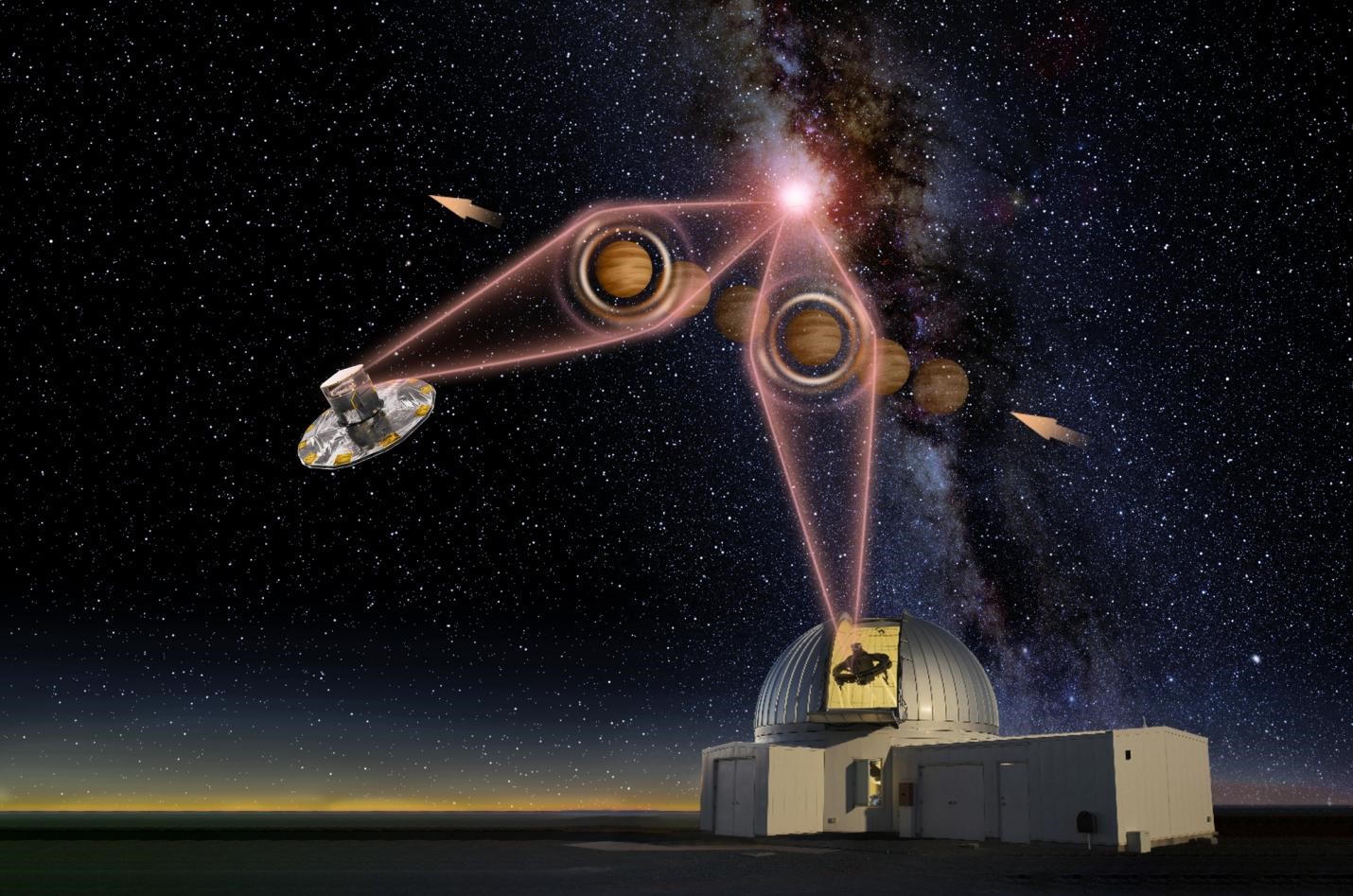
[Artist Impression] Telescopes on the ground and in space captured a microlensing event, and through these observations, researchers used parallax to measure the rogue planet candidate’s mass and distance. (Credit: Yu Jingchuan)
Contact Us
National Natural Science Foundation of China
Add: 83 Shuangqing Rd., Haidian District, Beijing, China
Postcode: 100085
Tel: 86-10-62327001
Fax: 86-10-62327004
E-mail: bic@nsfc.gov.cn