
Chinese Researchers Made Breakthrough in Phase-Change Thermal Energy Storage
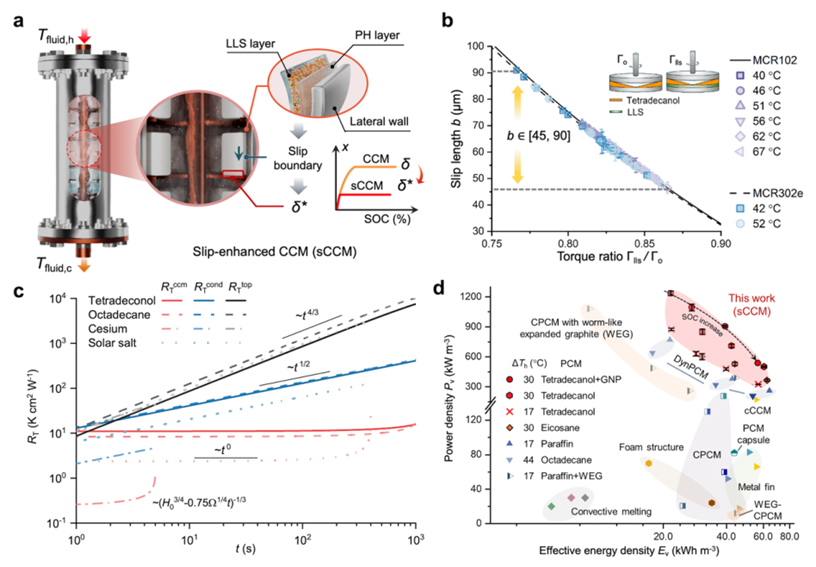
Figure: (a) Fast charging of phase-change thermal batteries with slip-enhanced close-contact melting (sCCM). (b) Slip length b of the liquid-like surface (LLS) was determined from rheological tests, suggesting that b ≈ 45–90 μm. (c) Thermal resistance analysis during the sCCM process for different types of PCM. (d) Volumetric power density Pv versus effective energy density Ev using different heat-transfer enhancement approaches.
Supported by the National Natural Science Foundation of China (Grant No. 52276088), a research team led by Professor Fan Liwu at Zhejiang University, in collaboration with Professor Ye Yumin at Ningbo University and Postdoctoral Research Fellow Hu Nan at Princeton University, has achieved significant progress in the field of thermal energy storage. The related research findings were published online in Nature on January 8, 2026, under the title "Pulse heating and slip enhance charging of phase-change thermal batteries". The paper is available at: https://www.nature.com/articles/s41586-025-09877-0.
Thermal energy storage (TES) is a critical technology for enhancing energy conversion and utilization efficiency, playing a pivotal role in the low-carbon transformation of the energy sector and supporting sustainable development. Phase-change thermal energy storage offers key advantages, including high energy density, broad working temperature range, and flexible, controllable heat storage/release processes. These features make it a promising solution for renewable energy utilization, industrial waste heat recovery, energy-efficient buildings, and thermal management. However, phase change materials (PCMs) typically exhibit low thermal conductivity, which limits the charging rate during the TES process, leading to a persistent trade-off between high energy density and fast charging in phase-change TES systems.
To address this challenge, the research team drew on the fundamental knowledge of Engineering Thermophysics and integrates concepts from Fluid Mechanics and Materials Science to develop a novel slip-enhanced close-contact melting (sCCM) mechanism. By coupling mechanical design, surface engineering, and heat transfer mechanism, this strategy enables a passive rapid heat charging of phase-change TES devices (denoted as “phase-change thermal batteries”). The sCCM relies on an all-solid-state composite surface that integrates a preheating layer with a slip boundary, on which molten PCMs exhibit slip lengths of 45–90 μm.
Building on lubrication theory, the team developed a theoretical model applicable to different melting modes to analyze heat transfer characteristics and thermal resistance evolutions. The analysis reveals that when the slip length becomes comparable to the thickness of the micro liquid film near the lateral wall, drag on the remaining solid PCM markedly decreases. As a result, "close-contact" melting at the bottom heated surface persists throughout the entire heat charging process.
In sealed phase-change thermal batteries, the use of composite PCMs based on an organic matrix PCM (tetradecanol) achieves an ultrahigh charging power density of >1 MW m-3 while maintaining a high energy density of 27 kW·h m-3. In addition, the study examines a sugar alcohol PCM with a melting point exceeding 100 °C (erythritol) and performs experimental validation in both a visualization test unit and a sealed phase-change thermal battery prototype. These results further demonstrate that this sCCM mechanism exhibits long cycle life, strong adaptability, and scalability. This strategy can be applied to diverse PCMs, enabling high-performance TES across a wide working temperature range. Collectively, this work establishes a new technological pathway for developing high-performance phase-change thermal batteries that simultaneously deliver high energy density and high power density.
Contact Us

National Natural Science Foundation of China
Add: 83 Shuangqing Rd., Haidian District, Beijing, China
Postcode: 100085
Tel: 86-10-62327001
Fax: 86-10-62327004
E-mail: bic@nsfc.gov.cn