Chinese Scholars Make New Advances in Thermoelectric Materials and Devices
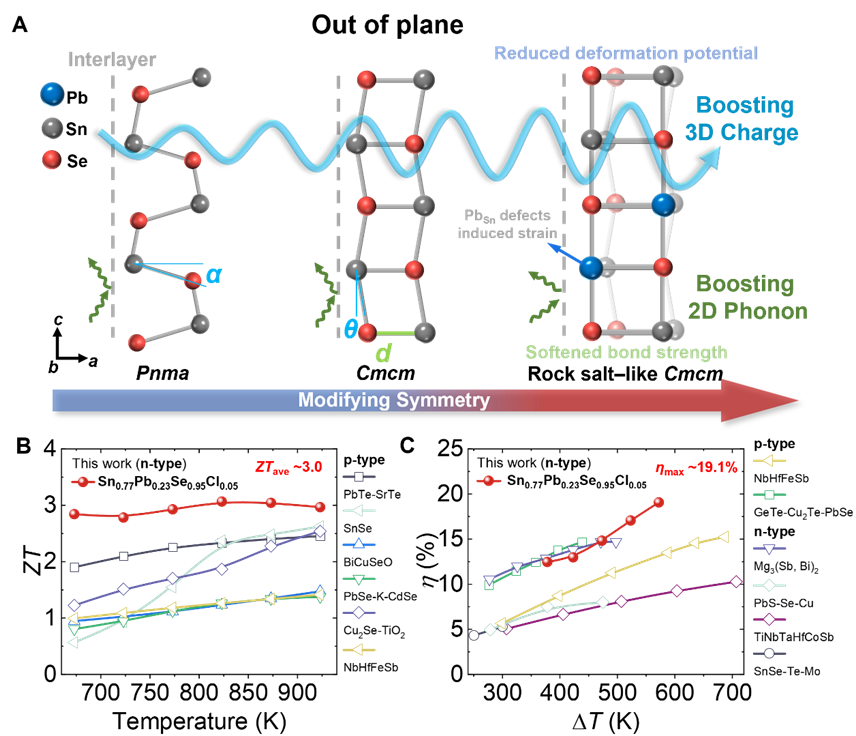
Figure Enhancing the lattice symmetry intensity 2D phonon/3D charge transports of n-type SnSe crystals (A), achieving obviously optimization of wide-temperature-range thermoelectric performance (B) and single-leg power generation efficiency (C).
Supported by projects such as the National Natural Science Foundation of Young Scientist Fund (Category A Renewal Funding) (Grant No. 52525101) and other programs, Professor Zhao Li-dong’s team from Beihang University has achieved breakthrough progress in the field of thermoelectric materials and devices. Professor Su Lizhong's team from Taiyuan University of Science and Technology collaborates in this work. Their study, titled “Extending the temperature range of the Cmcm phase of SnSe for high thermoelectric performance,” were published in the prestigious journal Science on December 19, 2025. The paper can be accessed via: https://www.science.org/doi/10.1126/science.adt0831.
Energy serves as a fundamental material basis for human society and social development. However, more than 50% of energy is consumption results in loss as waste heat. Recovering this thermal energy and converting it into electricity would have profound implications. Thermoelectric technology enables direct conversion between thermal and electrical energy—utilizing the Seebeck effect for power generation from temperature differences and the Peltier effect for refrigeration. It holds enormous potential for applications in critical fields such as power supplies for deep-space exploration and thermal management of integrated circuits. The conversion efficiency of thermoelectric materials is primarily determined by the dimensionless figure of merit ZT=(S2σ/κ) T. At a given temperature T, high-performance thermoelectric materials should possess a large Seebeck coefficient S (to generate a large thermoelectric voltage), high electrical conductivity σ (to reduce Joule heating losses), and low thermal conductivity κ (to maintain a large temperature difference). However, the intrinsic coupling among these thermoelectric parameters limits the enhancement of ZT.
Tin selenide (SnSe) is a layered materials with low-symmetry crystal structure, showing large potential in phonon-electron decoupling. SnSe undergoes a phase transition from the Pnma phase to the Cmcm phase at ~800 K. While previous research has predominantly focused on Pnma-phase SnSe crystals, the thermoelectric potential of the more symmetric Cmcm phase remains unexplored. Moreover, studies on thermoelectric devices based on the out-of-plane direction of n-type SnSe crystals remain scarce. This study focused on n-type–Cmcm SnSe crystals, broadening the temperature stability range of the Cmcm phase by sufficiently alloying a high-symmetry phase (cubic PbSe). Concurrently, the enhanced local lattice symmetry of the n-type–Cmcm SnSe crystals substantially strengthens the "2D phonon/3D charge" transports: 1) Enhanced lattice symmetry reduces the deformation potential, optimizing the carrier mobility (μH) in the high-temperature Cmcm phase despite a considerable increase of the density-of-states effective mass (md*) and carrier concentration (nH), strengthening the 3D charge transport; 2) Concomitant bond softening suppresses lattice thermal conductivity, intensifying the 2D phonon scattering of n-type-Cmcm SnSe crystals (Figure A). As a result, an exceptional average ZT of ~3.0 is achieved over a broad temperature range from 673 K to 923 K (Figure B). Furthermore, this team developed a thermoelectric device based on the n-type SnSe crystal to demonstrate the outstanding potential of n-type SnSe crystals. A single-leg device achieved a power-generation efficiency of ~19.1% at a temperature difference of 572 K (Figure C). This study not only reveals the great potential of n-type SnSe crystals in thermoelectric power generation, but also provides new strategy for optimizing the performance of other low-symmetry thermoelectric material systems.
Contact Us

National Natural Science Foundation of China
Add: 83 Shuangqing Rd., Haidian District, Beijing, China
Postcode: 100085
Tel: 86-10-62327001
Fax: 86-10-62327004
E-mail: bic@nsfc.gov.cn