
Chinese Researchers Make Progress in High-Performance Electrically Driven Artificial Muscles
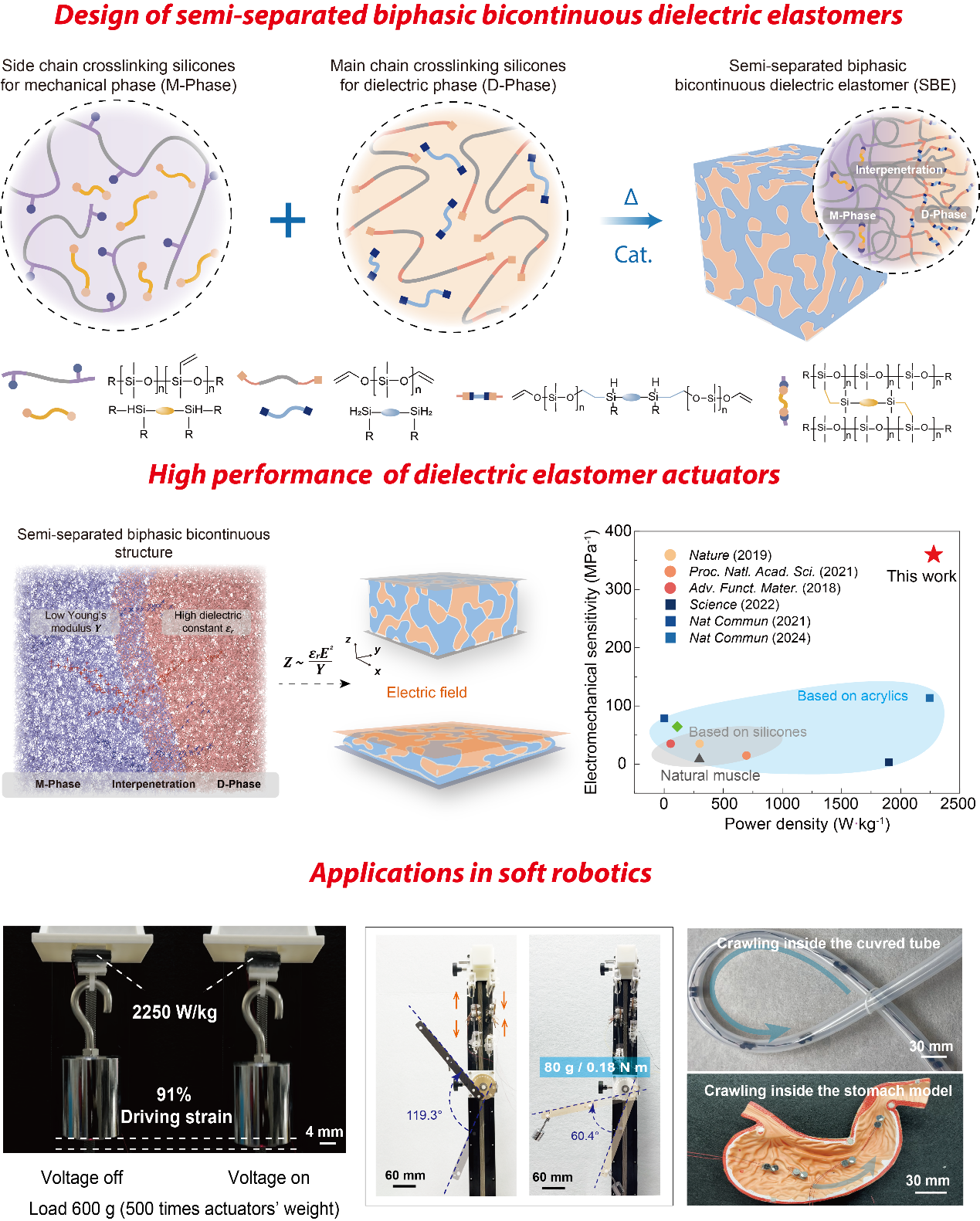
Figure. Material design of the biphasic bicontinuous dielectric elastomer and its applications in soft robotics.
Supported by the National Natural Science Foundation of China (Grant Nos. 52025057, 91948302 and 52275024), the team led by Prof. Xiangyang Zhu and Prof. Guoying Gu from the Institute of Robotics at School of Mechanical Engineering, Shanghai Jiao Tong University, in collaboration with Prof. Baoyang Lu from Jiangxi Science & Technology Normal University, has made new progress in designing high-performance dielectric elastomer artificial muscles. Their work, titled “Semiseparated biphasic bicontinuous dielectric elastomer for high-performance artificial muscle,” was published online in Science on December 5, 2025. (Paper link: https://www.science.org/doi/10.1126/science.adr3521). PhD candidate Xiaotian Shi and Associate Professor Jiang Zou from Shanghai Jiao Tong University are co-first authors.
Developing high-performance electrically driven artificial muscles has long been a major challenge in soft robotics, haptic interaction, and intelligent prosthetics. The output performance of conventional dielectric elastomer materials under low electric fields has been constrained for years by their limited electromechanical sensitivity.
The research team proposed an “hetero-crosslinking-induced phase separation” strategy and developed a semi-separated biphasic bicontinuous dielectric elastomer (SBE), raising the electromechanical sensitivity to 360 MPa⁻¹. This strategy utilizes varying crosslinking mechanisms applied to two commercial silicone elastomers (i.e., Sylgard 170 and Elastosil P7676) to form an interconnected dielectric phase (D-Phase) within a very soft mechanical phase (M-Phase). The D-Phase of Sylgard 170 (with a high relative dielectric constant of ~3.9) is synthesized by high-density main chain crosslinking of telechelic vinyl functionalized polydimethylsiloxane with a multi-hydrosilane (Si–H) functionalized cross-linker. At the same time, the M-Phase of Elastosil P7676 (with an ultralow Young’s modulus of ~8 kPa) is achieved by low-density side chain crosslinking of bottle-brush polydimethylsiloxane via hydrosilylation in the presence of a commercial platinum catalyst. They produce a biphasic structure with interpenetrating and interface-fused domains. This microstructure preserves the material’s low Young’s modulus while simultaneously enhancing its dielectric constant and dielectric breakdown strength. Experiments show that an SBE material containing only 10% D-phase has a Young’s modulus of about 10 kPa and a relative permittivity of 3.6, achieving high electromechanical sensitivity. Artificial muscles fabricated from this material reached 90% areal strain at an electric field of 35 V/μm, without any pre-stretch.
Based on this material, the team developed high-performance pure-shear artificial muscles. Under low electric-field actuation, muscles with different compositions exhibited excellent strain output: they generated over 50% linear strain without prestretch, achieved a strain rate of 400%/s, and reached an energy density of 375 J/kg, demonstrating the benefits of the biphasic architecture in enhancing overall performance. Furthermore, the researchers fabricated stacked and rolled artificial muscle. The stacked artificial muscle achieved a blocking stress of 21.76 kPa and a power density of 2250 W/kg at high frequency. A stacked artificial muscle weighing 1.2 g was able to perform reciprocating motion while lifting a 300 g load, achieving 91% linear strain. To demonstrate application potential, the team developed a humanoid robotic arm driven by four SBE artificial muscles, providing a 119.3° range of motion and 0.24 N·m torque output. In addition, a multimodal soft crawling robot driven by the muscles reached a speed of 22 body lengths per second at 300 Hz; simply adjusting the phase difference between front and rear muscles enabled forward and backward locomotion. The robot could also traverse unstructured environments such as curved pipelines and a complex stomach model.
Through material design, device development, and soft-robotic applications, this work demonstrates breakthroughs in the electromechanical sensitivity, output force, power density, and durability of dielectric elastomer artificial muscles. It offers a new technological pathway for developing next-generation, high-performance, electrically driven soft robots.
Contact Us

National Natural Science Foundation of China
Add: 83 Shuangqing Rd., Haidian District, Beijing, China
Postcode: 100085
Tel: 86-10-62327001
Fax: 86-10-62327004
E-mail: bic@nsfc.gov.cn