
Chinese Scientists Achieve Entanglement-Enhanced Nanoscale Single-Spin Quantum Sensing
Supported by the National Natural Science Foundation of China (Grant Nos. T2325023, T2388102, 92265204, T2125011, 12474500, 12504570, 12504594, 12261160569), a researcher team from the Laboratory of Spin Magnetic Resonance at the University of Science and Technology of China, led by Professor Wang Ya, in collaboration with the State Key Laboratory of Ocean Sensing at Zhejiang University, have, for the first time, realized entanglement-enhanced nanoscale single-spin detection under noisy environments. The related results, entitled “Entanglement-enhanced nanoscale single-spin sensing”, were published in Nature on November 27, 2025. Link to paper.
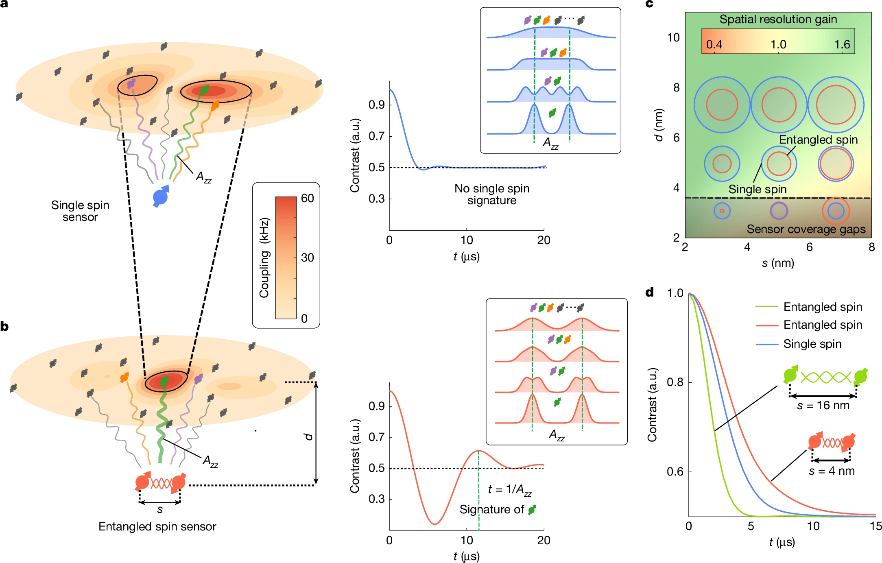
Figure: Schematic diagram of an entangled nanoscale sensor based on spin sensing.
In the microscopic world, the “spin” of electrons is one of their fundamental properties, akin to tiny magnetic needles. Many macroscopic material properties, such as the magnetism of magnets or the zero resistance of superconductors, originate from the arrangement and interaction of these microscopic “needles.” Diamond nitrogen-vacancy (NV) center quantum sensors are a key technology for achieving single-spin detection. With advances in high-precision spin quantum control and the development of core devices and equipment for diamond quantum sensing, researchers have been able to identify single spins with special “labels.” However, how to stably capture the weak signals of arbitrary single spins in complex noisy environments has remained unresolved, posing higher demands on both sensitivity and spatial resolution. In theory, quantum entanglement offers a possible route to overcome this bottleneck, pushing detection precision toward the ultimate limits allowed by quantum mechanics. Although some preliminary proof-of-principle demonstrations exist, achieving effective “entanglement enhancement” has faced major technical challenges in both system preparation and control.
Through coordinated innovation in material preparation and quantum control, the research team has, for the first time, developed entanglement-enhanced nanoscale single-spin sensing technology, simultaneously improving in sensitivity and spatial resolution for detecting microscopic magnetic signals in solid-state systems. Using independently developed techniques for ultra-pure diamond growth and nanoscale precision doping, they fabricated NV center pairs with spacing as small as 5 nm and engineered them into special entangled quantum states. This approach effectively resolved the long-standing conflict between signal amplification and noise interference, enhancing spatial resolution by 1.6 times. The method achieved three breakthroughs: successfully distinguishing and detecting adjacent “dark” electron spins; improving detection sensitivity in noisy environments to 3.4 times that of a single sensor; and enabling real-time monitoring and active control of unstable spin signals. These advances open new pathways for nanoscale quantum precision measurement.
Contact Us

National Natural Science Foundation of China
Add: 83 Shuangqing Rd., Haidian District, Beijing, China
Postcode: 100085
Tel: 86-10-62327001
Fax: 86-10-62327004
E-mail: bic@nsfc.gov.cn