
Chinese Scientists Achieve and Detect Higher-Order Nonequilibrium Topological Phases in Quantum Systems
Supported by the National Natural Science Foundation of China (Grant Nos. T2322024, 12474495, 12474361, 12034012, 12074234, 92476203), a team led by Jian-Wei Pan at the University of Science and Technology of China, in collaboration with the Institute of Laser Spectroscopy at Shanxi University, has for the first time realized and detected higher-order nonequilibrium topological phases in quantum systems using the programmable superconducting quantum processor “Zuchongzhi 2.0.” The results, titled “Programmable Higher-Order Nonequilibrium Topological Phases on a Superconducting Quantum Processor”, were published in Science on November 28, 2025. Link to paper.
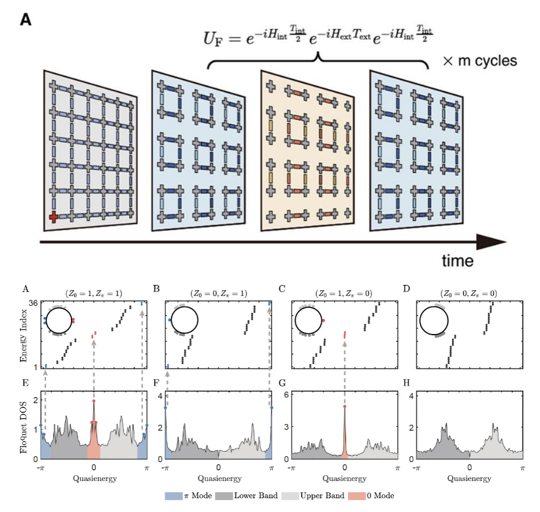
Figure: The experiment was performed on a 6x6 two-dimensional qubit array with periodic driving, enabling the observation of quasi-energy spectrum features of non-equilibrium second-order topological states, in agreement with theoretical predictions.
In recent years, higher-order topological phases have become a frontier in condensed matter physics and quantum simulation. These phases are characterized by localized states appearing at on lower-dimensional boundaries, challenging the conventional bulk–boundary correspondence. Although such phases have been experimentally realized in classical metamaterials, realizing them in quantum systems has remained an international challenge. Meanwhile, research on topological states has expanded from equilibrium to nonequilibrium systems, revealing unique phenomena such as topological pumping, dynamical phase transitions, and π-energy boundary modes. These discoveries highlight the profound connection between topology and dynamics, offering new possibilities for robust manipulation of quantum states. However, the experimental realization of two-dimensional nonequilibrium higher-order topological phases has long been hindered by challenges in engineering suitable Hamiltonians and developing effective detection methods.
In this study, the team leveraged the programmability of the “Zuchongzhi 2.0” superconducting quantum processor to experimentally realize and probe both equilibrium and nonequilibrium second-order topological phases. Theoretically, they proposed static and Floquet quantum circuit designs tailored for higher-order topological phases, addressing key challenges in constructing higher-order equilibrium and nonequilibrium Hamiltonians in two-dimensional superconducting qubit arrays, and developed a general framework for dynamical topological measurements. Experimentally, through systematic processor optimization and precise calibration, they achieved dynamic control of qubit frequencies and coupling strengths. On a 6×6 qubit array, they successfully executed up to 50 Floquet cycles of evolution, realizing four distinct types of nonequilibrium second-order topological phases and systematically exploring their spectra, dynamical behavior, and topological invariants. This work represents a significant advancement in programmable two-dimensional quantum simulation capabilities.
Contact Us

National Natural Science Foundation of China
Add: 83 Shuangqing Rd., Haidian District, Beijing, China
Postcode: 100085
Tel: 86-10-62327001
Fax: 86-10-62327004
E-mail: bic@nsfc.gov.cn