
Chinese Researchers Make Breakthrough in Efficient Electroluminescence of Insulating Lanthanide Nanocrystals
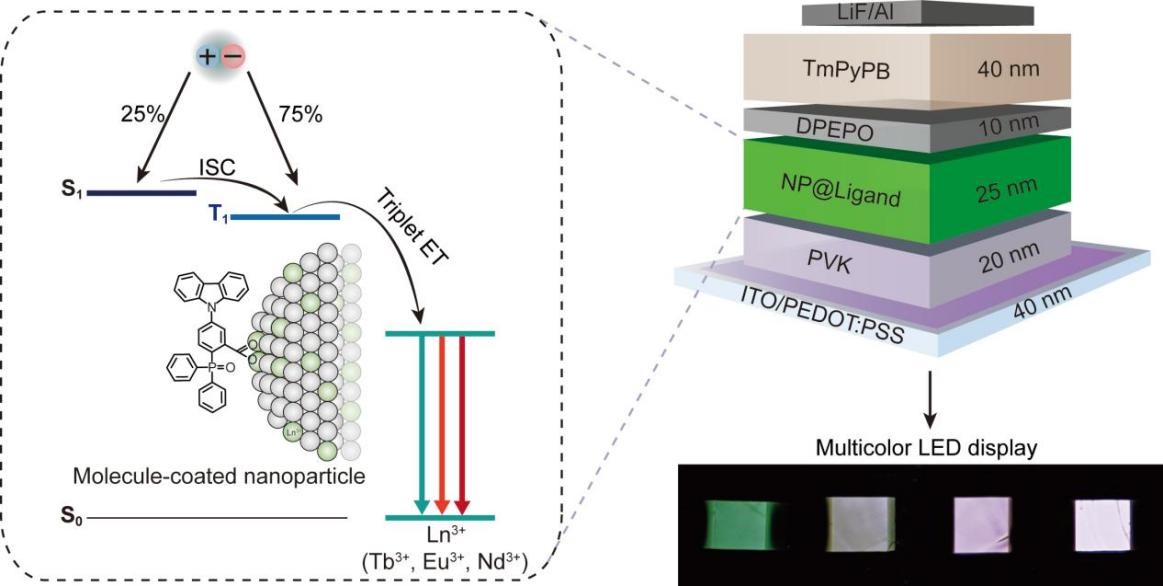
Figure: Schematic diagram of the mechanism for achieving electroluminescence via sensitization of lanthanide nanocrystals with organic semiconductor ligands.
Supported by the National Natural Science Foundation of China (Grant No. 22325502) and other funding sources, a research team led by Professors Xu Hui and Han Chunmiao from the School of Chemistry and Materials Science and Engineering at Heilongjiang University, in collaboration with Associate Professor Han Sanyang from Tsinghua Shenzhen International Graduate School and Academician Liu Xiaogang from the Department of Chemistry at the National University of Singapore, has achieved significant progress in the field of lanthanide nanocrystal electroluminescence (EL). The related research findings were published online in Nature on November 19, 2025, under the title "Electro-generated excitons for tunable lanthanide electroluminescence" The paper is available at: https://www.nature.com/articles/s41586-025-09717-1.
Lanthanide-doped nanocrystals are regarded as ideal optical materials due to their narrow-band emission, high color purity, and excellent stability. However, their intrinsic insulating nature hinders efficient charge injection, severely limiting their application in optoelectronic devices and presenting a major scientific bottleneck in the field.
To address this challenge, the research team innovatively designed and synthesized a series of arylphosphine oxide carboxylic acid ligands. By strengthening coordination interactions and precisely regulating the energy-level alignment of the organic-inorganic hybrid system, they constructed an efficient multi-channel energy transfer pathway. This strategy utilizes the organic ligands to capture electro-generated excitons, which then undergo ultrafast intersystem crossing (<1 ns) to form triplet excitons. These excitons are efficiently transferred to the lanthanide luminescent centers within the nanocrystals, achieving a triplet energy transfer efficiency as high as 96.7%. This approach cleverly circumvents the inherent limitations of traditional charge injection pathways.
Based on this strategy, the constructed green EL device achieved an external quantum efficiency (EQE) of 5.9%, representing a 76-fold improvement compared to non-functionalized devices, with an exciton utilization efficiency reaching 88%. Notably, by adjusting the doping composition and concentration of rare-earth ions in the nanocrystals, continuous and precise tuning of the emission spectrum, from green and warm white to near-infrared, was achieved without modifying the device architecture or surface ligands. This approach demonstrates excellent versatility and application flexibility.
This research lays a foundational framework for the development of low-cost, wide-color-gamut ultra-high-definition display technologies, as well as advanced optoelectronic devices for near-infrared communication and bioimaging applications.
Contact Us

National Natural Science Foundation of China
Add: 83 Shuangqing Rd., Haidian District, Beijing, China
Postcode: 100085
Tel: 86-10-62327001
Fax: 86-10-62327004
E-mail: bic@nsfc.gov.cn