
Chinese Research Team Achieved 96 K High-Temperature Superconductivity in Nickelate Single Crystals under Pressure
Supported by the National Natural Science Foundation of China (Grant Nos. 12074219, 12374457, 12374142, 12304170, 12025408, 12274062, 12304030, U23A6003), a joint research team consisting of Prof. Zhang Junjie and Prof. Tao Xutang at Shandong University, Prof. Zeng Qiaoshi and Dr. Peng Di at the Center for High Pressure Science and Technology Advanced Research, Prof. Zhou Rui at the Institute of Physics, Chinese Academy of Sciences, and Prof. Zheng Qiang at the National Center for Nanoscience and Technology has eliminated the long-standing reliance on high-pressure synthesis and achieved a new record of 96 K for nickelate high-temperature superconductivity. The work entitled “Bulk superconductivity up to 96 K in pressurized nickelate single crystals” has published in Nature on December 2, 2025, and are available at https://www.nature.com/articles/s41586-025-09954-4.
Since the discovery of superconductivity in 1911, the quest for materials with increasingly higher critical temperatures (Tc) has remained a central frontier in condensed-matter physics. Nickelates (nickel oxides), a new class of high-temperature superconductors discovered in 2019, have rapidly risen to prominence in the research community. Until now, the highest Tc reported in nickelate superconductors had plateaued at around 80 K. Designing and synthesizing nickelates with higher Tc therefore represents a fundamental scientific challenge and a major barrier to advancing the field.
Within the bilayer R₃Ni₂O₇ (R = rare-earth elements) family, only the La-based compound has previously been synthesized. Even then, La₃Ni₂O₇ single crystals can only be grown using the high-pressure floating-zone method, which often leads to issues such as chemical inhomogeneity, oxygen vacancies, and impurity phases, such as the single-layer/triple-layer hybrid Ruddlesden–Popper phase—factors that known to degrade superconducting performance. This makes the development of a new, efficient single-crystal growth technique a pressing need.
To address this challenge, the research team introduced an innovative ambient-pressure flux method that eliminates reliance on high-pressure synthesis and significantly reduces fabrication costs. Using this method, they successfully achieved controlled growth of high-quality La₃₋ₓRₓNi₂O₇₋δ (R = La, Pr–Er) single crystals. Remarkably, the team found that La₂SmNi₂O₇₋δ single crystals exhibit a Tc of 92 K under high pressure, surpassing all previously reported values for nickelate superconductors. Based on this, they proposed a new chemical-stress tuning strategy that further enhanced Tc to 96 K. This approach offers a practical and generalizable pathway toward synthesizing nickelate superconductors with even higher transition temperatures.
Historically, realizing bulk superconductivity in nickelates required two forms of “high pressure”: high-pressure crystal growth and high-pressure measurements. This study marks a major breakthrough by overcoming the reliance on high-pressure environments for crystal synthesis, enabling the growth of high-quality single crystals at ambient conditions. Meanwhile, through the application of a chemical stress engineering, the team established a new Tc record of 96 K. Together, these advances not only provide an efficient and scalable route for enhancing nickelate superconductivity, but also open up promising avenues for unraveling the long-standing mystery of high-temperature superconductivity mechanisms.
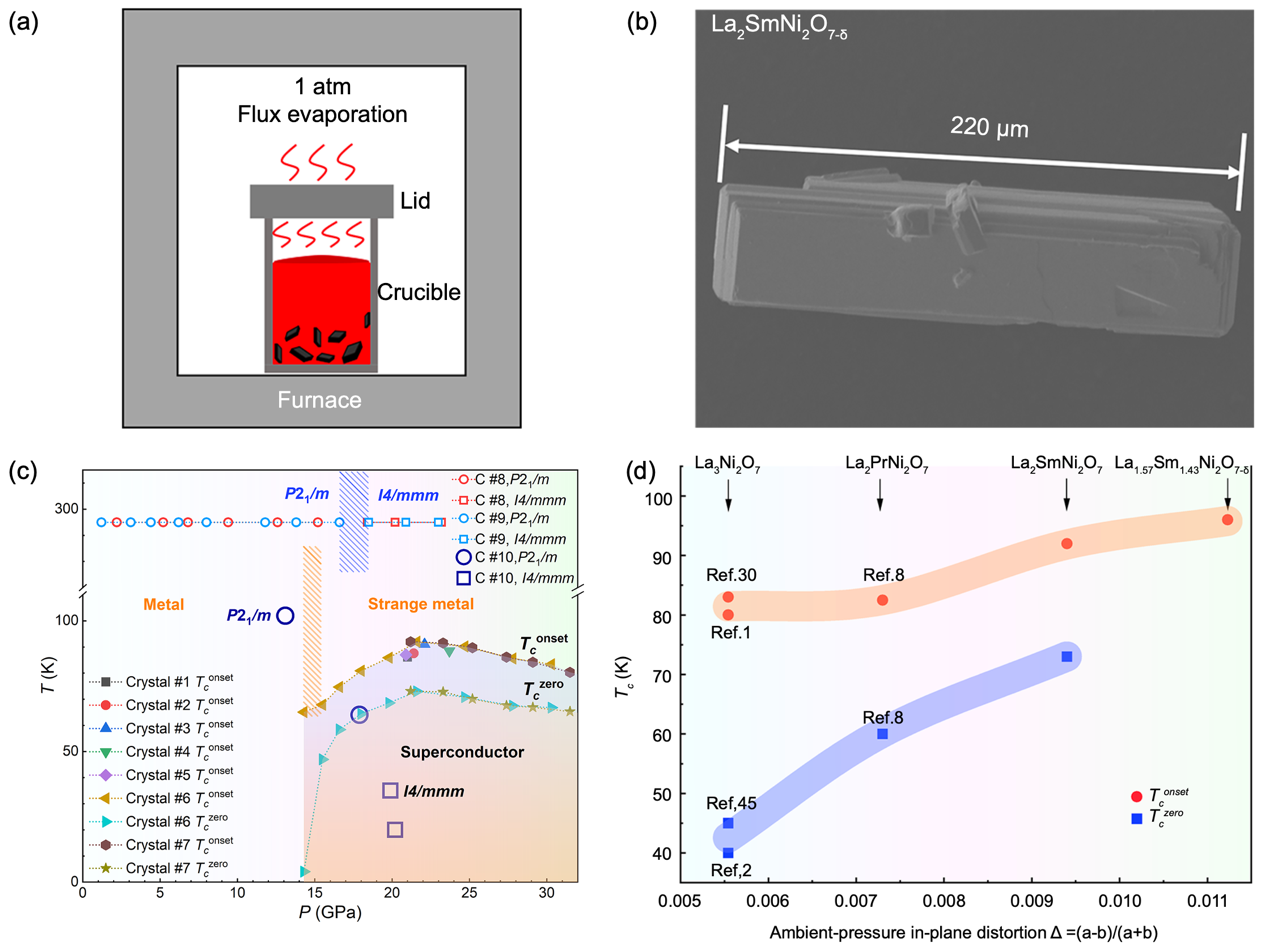
Figure: (a) Schematic of ambient-pressure single-crystal growth; (b) A typical single crystal grown at ambient pressure; (c) Temperature–pressure phase diagram of La2SmNi2O7-δ; (d) Chemical-stress tuning strategy for Tc enhancement. Note: See full article for Refs. 1, 2, 8, 30, 45.
Contact Us

National Natural Science Foundation of China
Add: 83 Shuangqing Rd., Haidian District, Beijing, China
Postcode: 100085
Tel: 86-10-62327001
Fax: 86-10-62327004
E-mail: bic@nsfc.gov.cn