
Chinese Scientists Make Progress in Fluorescence Lifetime Multiplexed Imaging
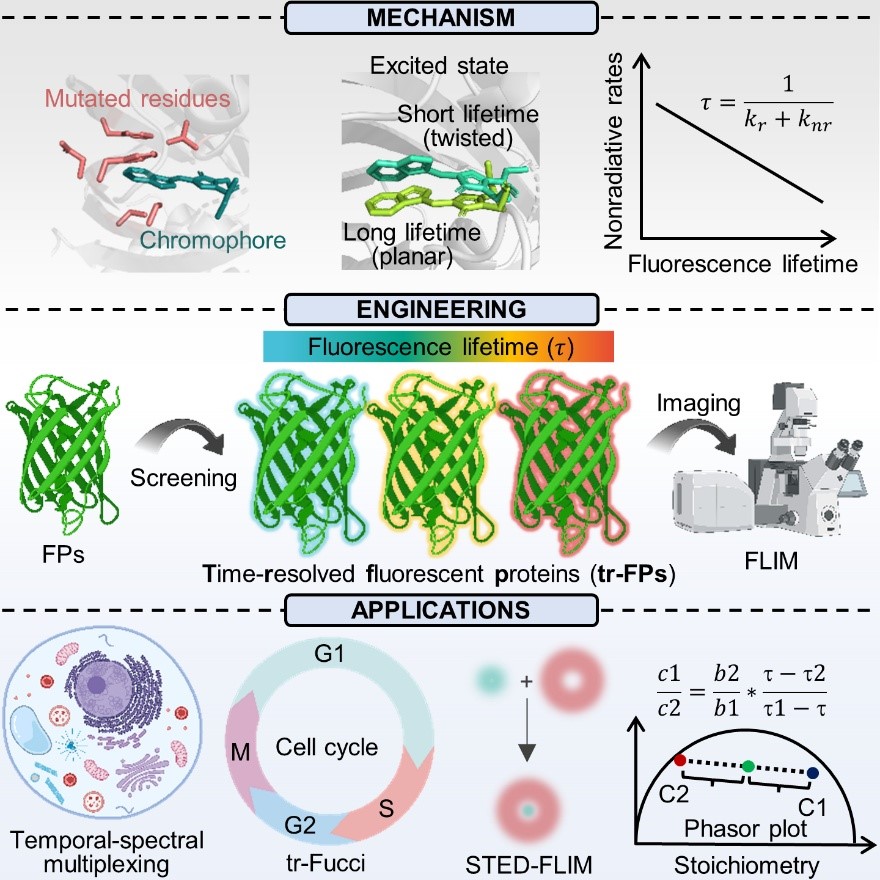
Figure. Regulation Mechanisms of Fluorescence Lifetime in tr-FPs and Their Applications in Multiplexed Imaging
Supported by the National Natural Science Foundation of China (Grant Nos. 22494700, 22477102, 82273257, 32450793, 22222410, 22374148), the research team led by Xin Zhang from Westlake University repots a significant breakthrough in the field of fluorescent imaging. Their findings were published in Cell on November 26, 2025, titled "Time-resolved fluorescent proteins expand fluorescent microscopy in temporal and spectral domains", and the paper can be accessed at https://www.cell.com/cell/fulltext/S0092-8674(25)01027-X. The study developed a novel class of time-resolved fluorescent proteins (tr-FPs) by elucidating and regulating fluorescence-lifetime mechanisms, thereby overcoming a key bottleneck in multiplexed live-cell imaging and providing a powerful new imaging tool.
Fluorescence microscopy is an essential tool in life-science research. Intensity-based (steady-state) imaging is the most commonly used detection mode, whereas lifetime-based (time-resolved) imaging has been comparatively underexplored. Fluorescent proteins (FPs), developed and engineered since the mid-1990s, have become indispensable labels for studying subcellular events and biological functions. Despite a rich spectral palette and many biosensor variants, FP-based multiplexing remains constrained by spectral overlaps; traditional spectral unmixing can suffer severe crosstalk when attempting to detect six targets simultaneously.
The time-resolved dimension–fluorescence lifetime–is orthogonal to intensity and not limited by spectral bandwidth. By exploiting lifetime as an additional axis, the authors demonstrate multiplexed imaging of nine distinct proteins in live cells, complementing spectral separation with temporal resolution. The team also introduced tr-FPs into fluorescent ubiquitination-based cell cycle indicator (Fucci) system, creating time-resolved Fucci (tr-Fucci) in which a single spectral channel can monitor all cell-cycle phases. They further show lifetime-based super-resolution microscopy visualizing four proteins simultaneously (spatial resolution down to 50 nm ´ 50 nm for tubulin) and quantification of cellular protein stoichiometry, highlighting the power of lifetime readouts alongside spectra.
In this work, the team successfully engineered a novel family of time-resolved fluorescent proteins (tr-FPs) spanning the visible range (383–627 nm), with programmable fluorescence lifetimes on the order of ~1–5 ns, while preserving spectral color. Guided by molecular-level insights, the team revealed that mutations of amino acids surrounding the chromophore modulate excited-state conformations and nonradiative decay rates, thereby controlling lifetime without substantially shifting spectra. These tr-FPs enabled complex, live-cell multiplexing (including cell-cycle-linked readouts) and can be integrated with super-resolution and quantitative analyses, offering a broadly applicable toolkit to bring unprecedented research opportunities to life sciences by enhancing quantitative precision.
Contact Us

National Natural Science Foundation of China
Add: 83 Shuangqing Rd., Haidian District, Beijing, China
Postcode: 100085
Tel: 86-10-62327001
Fax: 86-10-62327004
E-mail: bic@nsfc.gov.cn