
Chinese researchers and oversea collaborators advance understanding of global hydroclimatic risks and decommissioning pathways for thermal power units
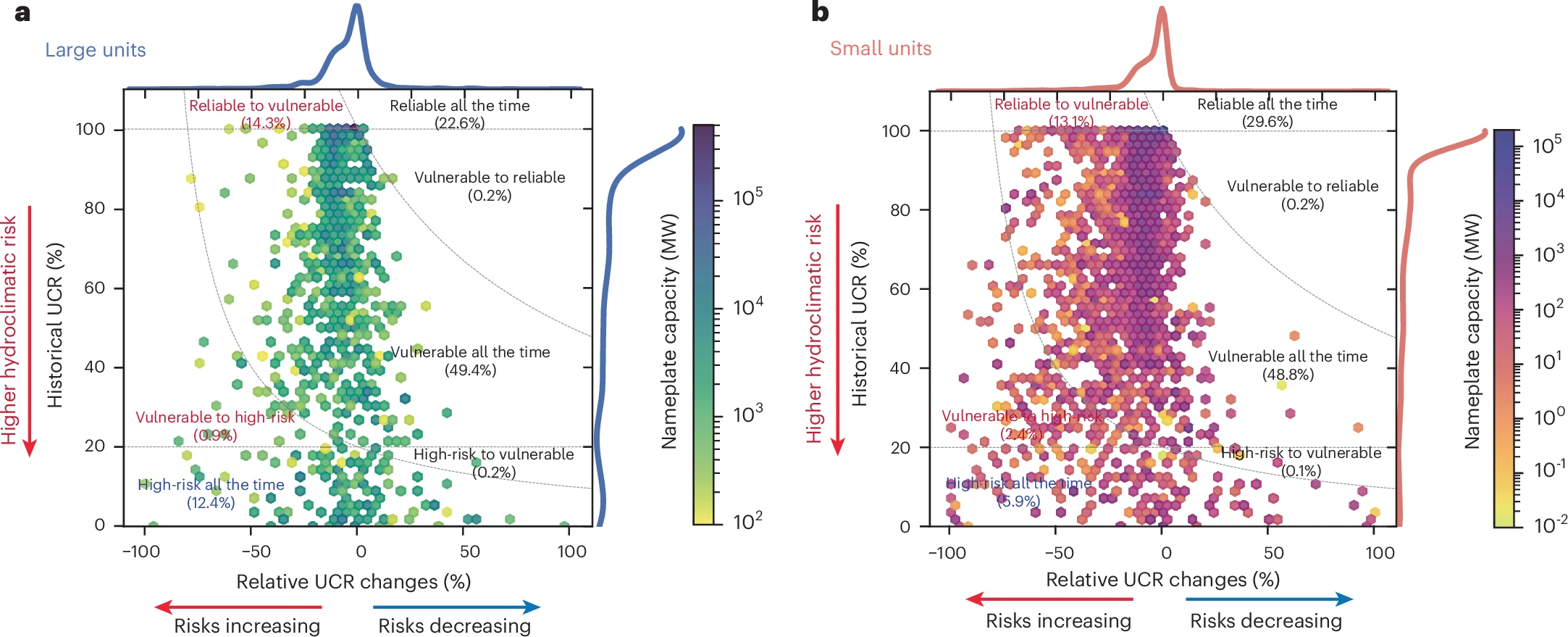
Figure. Climate-induced hydroclimatic risks diffusion for thermal power units
With support from the National Natural Science Foundation of China (Grant Nos. 42361144876, 42471021, and 42277482), the research team led by Prof. Yue Qin at Peking University, in collaboration with multiple domestic and international research groups, has made significant progress in the study of global hydroclimatic risks to thermal power units and low-carbon transition strategies. The research findings, titled “Global hydroclimatic risks and strategic decommissioning pathways for thermal power units,” were published online in Nature Sustainability on December 9, 2025 (https://doi.org/10.1038/s41893-025-01692-9). A policy brief was released simultaneously: https://www.nature.com/articles/s41893-025-01711-9.
Thermal power generation remains the backbone of the global electricity supply, supplying approximately 60-70% of electricity demand in China and worldwide. During the transition toward a low-carbon energy system, thermal power will continue to play a critical role in providing baseload and peaking capacity, serving as a strategic “backstop” for energy security. However, compound water stresses induced by climate change, such as water scarcity, rising water temperatures, and intensified conflicts over environmental flows, can undermine cooling efficiency and reduce the available generation capacity of thermal power units, posing potential challenges to energy security.
By developing a unit-level hydroclimatic risk simulation and low-carbon decommissioning model that integrates physical processes modeling with machine learning approaches (E-Risks), the research team systematically reveals the mechanisms and spatiotemporal evolution of hydroclimatic risks faced by thermal power units under the dual pressures of climate change and the low-carbon transition. The study finds that incorporating hydroclimatic constraints into decommissioning planning can substantially increase the average available capacity factor of retained operating units during the transition period by 26-37%, thereby effectively enhancing power-system climate resilience. By identifying mismatches between unit-level hydroclimatic risks and existing decommissioning strategies, this research provides critical scientific evidence for coordinating low-carbon energy transition pathways under constraints of water resources and rising water temperatures, and offers important decision support for simultaneously safeguarding energy security while promoting climate mitigation.
Contact Us

National Natural Science Foundation of China
Add: 83 Shuangqing Rd., Haidian District, Beijing, China
Postcode: 100085
Tel: 86-10-62327001
Fax: 86-10-62327004
E-mail: bic@nsfc.gov.cn