
Chinese Scientists and Overseas Collaborators Make Breakthrough in Experimental Particle Physics
Supported by the National Natural Science Foundation of China (Grant Nos.11925504, 12061141007, 12188102), a research team led by Professor Yuanning Gao from the School of Physics at Peking University, in collaboration with domestic and international scientists, has measured a violation of charge conjugation–parity (CP) symmetry, or CP violation, for the first time in baryons at the Large Hadron Collider beauty (LHCb) experiment at the European Organization for Nuclear Research (CERN). Their latest study, under the title “Observation of charge-parity symmetry breaking in baryon decays,” were published online in the journal Nature on July 16, 2025. Link to full text: https://www.nature.com/articles/s41586-025-09119-3.
13.8 billion years ago, the Big Bang should have produced equal amount of matter and antimatter. The vast majority of which recombined and annihilated shortly afterwards. Today however, the universe appears to be made almost exclusively of matter with very little antimatter present. This excess of matter is not explained by the Standard Model, and the existence remains one of the biggest mysteries in the universe.
Since the proposal of parity violation in weak interactions by Tsung-Dao Lee and Chen-Ning Yang in 1956, numerous observations of CP violation have been made in mesonic systems. However, despite decades of experimental searches, CP violation has not been observed yet in the decays of baryons ─ particles made up of triplets of quarks, which are the building blocks of the everyday things around us.
Gao’s team, in close collaboration with theoretical physicists, conducted a comprehensive investigation into a series of bottom baryon decays highly sensitive to CP violation. Their analysis leveraged the vast dataset of proton-proton collisions recorded by the LHCb detector at the LHC. Among these decays, the process Λb0→pK-π+π- (and its antimatter counterpart, anti-Λb0→anti-pK+π-π+) was studied in-depth. Machine learning algorithms were employed to optimize the signal event selection while effectively suppressing background contributions. Systematic uncertainties were reduced significantly by measuring CP asymmetry relative to a well-controlled reference decay channel. The invariant mass distributions of Λb0 and anti-Λb0 baryons revealed a striking yield asymmetry between matter and antimatter - a direct manifestation of CP violation in Λb0 decays (see Figure).
This discovery opens a new path for testing the Standard Model and searching for new physics, shedding light into the CP-violation puzzle. It is a significant step in physicists’ quest to solve why there is something rather than nothing.
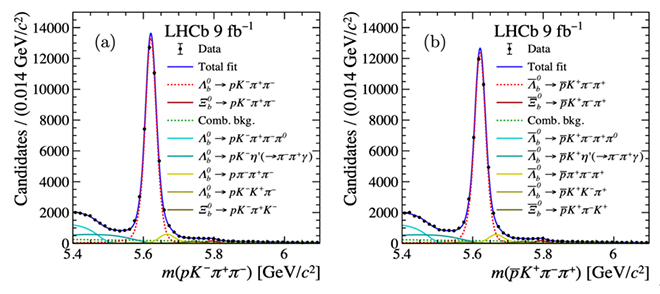
Figure. Mass distributions of Λb0 and anti-Λb0 decay products reveal a clear signature of CP violation, confirming the first-ever observation in baryons
Contact Us

National Natural Science Foundation of China
Add: 83 Shuangqing Rd., Haidian District, Beijing, China
Postcode: 100085
Tel: 86-10-62327001
Fax: 86-10-62327004
E-mail: bic@nsfc.gov.cn