
Chinese Scholars Discover Hyperbolic Phonon Polaritons on a Non-hyperbolic Crystal Surface
Supported by the National Natural Science Foundation of China (Grant Nos. 52172162, 52072349, 52402020), the research team led by Prof. Guogang Li and Prof. Zhigao Dai from China University of Geosciences (Wuhan), in collaboration with domestic and international partners, has made a significant breakthrough in the field of polaritonic nanophotonics. Their latest study, titled “Long-range hyperbolic polaritons on a non-hyperbolic crystal surface,” was published in Nature in July 17, 2025. (Full article link at https://www.nature.com/articles/s41586-025-09288-1).
Hyperbolic materials are regarded as essential platforms in nanophotonics due to their unique electromagnetic properties. Hyperbolic polaritons, which enable extreme light confinement at material surfaces, play a key role in frontier applications such as ultrasensitive sensing and super-resolution imaging. However, current research primarily relies on artificial hyperbolic metamaterials and naturally hyperbolic media—such as metal-dielectric multilayers, hexagonal boron nitride, and molybdenum trioxide—that exhibit hyperbolic behavior only within specific “hyperbolic frequency bands” (Reststrahlen bands). A major challenge in the field is whether hyperbolic polaritons can be excited and dynamically tuned within non-hyperbolic materials. To addresse this challenge, the research team from China University of Geosciences (Wuhan) employed rare-earth yttrium orthovanadate (YVO4) crystals as a platform, combining theoretical modeling, numerical simulation, and near-field optical imaging. For the first time, they discovered surface phonon polaritons with hyperbolic dispersion characteristics within a non-hyperbolic frequency range of the material.
By precisely tuning the temperature (150–300 K), the team observed a topological transition in polariton dispersion—from elliptical to collimated and ultimately to hyperbolic regimes—greatly expanding the tunable spectral range and candidate material pool for hyperbolic polaritons. Using scattering-type near-field optical microscopy (s-SNOM), they directly visualized the ray-like wavefronts of hyperbolic phonon polaritons propagating along the non-hyperbolic crystal surface at both room and cryogenic temperatures. These polaritons exhibited propagation lengths up to 59 microns—surpassing those in typical 2D polaritonic materials—and simultaneously featured low loss and long lifetimes, indicating strong application potential in the mid-infrared regime. Moreover, the tunability of these hyperbolic polaritons via temperature-induced dispersion engineering provides precise control over polariton wavelength and group velocity, enabling high-sensitivity and fast-response modulation functionalities.
This work fundamentally redefines the requirements for generating hyperbolic polaritons, demonstrating that neither hyperbolic dispersion nor hyperbolic crystal structure is a prerequisite. It substantially broadens the landscape of hyperbolic nanophotonics and overturns the long-standing assumption that hyperbolic polaritons must originate from inherently hyperbolic materials. The discovery establishes the novel concept of “hyperbolic polaritons in non-hyperbolic materials,” opening new physical avenues and engineering strategies for exploring light–matter interactions and advancing polariton-based device applications.
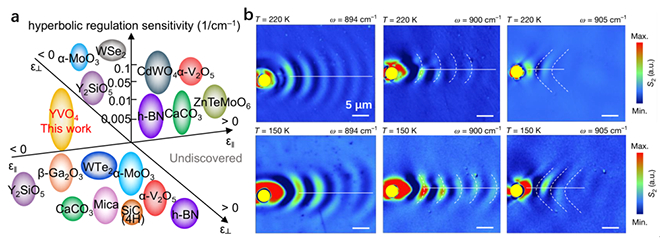
Figure. (a) Comparison of dielectric tensor sign distributions and hyperbolic bands in conventional hyperbolic materials versus YVO4 crystal. (b) Temperature-driven optical topological transition in YVO4 crystal enabling the evolution of polariton dispersion from elliptical to hyperbolic.
Contact Us

National Natural Science Foundation of China
Add: 83 Shuangqing Rd., Haidian District, Beijing, China
Postcode: 100085
Tel: 86-10-62327001
Fax: 86-10-62327004
E-mail: bic@nsfc.gov.cn