
Chinese scholars make new progress in understanding changes in global methane emissions and sinks
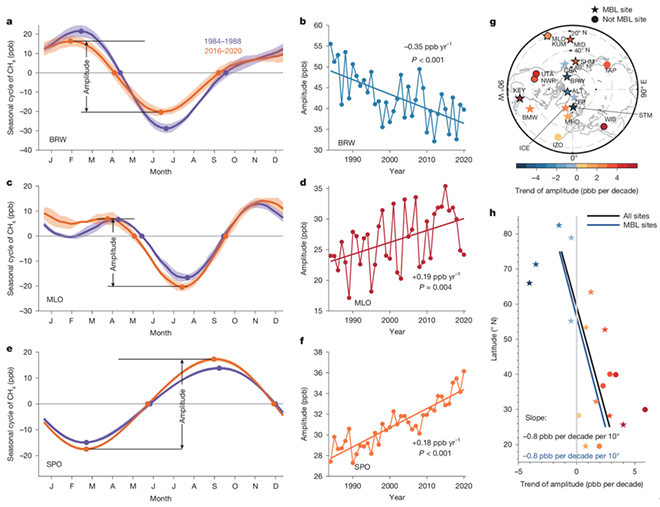
Figure. The long-term changes in seasonal amplitude of atmospheric methane concentrations
Supported by the National Natural Science Foundation of China (Youth Scientist Fund-A, Grant No. 42325102), the research team led by Professor Shushi Peng from Peking University, in collaboration with international partners, has achieved significant progress in understanding the changes in global methane emissions and sinks. This study, titled “Trends in the seasonal amplitude of atmospheric methane”, was published in Nature on May 15, 2025 (https://www.nature.com/articles/s41586-025-08900-8).
Methane, the second-largest contributor to global warming after carbon dioxide, has a high global warming potential and a short atmospheric lifetime. Therefore, effective methane mitigation is thus critical to addressing climate change. Under the context of global change, understanding long-term changes in methane sources (emissions) and sinks (removal processes) is essential for managing atmospheric methane concentrations.
By analyzing ground-based and aircraft observations of atmospheric methane concentrations and model simulations, Professor Peng’s team uncovered distinct regional trends. Since the 1980s, the weakening seasonal amplitude of methane concentrations over the high-latitude regions in the Northern Hemisphere is primarily driven by enhanced natural emissions (e.g., wetlands) due to climate warming. In contrast, the increasing seasonal amplitude in subtropical and tropical regions is attributed to strengthened atmospheric sinks (e.g., hydroxyl radical oxidation). These spatially divergent trends in seasonal amplitude of atmospheric methane concentrations provide critical observational evidence for deciphering the long-term evolution of methane sources and sinks.
This study offers fresh insights into the spatiotemporal dynamics of methane fluxes, laying a scientific foundation for refining methane emission inventories and optimizing climate policies. It also emphasizes the urgency of coordinated climate strategies. Under continued warming and air pollutant reduction scenarios (e.g., nitrogen oxides), even with controlled anthropogenic methane emissions, rising natural emissions in high-latitude regions and weakening sinks could drive further increases in atmospheric methane. To achieve the goals of the Paris Agreement, “additional” mitigation efforts beyond current commitments may be necessary. This study highlights the complex interplay between human activities, natural systems, and atmospheric chemistry in shaping methane trends—a crucial step toward net-zero targets.
Contact Us

National Natural Science Foundation of China
Add: 83 Shuangqing Rd., Haidian District, Beijing, China
Postcode: 100085
Tel: 86-10-62327001
Fax: 86-10-62327004
E-mail: bic@nsfc.gov.cn