
Chinese Researchers Make Progress in Asymmetric Photocatalysis
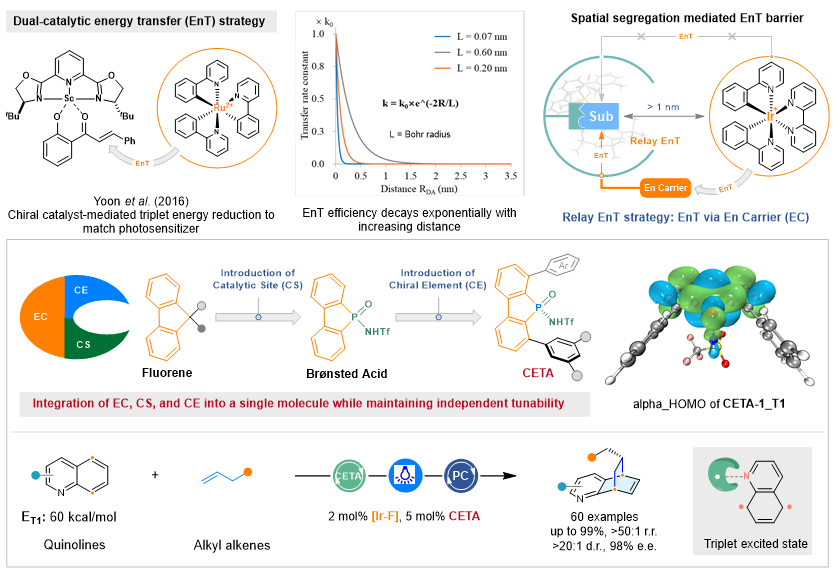
Figure. A relay energy transfer paradigm for asymmetric photocatalyzed [4+2] cycloadditions.
Supported by the National Natural Science Foundation of China (Grant Nos. 22425011, 22231004, 22371113, and 22271135), a research team led by Tan Bin at Southern University of Science and Technology has made progress in the field of asymmetric photocatalysis. Their work, titled “A relay energy transfer paradigm for asymmetric photocatalyzed [4+2] cycloadditions”, was published online in Science on May 22, 2026. The paper is available at: https://www.science.org/doi/10.1126/science.aeb8506.
Photocatalysts activate substrates primarily through two modes: single-electron transfer (SET) and energy transfer (EnT). While SET-based photoredox catalysis has greatly expanded the boundaries of synthetic chemistry, the application potential of EnT catalysis remains underexplored. In the field of asymmetric energy transfer photocatalysis, three strategies have been developed successively: the direct excitation strategy, the hybrid catalytic strategy, and the dual-catalytic strategy. Compared with the other two strategies, the dual-catalytic strategy combines the advantages of visible-light photocatalytic properties and freely tunable chiral environments. However, this mode encounters a spatial segregation-induced EnT barrier between the photosensitizer and the substrate, which fundamentally limits the efficiency of photocatalysis.
To overcome this challenge, the research team proposed a relay energy transfer catalytic strategy, which introduces energy carriers into the chiral catalyst scaffold to facilitate EnT from the photosensitizer to the substrate. Guided by this concept, the team developed a novel class of chiral energy transfer acid (CETA) catalysts capable of absorbing and delivering triplet energy up to 60 kcal/mol. The energy carrier on CETA catalysts serves as a bridge for EnT between the photosensitizer and the substrate while activating the substrate. CETA successfully enabled the asymmetric [4+2] cycloaddition of quinolines with alkenes, liberating this transformation from its dependence on stoichiometric amounts of catalysts. Furthermore, the side arms of CETA catalysts are readily tunable, allowing for efficient control over the regio- and stereoselectivity of the reaction. In addition to facilitating energy transfer, CETA significantly extends the excited-state lifetime of the substrate through energy exchange, thereby enhancing the reaction efficiency.
Contact Us

National Natural Science Foundation of China
Add: 83 Shuangqing Rd., Haidian District, Beijing, China
Postcode: 100085
Tel: 86-10-62327001
Fax: 86-10-62327004
E-mail: bic@nsfc.gov.cn