
Chinese Researchers Achieve Breakthrough in Neural Regulation of Skin Aging
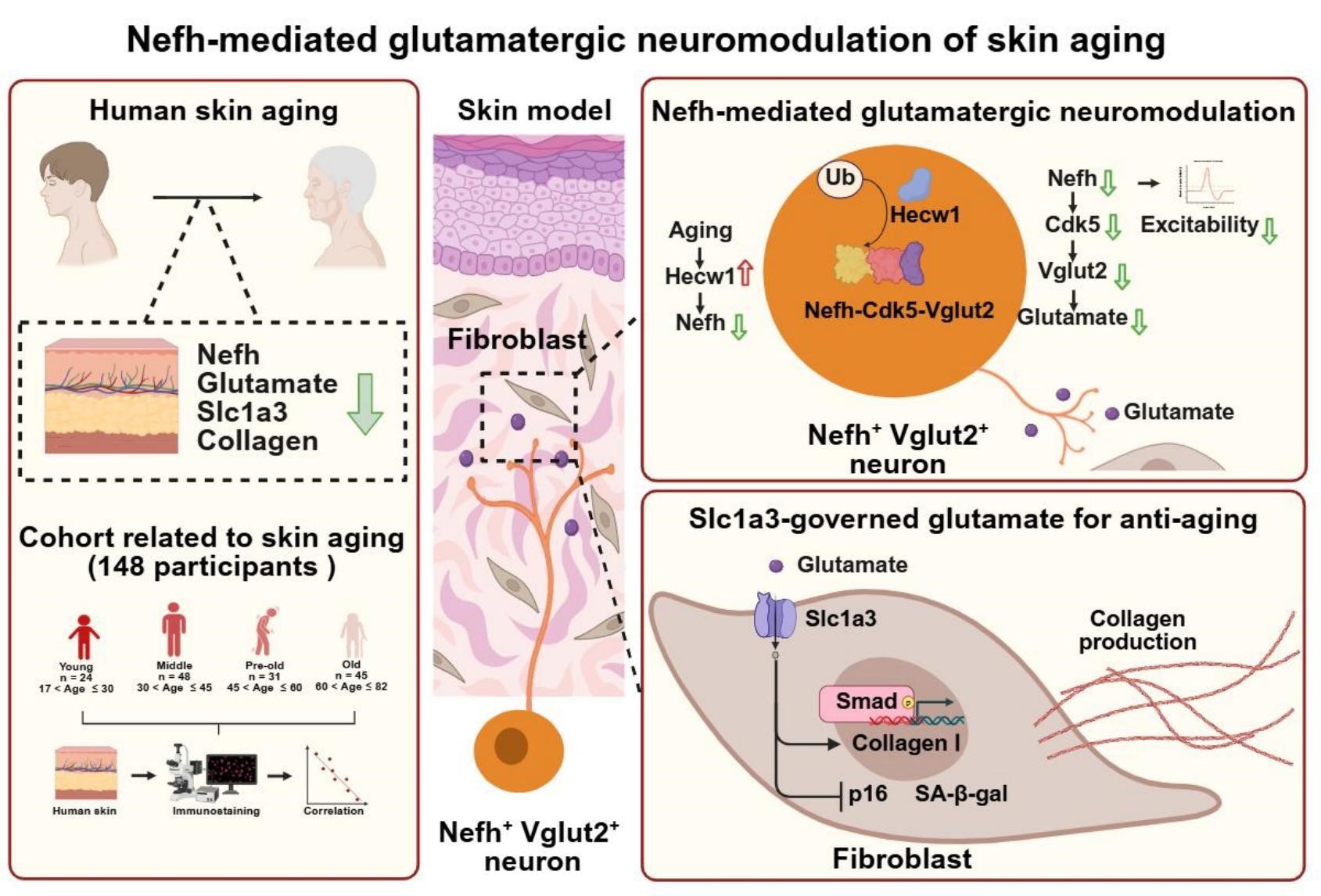
Figure: Schematic diagram of neural regulation in skin aging
Supported by the National Natural Science Foundation of China (Grant Nos. 82450903, 82504250, 82203914, 82373470, 82471773, 82404128, 32300742, et al.), Professor Honglin Wang's team from Shanghai General Hospital, Shanghai Jiao Tong University School of Medicine, has achieved a major breakthrough in the neural regulation of skin aging. The study, titled "Skin-innervating glutamatergic neurons modulate aging" (link: https://www.cell.com/cell/abstract/S0092-8674(26)00752-X), was published online in Cell on July 17, 2026.
Skin aging is a visible manifestation of systemic aging, characterized by collagen loss, impaired barrier function, and diminished repair capacity. Fibroblast senescence is a key driver of this process, but its upstream regulatory mechanisms have remained unclear. Previous studies have focused on the immunomodulatory roles of peripheral nerves in chronic skin diseases; however, whether and how nerves influence skin aging progression has lacked systematic investigation.
To address this question, the research team employed multiple nerve ablation strategies and found that skin denervation accelerated the aging process and caused significant collagen reduction. Further analysis revealed that neurofilament heavy chain (Nefh) expression was markedly decreased in aged skin and predominantly localized to vesicular glutamate transporter 2 (Vglut2)-positive glutamatergic neurons. Analysis of skin aging cohorts showed that Nefh expression declined with age and positively correlated with skin collagen content. Spatially, fibroblasts were found in close contact with Nefh-positive nerve terminals, suggesting a functional connection between the two.
Mechanistic studies demonstrated that Nefh regulates Vglut2 function via cyclin-dependent kinase 5 (Cdk5), thereby modulating glutamatergic neuronal excitability and glutamate release. Nefh deficiency or Cdk5 inhibition reduced glutamate secretion, accelerated fibroblast senescence, and decreased collagen synthesis. Notably, local or oral glutamate supplementation significantly ameliorated the skin aging phenotypes caused by Nefh deficiency. Further validation confirmed that the anti-aging effect of glutamate on fibroblasts depends on the high expression of solute carrier family 1 member 3 (Slc1a3). Knockout of Slc1a3 inhibited this effect and exacerbated skin aging.
Besides, in the bleomycin-induced skin fibrosis model, targeting the Nefh–Cdk5 pathway effectively inhibited excessive collagen deposition, indicating its potential as a therapeutic target for fibrotic diseases (see Figure).
Collectively, this study establishes a "neuron–fibroblast" functional regulatory network in skin aging, identifies Nefh as a key signature molecule mediating glutamatergic neural regulation of collagen homeostasis, and provides potential precision intervention targets for delaying skin aging and treating fibrotic disorders. The findings expand the current understanding of the regulatory mechanisms of skin aging and offer a theoretical foundation and new directions for future translational research.
Contact Us

National Natural Science Foundation of China
Add: 83 Shuangqing Rd., Haidian District, Beijing, China
Postcode: 100085
Tel: 86-10-62327001
Fax: 86-10-62327004
E-mail: bic@nsfc.gov.cn