
Chinese Scholars Make Progress in Single-Molecule Peptide Sequencing
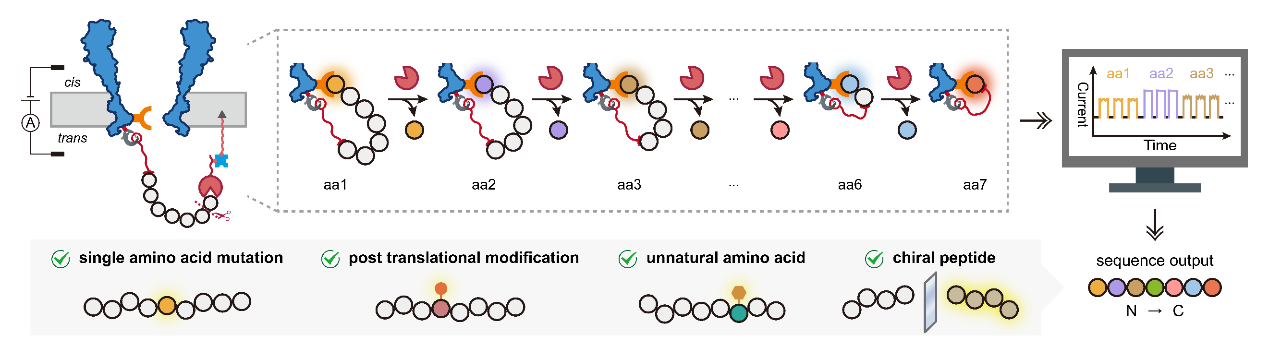
Figure. Nanopore-based "chop and measure" method achieves single-amino-acid resolution peptide sequencing
With support from the National Natural Science Foundation of China (Grant Nos. 22225405, 22534004, 223B2402), the team led by Professor Huang Shuo at Nanjing University has made significant progress in single-molecule peptide sequencing. The research result was published online on July 29, 2026, in Nature under the title “Sequential reading of a stepwise-shortened peptide immobilized on nanopore”. Paper link: https://www.nature.com/articles/s41586-026-10881-1.
Proteins, as the core executors of biological activities, carry sequence information crucial for deciphering biological processes and disease mechanisms. Traditional sequencing technologies exhibit notable limitations in sensitivity and dynamic range, making it difficult to meet the demands for precise analysis of low-abundance proteins and post-translational modifications. Developing peptide sequencing technology at the single-molecule level has thus become a key direction for overcoming the bottleneck of proteomics detection.
To tackle this challenge, the research team led by Huang Shuo at Nanjing University developed a nanopore “chop and measure” method. Using genetic codon expansion technology, the team constructed the first engineered nanopore with dual reactive sites, and established a novel “transient pore analyte looping” sensing strategy through dual modifications. The C-terminus of the target peptide is covalently anchored at the lower rim of the nanopore, while its free N-terminus forms a reversible coordination bond with a nitrilotriacetic acid-nickel ion (NTA-Ni) adapter modified in the recognition region of the pore, enabling continuous and repeated reading of a single peptide. By introducing an aminopeptidase to sequentially hydrolyze the anchored peptide one residue at a time, sequence-dependent current signals can be obtained. With custom-developed machine learning algorithms, these sequencing signals can be decoded and reconstructed into complete peptide sequence.
This method addresses the long-standing bottlenecks of insufficient resolution and poor signal consistency in nanopore peptide sequencing, achieving peptide sequence readout at single-amino-acid resolution. It enables direct identification of single amino acid mutations, post-translational modifications, and unnatural amino acid insertions within the peptide, providing a brand-new technical route for chiral peptide analysis and proteomics research.
Contact Us

National Natural Science Foundation of China
Add: 83 Shuangqing Rd., Haidian District, Beijing, China
Postcode: 100085
Tel: 86-10-62327001
Fax: 86-10-62327004
E-mail: bic@nsfc.gov.cn