
Chinese Scientists make progress in Biosynthesis of Anticancer Cephalotaxus Alkaloids
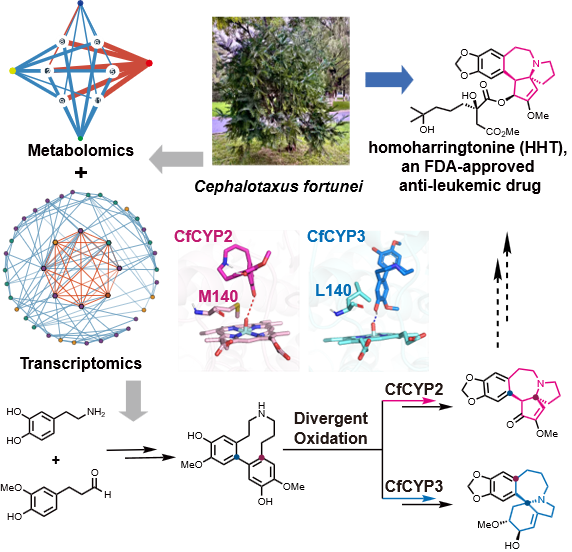
Figure. Biosynthetic pathways of cephalotaxinone and homoerythratine.
Supported by the National Natural Science Foundation of China (Grant Nos. 22193073, 32425011), the research team led by Xiaoguang Lei from Peking University, in collaboration with Jianbin Yan from Shenzhen Agricultural Genomics Institute, Chinese Academy of Agricultural Sciences, reported a progress in the field of natural-product biosynthesis. Their findings were published in Cell on June 12, 2026, titled "Complete biosynthesis of the anticancer cephalotaxinone and homoerythratine", and the paper can be accessed at https://www.cell.com/cell/abstract/S0092-8674(26)00656-2. The study fully elucidates the biosynthetic pathways of two major natural products—cephalotaxinone and homoerythratine—clarifies the differential catalytic mechanisms of homologous enzymes, and achieves heterologous reconstitution of the pathways, thereby laying a critical foundation for green, large‑scale production of anticancer drugs.
Cephalotaxus (plum yew) is a rare and endangered gymnosperm. Its derived compound homoharringtonine is a first‑line clinical drug for treating chronic myeloid leukemia. Currently, this drug is primarily produced by extraction from wild plants combined with chemical semi‑synthesis. However, due to slow plant growth and extremely low natural product content, production capacity falls far short of clinical demand, and the process severely depletes wild resources. Moreover, total chemical synthesis involves cumbersome steps and low yields, making industrial production impractical. For decades, the complete biosynthetic pathways, key catalytic enzymes, and branch‑regulatory mechanisms of these two alkaloids remained elusive, representing a major bottleneck in the field.
The research team employed an integrated approach combining multi‑omics analysis, chemical synthesis, enzymatic characterization, and computational biology. Through tissue‑specific metabolite detection, they identified that the biosynthetic intermediates of the alkaloids are mainly enriched in the roots of Cephalotaxus. By integrating transcriptomic and metabolomic analyses with anchor‑enzyme screening strategies, they sifted through a vast pool of genes and ultimately identified 13 core functional enzymes, delineating the complete metabolic route starting from aromatic amino acids.
One of the most innovative discoveries was the identification of a pair of homologous cytochrome P450 enzymes, CfCYP2 and CfCYP3, sharing 91.6% sequence identity. Using the same intermediate as substrate, these two enzymes produce divergent oxidation reactions driven by only two key amino‑acid differences in their active pockets, acting as the core "molecular switch" that directs the two alkaloid biosynthetic branches. This finding reveals the molecular mechanism of functional differentiation among homologous enzymes and provides a paradigm for studying the evolution of plant secondary metabolic pathways.
The team then transferred the relevant genes into Nicotiana benthamiana and successfully achieved heterologous reconstitution of both pathways, with the host plants stably producing the target alkaloids. Phylogenetic analysis also clarified the evolutionary trajectory of these biosynthetic genes.
Contact Us

National Natural Science Foundation of China
Add: 83 Shuangqing Rd., Haidian District, Beijing, China
Postcode: 100085
Tel: 86-10-62327001
Fax: 86-10-62327004
E-mail: bic@nsfc.gov.cn