
Chinese Scientists Make Progress in Developing Multimodal Clocks of Human Aging
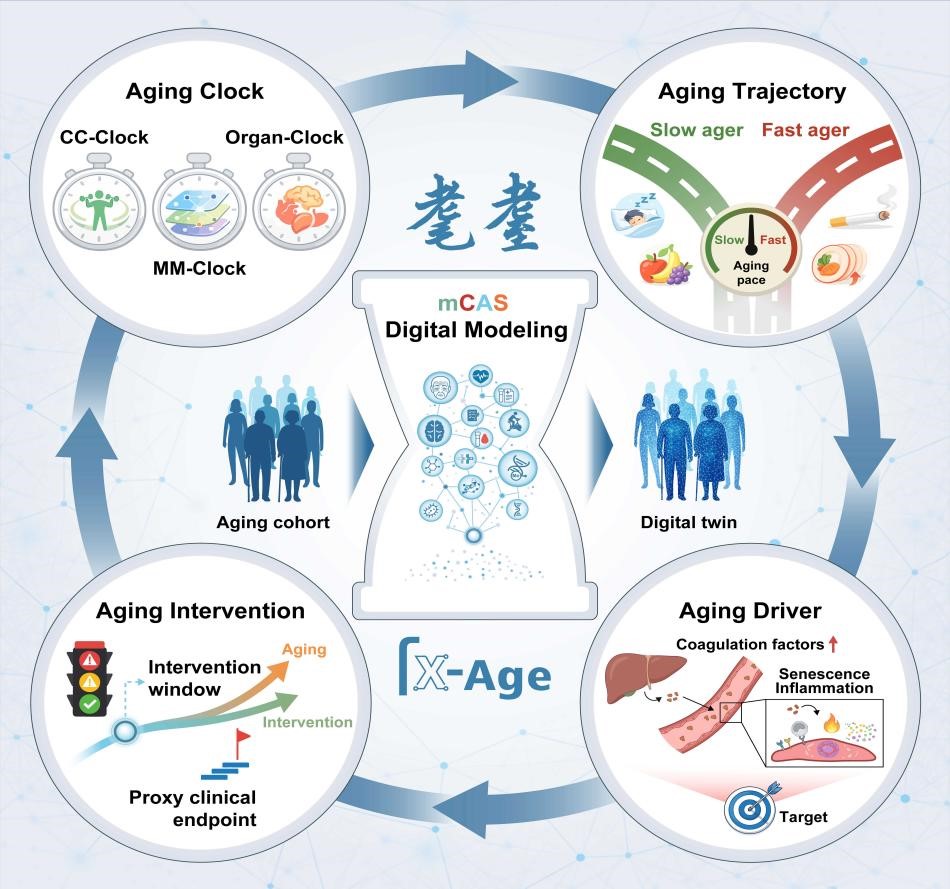
Figure. Assessment and early warning of human aging based on the "Digital Human of Aging" framework.
Supported by the National Natural Science Foundation of China (Grant Nos. 82488301, 82125011, 82361148131, and 82330044), a collaborative team led by Professor Guang-Hui Liu and Professor Jing Qu from the Institute of Zoology, Chinese Academy of Sciences (CAS), in partnership with Professor Weiqi Zhang from the Beijing Institute of Genomics, CAS, Professor Guoguang Zhao from Xuanwu Hospital, Capital Medical University, Professor Feng Zhang from Quzhou Hospital, Wenzhou Medical University, Professor Jun Bu from Renji Hospital Affiliated to Shanghai Jiao Tong University School of Medicine, Professor Wei Zhang from the First Affiliated Hospital of Nanchang University, and Professor Gang Pei from Tongji University, has made significant progress in constructing multimodal clocks of human aging. Their study, entitled “Multimodal clocks of human aging,” was published online in Cell on May 8, 2026. The paper is available at: https://doi.org/10.1016/j.cell.2026.04.025.
Aging is a systemic process involving multiple molecules and organs, characterized by marked individual heterogeneity. For a long time, this field has faced a core dilemma: it remains more descriptive than predictive, and more correlative than causal. Conventional studies have largely focused on single molecular or physiological indicators, lacking a truly quantifiable biological age definition and a comprehensive evaluation system. Consequently, critical scientific questions—such as the speed of individual aging, the sequential order of organ decline, and methods for anti-aging intervention—have remained unanswered.
To address these challenges, the research team first established a multi-center (Beijing, Ningbo, Quzhou, and Nanchang) standardized aging cohort involving 2,019 healthy volunteers aged 18 to 91 years, termed the multicentric Chinese aging standardized cohort (mCAS). They systematically collected over 240 physiological, imaging, and molecular parameters from this cohort. Based on this database, they constructed a multimodal, interpretable three-tiered aging clock system, forming a conceptual framework named the "Digital Human of Aging." This tiered system includes: a core capacity clock that integrates macro-physiological indicators to quantify functional decline; a multimodal clock that integrates multi-layered molecular data to precisely predict biological age; and an organ-specific clock based on liquid biopsy data to independently evaluate the biological age of six major organs, including the brain, liver, lungs, muscle, vasculature, and skin. Applying this clock system, the study revealed a pronounced asynchronous progression of organ decline in healthy populations (e.g., the liver reaches its aging inflection point earlier than the brain) and identified two distinct non-linear accelerated aging windows at ages 40–50 and 60–70.
Further exploration into the functional mechanisms of this three-tiered clock system via causal inference analysis revealed that the synergistic upregulation of specific coagulation factors (such as F13B), primarily derived from the aging liver, serves as a critical event driving individual accelerated aging. In vitro and in vivo intervention experiments confirmed that the key coagulation factor F13B can directly induce accelerated senescence in endothelial cells and multiple tissues. Furthermore, lifestyle analysis showed that optimal sleep timing, moderate walking, and regular fruit intake were significantly associated with decelerated aging, whereas smoking, insufficient sleep, and high meal frequency displayed opposite correlations (Figure).
This study constructs a conceptual framework for the "Digital Human of Aging" that spans from aging clock modeling to attribution analysis, establishing a feasible methodology for quantitatively measuring individual biological age. It identifies precise novel targets, such as the coagulation pathway, for tailored anti-aging interventions. This breakthrough marks a paradigm shift in aging research from descriptive observations to a systemic, traceable approach, ultimately providing a comprehensive solution for establishing standardized, translatable healthy aging pathways.
Contact Us
National Natural Science Foundation of China
Add: 83 Shuangqing Rd., Haidian District, Beijing, China
Postcode: 100085
Tel: 86-10-62327001
Fax: 86-10-62327004
E-mail: bic@nsfc.gov.cn