
Chinese Scientists Develop the First Systematic Global Map for Prioritizing Precipitation Observation Stations
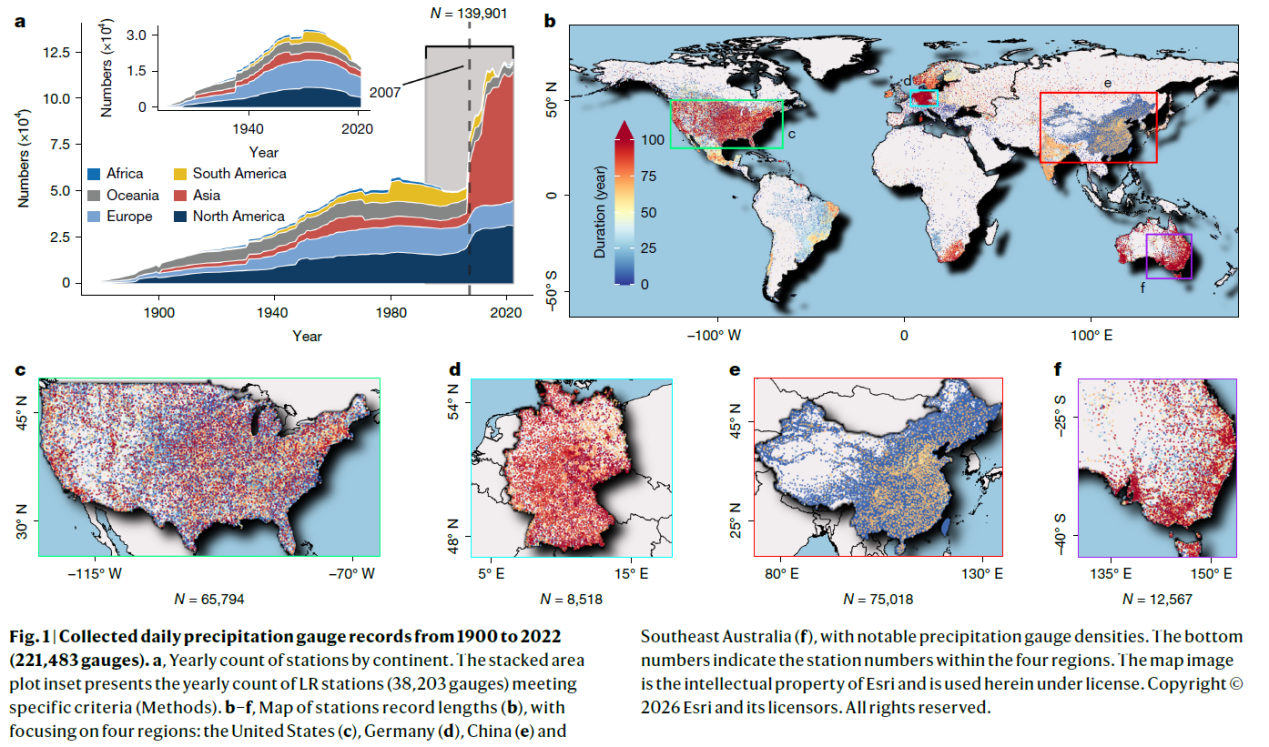
Figure. Distribution and evolution of global ground-based precipitation observation stations (1900–2022)
Precipitation is a fundamental component of the global water cycle, and extensive, continuous, and reliable observations are essential for understanding precipitation variability and addressing the growing challenges of climate change. However, systematic global-scale assessments of precipitation observation networks, as well as the identification of priority regions for future station deployment, have remained limited. Supported by the National Natural Science Foundation of China (Grant Nos. 42521001 and U24A20572), a research team led by Professor Chiyuan Miao from Beijing Normal University has made important progress in evaluating global precipitation observation networks and identifying priority regions for future station deployment. The related study, entitled “Precipitation observing network gaps limit climate change impact assessment”, was published in Nature on March 25, 2026. The paper is available at: https://www.nature.com/articles/s41586-026-10300-5.
The research team compiled daily precipitation records from more than 220,000 observation stations worldwide spanning 1900–2022. Using these data, the study quantified the global coverage of precipitation observation networks for the first time. The results revealed that only 13.4% of global land areas currently meet the station density standards recommended by the World Meteorological Organization, highlighting the severe insufficiency of the existing global precipitation observation network and the urgent need to strengthen meteorological observation systems worldwide. The study further showed that the rapid expansion of the Asian precipitation observation network has been driven primarily by the accelerated development of China’s integrated meteorological observation system. By 2022, Asia accounted for 57.2% of global precipitation observation stations, underscoring China’s substantial contribution to precipitation observation network development in Asia and worldwide. Building on these findings, the research team further integrated station density, historical precipitation information, future climate projections, population dynamics, and socioeconomic development into a comprehensive analytical framework. Based on this framework, the team developed the first global prioritization index for precipitation observation station deployment and systematically identified the regions where future precipitation observation stations are most urgently needed worldwide. The results show that under a high greenhouse gas emission scenario, priority deployment regions could expand to 32.1% of the global land area as climate change intensifies.
This study provides quantitative evidence of gaps in global precipitation observation networks and systematically identifies priority regions for future station deployment at the global scale. The findings offer important scientific support and decision-making guidance for improving water resource monitoring systems, optimizing meteorological observation networks, and strengthening climate change adaptation in a warming world.
The Scientific Story Behind the Research
Precipitation may seem like an ordinary natural phenomenon, yet for scientists, truly “seeing” global precipitation is far more challenging than it appears. Can intense precipitation trigger catastrophic floods? Which regions may face more severe droughts in the future? Will global warming lead to more frequent extreme precipitation events? Answering these questions depends on long-term, accurate, and continuous precipitation observations. Yet one fundamental question has long remained overlooked: Have we really measured global precipitation well enough?
Although vast meteorological observation datasets have been accumulated and satellite remote sensing technologies continue to advance rapidly, there remains no quantitative and systematic global assessment of precipitation observation networks, including their coverage, regional balance, and future adequacy for climate change evaluation. This gap in fundamental scientific assessment has motivated Professor Chiyuan Miao’s team (Beijing Normal University) to systematically examine several key questions: How many precipitation observation stations exist globally? Are they sufficient to monitor precipitation? Where are critical observations still lacking? And where will future observations be most urgently needed?
1. How many precipitation observation stations exist globally?
This question may sound straightforward, but it is, in fact, extremely challenging. To address it, the research team spent several years systematically integrating precipitation records from multiple global databases. Ultimately, they compiled daily precipitation observations from over 220,000 observation stations spanning 1900–2022, establishing one of the most comprehensive and longest-term global precipitation station databases available.
2. Is the current observation network sufficient to monitor precipitation?
After completing the data integration, the team faced another critical challenge: What exactly qualifies as “sufficient observation coverage”?
Using the station density standards recommended by the World Meteorological Organization, the team quantitatively assessed the global coverage of precipitation observation networks for the first time, providing a measurable benchmark for evaluating global precipitation observation capacity. The results revealed a severe reality: as of 2022, only 13.4% of global land areas meet the recommended observation density standards, meaning that nearly 90% of the world’s land areas still suffer from varying degrees of precipitation observation gaps. Vast regions across the globe, particularly those already highly vulnerable to droughts and floods, remain seriously under-observed. The lack of critical measurements limits our understanding of precipitation variability and hampers accurate tracking of how climate change is reshaping precipitation patterns. To some extent, this also explains why climate risk assessments in many regions continue to carry large uncertainties.
3. Where future observations will be most urgently needed?
The research team was concerned not only with “where observations are currently lacking,” but also with “where will future observations be most urgently needed.”
Against the backdrop of global warming, risks associated with extreme precipitation are increasing rapidly. Population growth, urban expansion, and the concentration of economic activities are exposing more people to flooding and other extreme weather hazards. If future observation networks continue to develop along historical trajectories, many newly emerging high-risk regions may remain insufficiently monitored. To address this challenge, the team integrated station density, historical precipitation changes, future climate projections, population dynamics, and socioeconomic development into a comprehensive analytical framework. This led to the development of a global prioritization index system for precipitation observation station deployment, achieving a breakthrough in assessing where to place new stations.
In simple terms, the team aimed to answer: If only a limited number of new precipitation observation stations can be added globally in the future, which regions should be prioritized? The results show that under a high greenhouse gas emission scenario, priority deployment regions could expand to 32.1% of global land area. This indicates that as climate change intensifies, the demand for precipitation monitoring will continue to increase. Regions experiencing rapid population growth, high climate sensitivity, and elevated risks of extreme precipitation are likely to become key priorities for the future development of the global precipitation observation network.
This achievement is not only a hydrometeorological study, but also one that directly relates to global disaster prevention, risk reduction, and water security. For meteorological agencies, the identified priority regions provide scientific guidance for future network optimization. For climate change research, a more complete precipitation observation network will improve the performance of global climate models and reduce uncertainties in future projections. For the public, more accurate precipitation monitoring enables timelier heavy precipitation warnings, more reliable flood risk assessments, and more effective climate adaptation measures.
From identifying where the world still lacks precipitation observations to determining where future stations are most urgently needed, this study provides the first systematic global “gap map” of precipitation observation networks and a “priority roadmap” for gauge deployment. As climate change continues to intensify worldwide, improving our ability to detect precipitation, quantify its characteristics, understand its governing mechanisms, and use observational data to enhance society’s capacity to cope with climate risks is becoming an increasingly important scientific challenge shared by the global community.
Contact Us

National Natural Science Foundation of China
Add: 83 Shuangqing Rd., Haidian District, Beijing, China
Postcode: 100085
Tel: 86-10-62327001
Fax: 86-10-62327004
E-mail: bic@nsfc.gov.cn