
Chinese Researchers Achieve Breakthrough in the Mechanism of Nickelate High-Temperature Superconductivity
Supported by the National Natural Science Foundation of China (Grant Nos. 92265112, 92565303, 12374455, and 12504166), a joint research team comprising the Junfeng He group at the University of Science and Technology of China (USTC), and Qi-Kun Xue-Zhuoyu Chen group at the Southern University of Science and Technology (SUSTech), the Guangdong-Hong Kong-Macao Greater Bay Area Center for Quantum Science has directly observed the nodeless superconducting gap and electron-boson coupling in Ruddlesden–Popper phase double-layer nickelate high-temperature superconducting films for the first time. This work provides decisive experimental evidence for resolving two core scientific issues in high-temperature superconductivity: the symmetry of the superconducting gap and the pairing mechanism. The findings were published in Science under the title "Nodeless superconducting gap and electron-boson coupling in (La,Pr,Sm)₃Ni₂O₇ films", available at https://www.science.org/doi/10.1126/science.adw8329.
Since its discovery in 1911, superconductivity has remained a central focus of international scientific research owing to its exceptional electromagnetic properties. Conventional superconductors suffer from extremely low transition temperatures, severely limiting their practical applications. Consequently, exploring high-temperature superconducting materials and uncovering their underlying mechanisms has become the core mission of this field. Over the past century, two classes of high-temperature superconductors—copper-based and iron-based—have been successively discovered, yet their microscopic mechanisms remain unresolved despite decades of intensive investigation. The recent emergence of nickel-based high-temperature superconductors has opened new avenues for tackling this long-standing puzzle, making the pursuit of key experimental evidence for the nickelate superconductivity mechanism a global research priority.
In preliminary material development, the group from SUSTech achieved ambient-pressure high-temperature superconductivity in nickelate thin films, establishing a critical material platform for probing the electronic structure of nickel-based high-temperature superconductors. Building on this foundation, the joint research team performed systematic electronic structure measurements on (La,Pr,Sm)₃Ni₂O₇ superconducting films using high-resolution laser-based angle-resolved photoemission spectroscopy (ARPES) developed at USTC and ARPES at Shanghai Synchrotron Radiation Facility. Focusing on the two central questions of superconducting gap symmetry and pairing mechanism, two key pieces of evidence were extracted from high-precision ARPES data: (1) A superconducting gap of approximately 18 meV with a prominent coherence peak was detected along the diagonal of the Brillouin zone. This finite gap persists uniformly across the entire momentum space without any nodes, in sharp contrast to the d-wave nodal gap characteristic of cuprate high-temperature superconductors. This observation indicates that nickelate superconductivity is consistent with s-wave (or s±-wave) symmetry, providing a critical criterion for identifying the origin of the pairing symmetry. (2) A characteristic "band kink" structure was observed in the electronic band dispersion at approximately 70 meV below the Fermi level (as shown in Figure 1).
This discovery confirms the presence of electron-boson coupling, furnishing pivotal experimental evidence for understanding the electron-pairing mechanism in high-temperature superconductivity, and is expected to advance the widespread application of superconducting technologies.
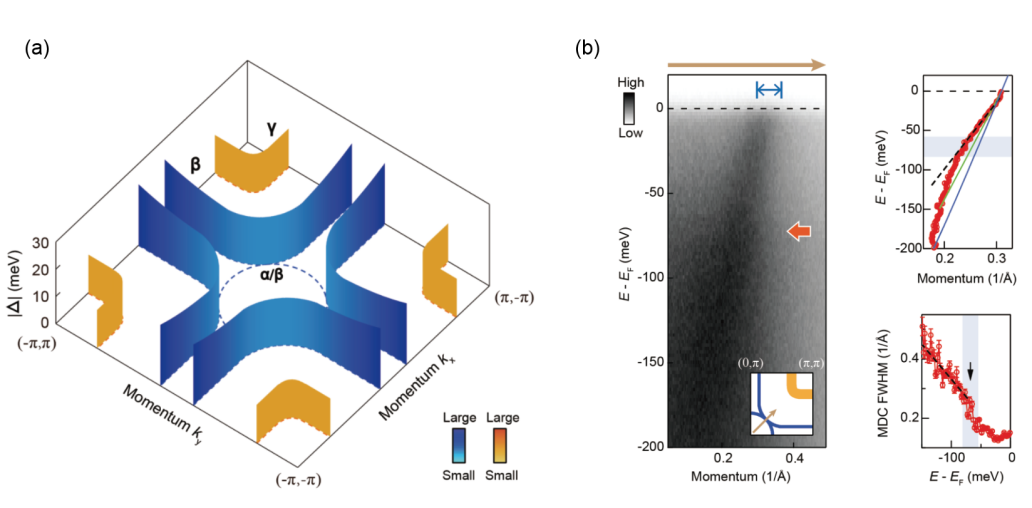
Figure 1. (a) The nodeless superconducting gap. (b) The electron-boson coupling.
Contact Us

National Natural Science Foundation of China
Add: 83 Shuangqing Rd., Haidian District, Beijing, China
Postcode: 100085
Tel: 86-10-62327001
Fax: 86-10-62327004
E-mail: bic@nsfc.gov.cn