
Global Hail Damage Expected to Rise Sharply by the End of the Century
Hailstorms are among the most damaging weather events worldwide. They occur frequently, but because they are small in size and short-lived, they are much harder to predict than large-scale systems such as tropical cyclones. This low predictability, combined with their destructive power, makes hailstorms a major driver of insurance losses and damage to society.
In recent decades, hail has begun to affect regions where it used to be rare, and annual economic losses have climbed to tens of billions of dollars. Yet most previous research has focused on where and how often hail occurs, rather than on hailstone size—the key factor that determines how much damage a hailstorm can cause. As a result, how climate warming will affect the global potential for hail damage has remained largely unknown.
Supported by the Key Project of the National Natural Science Foundation of China (Grant No. 42030607), a research team led by Professor Qinghong Zhang from Peking University, in collaboration with Professor John T. Allen from Central Michigan University, has made important progress in answering this question. Their new study, titled “Rising global hail potential damage in a warming world,” was published online in Nature on May 28, 2026, and selected as the cover article of this issue. Paper link: https://www.nature.com/articles/s41586-026-10543-2
Hailstone size is controlled by several atmospheric factors, including convective instability, vertical wind shear, and the thickness of the melting layer. These factors affect hail size through competing physical processes. On the one hand, global warming can increase atmospheric instability, strengthening updrafts in thunderstorms and helping hailstones grow larger inside the storm. On the other hand, warming can also thicken the melting layer, causing hailstones to melt more as they fall and become smaller by the time they reach the ground. Because of these competing effects, it has been challenging to determine how future warming will influence hail-related damage.
To tackle this problem, the research team analyzed 14,297 historical severe hail events worldwide and simulated how hail potential damage would change under different future greenhouse gas emission scenarios. Their results show that human‑induced climate change is likely to shift the distribution of near‑surface hail sizes toward larger hailstones in a warmer and moister lower atmosphere (Fig. a). This shift leads to greater potential damage, with stronger increases under higher levels of warming.
The study also reveals strong regional differences in future hail risk. In many mid‑ and high‑latitude regions—such as northern China, Europe, and the Great Plains of the United States—stronger low‑level warming combined with relatively weaker moistening favors the formation of larger hailstones, increasing potential damage. In contrast, in tropical and monsoon regions, weaker low‑level warming accompanied by stronger moistening tends to reduce hailstone size near the surface, leading to a decrease in potential hail damage (Fig. b).
This work provides the first global, quantitative assessment of how hailstone size distributions and associated damage potential may evolve in a warming climate. The findings offer crucial scientific support for future hail risk assessment, disaster prevention and mitigation, and climate adaptation planning worldwide.
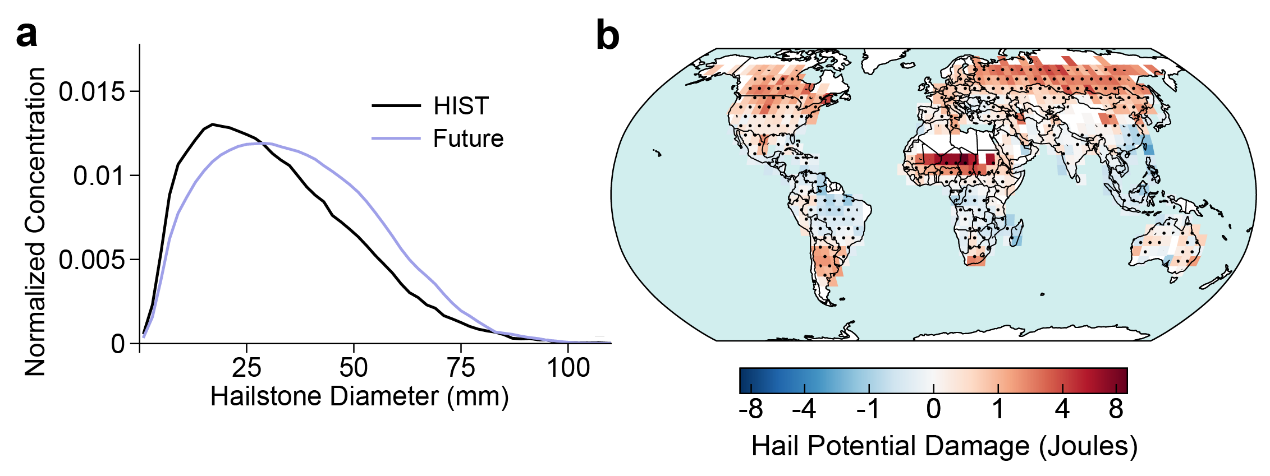
(a) Near-surface hail size distributions under historical and future climate scenarios; (b) Spatial distribution of projected changes in global hail potential damage under the SSP5-8.5 scenario.
Contact Us

National Natural Science Foundation of China
Add: 83 Shuangqing Rd., Haidian District, Beijing, China
Postcode: 100085
Tel: 86-10-62327001
Fax: 86-10-62327004
E-mail: bic@nsfc.gov.cn