Chinese Scientists Discover the Deepest Hard-substrate Fauna in the Ocean: a New Deep-sea Carbon Hotspot
Supported by the National Key Research and Development Program of China under the Key Special Project ‘Critical Technologies and Equipment for Deep Sea and Polar Research’ and the international Global Hadal Exploration Programme (GHEP), a United Nations Ocean Decade Programme, a research team led by the Institute of Deep-Sea Science and Engineering (IDSSE) of the Chinese Academy of Sciences has, for the first time, systematically revealed a protist-dominated hard-substrate fauna that is widely distributed across the world's hadal trenches.
The study, published in Science on May 14, 2026 (doi: 10.1126/science.aea7086), reports a unique hadal ecosystem dominated by agglutinated foraminifera in multiple hadal regions, including the Kermadec and Mariana trenches. Based on extensive seafloor imagery and biological samples collected during 98 dives of the full-ocean-depth manned submersible Fendouzhe, the researchers characterized the composition, ecological adaptations, and significance of this hard-substrate fauna in global deep-sea carbon cycling.
Across seven hadal regions surrounding Oceania, the team recorded 32 species belonging to six phyla, most of which are new to science, including one new family of foraminifera and one new family of bryozoans. Population densities reached as high as 4,300 individuals per square decimeter. The study further demonstrated that the enigmatic filamentous organisms, referred to in this study as shirong (‘rock feathers’), are in fact agglutinated foraminifera, resolving a long-standing question regarding their taxonomic identity that had persisted for many years.
Metagenomic and DNA metabarcoding analyses failed to detect any known chemolithoautotrophic symbionts in the dominant species. In contrast, terrestrial pine pollen grains were discovered within multiple taxa, providing direct evidence that these communities rely primarily on heterotrophic nutrition. These findings overturn the previous speculation that the assemblages were sustained by chemosynthesis-based ecosystems.
The researchers further showed that this fauna is widely distributed across multiple hadal trenches worldwide and is particularly well developed at depths between 9,000 and 10,898 meters (m). Based on cruise observations and biomass estimates, sessile agglutinated foraminifera contribute approximately 2–11% of the total eukaryotic biomass carbon in global hadal trenches. These organisms represent a previously overlooked but highly active deep-sea carbon hotspot, providing key scientific evidence for re-evaluating carbon cycling, biological pump efficiency, and ocean carbon sequestration processes in hadal ecosystems.
The study also extends maximum depth records for several marine taxa: the deepest known bryozoan (9,981 m), scyphozoan polyps (9,982 m) and hydrozoan polyps (9,195 m). The researchers found that the distinctive V-shaped trench topography and turbidity-current transport processes have shaped a unique ecological adaptation in which these organisms attach to vertical rock surfaces and grow in a downward-hanging posture.
This achievement not only expands humanity's understanding of life in the deepest parts of the global ocean, but also marks China's attainment of a world-leading position in full-ocean-depth biological exploration and hadal ecosystem research. The findings provide an important foundation for future studies of deep-sea biological evolution, deep-ocean carbon cycling, and global environmental change.

Maps of 98 manned submersible dive sites in seven hadal regions around Oceania. (Image by IDSSE)
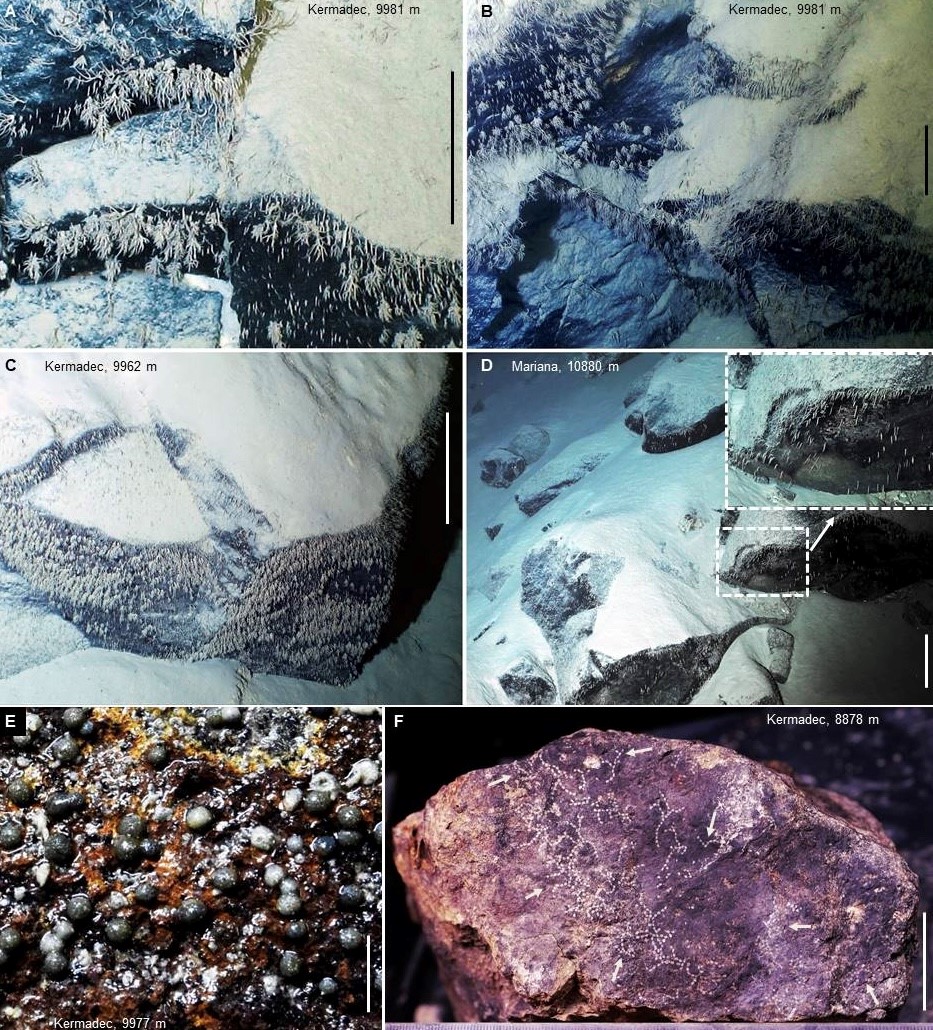
Overview of dominant species of the deepest hard-substrate fauna in the Kermadec and Mariana trenches. (A to C) In situ images of the agglutinated foraminiferans (Plumettidae fam. nov.: Plumetta gen. nov. spp.) from the Scholl Deep, Kermadec Trench. (D) In situ image of the Plumetta-like organisms from the Challenger Deep, Mariana Trench. (E and F) Onboard images for two new species recovered from rock surface from the Kermadec Trench. (E) Gromia hadalensis sp. nov. (Endomyxa), Scholl Deep. (F) Abundant dried colonies of the bryozoan Pierrella fendouzhei sp. nov. (arrows) on a basalt rock, 8878 m. Scale bars: (A, B, and F) 3 cm; (C and D) 10 cm; (E) 3 mm.
Contact Us

National Natural Science Foundation of China
Add: 83 Shuangqing Rd., Haidian District, Beijing, China
Postcode: 100085
Tel: 86-10-62327001
Fax: 86-10-62327004
E-mail: bic@nsfc.gov.cn