
Chinese Scholars Discover a Novel Quantum State of Matter in the Transdimensional Regime
Supported by the National Natural Science Foundation of China (Grant Nos. 12525403, 12550404, 12174257) and other funding, the research team led by Professor Lei Wang from the School of Physics, Nanjing University, and their collaborators have made a significant breakthrough in the study of strongly correlated quantum states of matter. For the first time, the team experimentally discovered a fundamentally new correlated electronic state in the transdimensional regime between two dimensions (2D) and three dimensions (3D), which they named it as the Transdimensional Anomalous Hall Effect. This finding breaks the framework of the classical anomalous Hall effect and reveals a novel mechanism arising from the interplay of dimensionality and strong electron correlations. The results were published online in Nature on April 29, 2026, under the title "Transdimensional anomalous Hall effect in rhombohedral thin graphite" (https://www.nature.com/articles/s41586-026-10471-1).
The anomalous Hall effect (AHE) is a key transport phenomenon in condensed matter physics that characterizes the coupling between magnetic order and electron orbital motion. It occurs without an external magnetic field, signifying spontaneous time-reversal symmetry breaking in the system. All previously reported AHE and quantum anomalous Hall effect—whether driven by spin–orbit coupling in conventional magnetic materials or by strong correlations in moiré systems such as twisted graphene—follow the same paradigm: they couple only to out-of-plane orbital magnetization generated by in-plane chiral orbital motion, with magnetization, current, and Hall field strictly mutually orthogonal.
This study revisits the AHE from the perspective of dimensionality, using rhombohedral-stacked graphite with a thickness of 2–5 nm as the research system. This material features nearly flat low-energy bands and high density of states; the van Hove singularities and Fermi surface structure can be tuned by an applied displacement field, significantly enhancing electron correlation effects. The team performed systematic transport measurements on nine-layer rhombohedral graphene devices and mapped the phase diagram as a function of carrier density and displacement field. A distinctive state region was found between the quarter-metal phase and a partially isospin-polarized phase, this region exhibits no conventional Shubnikov–de Haas oscillations and does not form Landau levels even under a strong perpendicular magnetic field of 13 T, representing a new quantum ground state stabilized by strong electron correlations.
Magnetic-field-dependent transport measurements on this ground state show pronounced hysteresis loops in the Hall resistance under both in-plane and out-of-plane magnetic fields, proving that the effect couples both in-plane and out-of-plane orbital magnetizations and breaks the traditional orthogonal picture. Through rigorous angular calibration and control experiments to exclude spurious effects, the team confirmed that the signal is an intrinsic physical effect of the material and named it the transdimensional anomalous Hall effect.
Systematic thickness-dependent experiments and theoretical calculations reveal that this effect occurs exclusively in the intermediate thickness window of 2–5 nm: ultrathin samples approach the 2D limit and overly thick samples lose interlayer coherence. Only in the transdimensional regime can electrons sustain coherent orbital motion both within the 2D plane and along the vertical interlayer direction simultaneously. Further theoretical calculations confirm that strong electron interactions drive the system into a peculiar orbital ferromagnetic metallic phase, which spontaneously generates in-plane and out-of-plane loop currents corresponding to out-of-plane and in-plane orbital magnetizations, respectively, collectively inducing the transdimensional anomalous Hall effect.
This work proposes and experimentally verifies a new paradigm for transdimensional electron transport for the first time. It breaks the study of the anomalous Hall effect from the conventional 2D/3D dichotomous framework and unlocks a brand-new transdimensional regime, opening up an entirely new direction for research in strongly correlated physics, topological states of matter, and low-dimensional quantum transport.
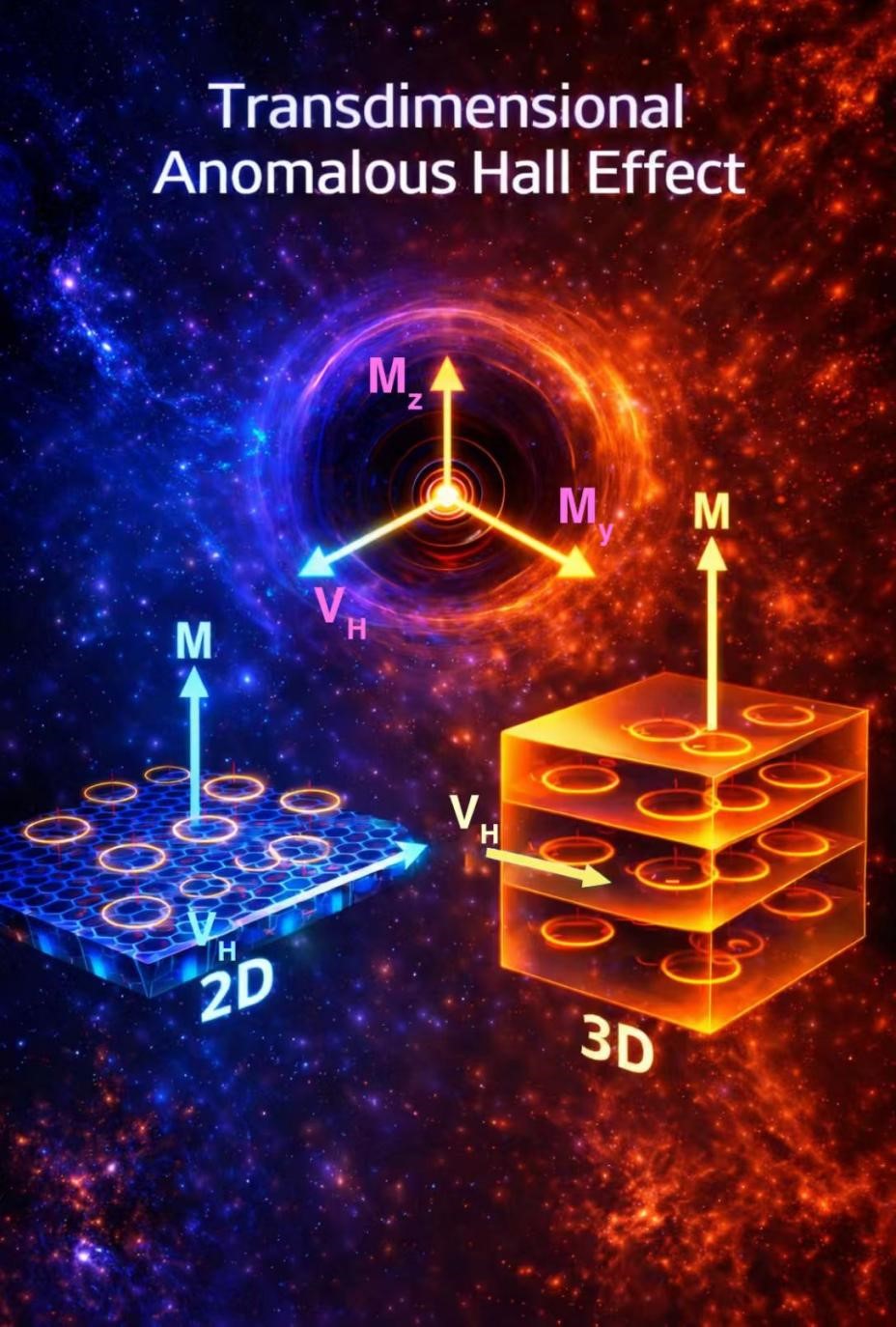
Figure: Schematic illustration of the anomalous Hall effect in the 2D regime (bottom left), 3D regime (bottom right), and transdimensional regime (middle).
Contact Us

National Natural Science Foundation of China
Add: 83 Shuangqing Rd., Haidian District, Beijing, China
Postcode: 100085
Tel: 86-10-62327001
Fax: 86-10-62327004
E-mail: bic@nsfc.gov.cn